<?xml version="1.0" encoding="utf-8" ?>
<rdf:RDF xmlns:rdf="http://www.w3.org/1999/02/22-rdf-syntax-ns#" xmlns:dc="http://purl.org/dc/elements/1.1/" xmlns:syn="http://purl.org/rss/1.0/modules/syndication/" xmlns="http://purl.org/rss/1.0/">


<channel rdf:about="http://www.mursi.org/search_rss">
  <title>Mursi Online</title>
  <link>http://www.mursi.org</link>

  <description>
    
            These are the search results for the query, showing results 1 to 15.
        
  </description>


  <image rdf:resource="http://www.mursi.org/logo.png"/>

  <items>
    <rdf:Seq>
      
        <rdf:li rdf:resource="http://www.mursi.org/news-items/david-turton-1940-2023"/>
      
      
        <rdf:li rdf:resource="http://www.mursi.org/new-publication-lands-of-the-future"/>
      
      
        <rdf:li rdf:resource="http://www.mursi.org/neighbours/hamar"/>
      
      
        <rdf:li rdf:resource="http://www.mursi.org/news-items/remembering-kirinomeri"/>
      
      
        <rdf:li rdf:resource="http://www.mursi.org/news-items/donor-balancing-act-on-human-rights-in-the-lower-omo-valley"/>
      
      
        <rdf:li rdf:resource="http://www.mursi.org/news-items/us-appropriations-act-prohibits-support-for-development-activities-in-the-lower-omo-which-2018directly-or-indirectly-involve-forced-evictions2019"/>
      
      
        <rdf:li rdf:resource="http://www.mursi.org/documents-and-texts/published-articles/moges-yigezu-david-turton-et-al"/>
      
      
        <rdf:li rdf:resource="http://www.mursi.org/documents-and-texts/published-articles/david-turton"/>
      
      
        <rdf:li rdf:resource="http://www.mursi.org/documents-and-texts/published-articles/copy3_of_moges-yigezu-david-turton-et-al"/>
      
      
        <rdf:li rdf:resource="http://www.mursi.org/documents-and-texts/published-articles/copy_of_moges-yigezu-david-turton-et-al"/>
      
      
        <rdf:li rdf:resource="http://www.mursi.org/about"/>
      
      
        <rdf:li rdf:resource="http://www.mursi.org/comments/comments-archive"/>
      
      
        <rdf:li rdf:resource="http://www.mursi.org/introducing-the-mursi/overview"/>
      
      
        <rdf:li rdf:resource="http://www.mursi.org/news-items/ethiopia-responds-to-unescos-world-heritage-committee-on-lake-turkana"/>
      
      
        <rdf:li rdf:resource="http://www.mursi.org/who-are-the-mursi/local-groups-bhuranyoga/index_html"/>
      
    </rdf:Seq>
  </items>

</channel>


  <item rdf:about="http://www.mursi.org/news-items/david-turton-1940-2023">
    <title>David Turton (1940-2023) </title>
    <link>http://www.mursi.org/news-items/david-turton-1940-2023</link>
    <description>Obituary by Jed Stevenson</description>
    <content:encoded xmlns:content="http://purl.org/rss/1.0/modules/content/"><![CDATA[<h3>It is with great sadness that we note the death of David Turton, founder of this website. The following tribute has just been published in <i>Anthropology Today</i>.</h3>
<p>One of the first anthropologists to work in lowland Ethiopia, David Turton drew attention to peoples on the periphery and the effects on them of state and capitalist projects – notably wildlife conservation and the building of large dams. He engaged in public anthropology, feeling a duty to serve as an advocate for people whom he knew first as research participants but whom he later became friends with and whom he viewed as kindred spirits. Just four months before he died, at the age of 83, he travelled back to Ethiopia to renew friendships with people he had known for more than fifty years.</p>
<p>David was born in London in 1940. His father was a shipping agent at the London Docks and his mother a school secretary. At 18, not having the necessary O-Levels to attend university, he undertook preparatory work at a Catholic seminary. He was selected to attend the English College in Rome, where he spent three years completing his Lic. Phil. <em>cum laude</em> at the Pontifical Gregorian University. Unsure of his calling, he returned to England in 1963 having secured a rare agreement to be readmitted should he have a change of heart. He completed his missing O-Levels and went to the London School of Economics in 1964 to do a BSc in sociology, where he met his future wife, Pat. They were assigned as tutor partners for the optional course they both chose in social anthropology.</p>
<p>David went on to complete a PhD in social anthropology at the LSE under the supervision of James Woodburn, a specialist on African hunter-gatherers. Interested in going to Ethiopia, David read the work of the 19<sup>th</sup> century explorer Vittorio Bottego and was struck by a description of hunter-gatherers living on the banks of the River Omo. They were the Kwegu, and they lived in close relation to a larger group, the Mursi. In the dry season of 1968, he negotiated with the Mursi to pitch his tent beside the Omo, where they were cultivating sorghum. He stayed by the Omo, slowly learning their language, until the time came for the Mursi to leave for their cattle camps. By this time, he had learned enough of the language and gained sufficient trust to be allowed to join them on the journey to the cattle camps.</p>
<p>Living and traveling with the Mursi helped David see that their way of life was threefold, involving flood-retreat cultivation along the Omo and Mago rivers, cattle herding, and shifting rain-fed cultivation. None of these strategies on its own was sufficient but in combination they provided a livelihood. The Mursi likened these activities to the three hearth-stones that support their cooking pots, all three being vital for their well-being. David’s recognition of these patterns – as described in his 1973 <a href="https://www.mursi.org/documents-and-texts/theses/turton-david/view">doctoral thesis</a> – led to a deeper appreciation of a culture that most outsiders had hitherto misunderstood and stereotyped as purely pastoralist.</p>
<p>David took up a lectureship at Manchester University in 1971, and continued to carry out fieldwork among the Mursi, initially focusing on <a href="https://www.mursi.org/introducing-the-mursi/leadership/orators-jalaba">political oratory</a>. The Mursi used public debates to reach collective decisions, particularly at times of crisis. Perennial concerns included conflict with neighbouring groups and territorial encroachment by wildlife reserves. As well as the Omo National Park, the Mursi were significantly affected by the establishment of the Mago National Park in 1978, which incorporated the majority of Mursiland. These tensions formed the backdrop to six <a href="https://www.mursi.org/audiovisual/film-and-video-clips/television-documentaries">ethnographic films</a> that David made with director Leslie Woodhead between 1974 and 2001. In 1987, inspired by his friend and former student Dan Marks, David established the <a href="https://granadacentre.co.uk/">Granada Centre for Visual Anthropology</a> at the University of Manchester.</p>
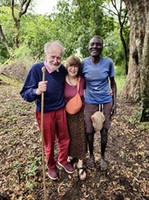
<div class="newsImageContainer"><a href="https://www.mursi.org/images/david-and-pat-turton-with-ulikoro-komoru-in-2023/image/image_view_fullscreen" id="parent-fieldname-image"> <img alt="David and Pat Turton with Ulikoro Komoru in 2023." class="newsImage" height="267" src="https://www.mursi.org/images/david-and-pat-turton-with-ulikoro-komoru-in-2023/image_mini" title="David and Pat Turton with Ulikoro Komoru in 2023." width="200" /> </a>
<p class="discreet"><span class=" kssattr-atfieldname-imageCaption kssattr-templateId-widgets/string kssattr-macro-string-field-view" id="parent-fieldname-imageCaption-18fcdf80-41a5-486b-93e6-2415626390c1"> David and Pat Turton with Ulikoro Komoru in 2023. </span></p>
</div>
<p>Although he strongly identified as an anthropologist, David did not define himself by his job. He was grateful that he had the opportunity to be do what he loved and believed to be meaningful, and to be led by his curiosity. It was in this spirit that he took early retirement from Manchester University in 1990 to have more time to pursue his fieldwork and other interests. He often joked that after his retirement he had “never been busier!”</p>
<p>Through the 1980s and 1990s David served on committees for Oxfam, the Windle Trust, and various professional associations; he also served as editor of the <em>Journal of the Royal Anthropological Institute</em> (1983-86) and the journal <em>Disasters</em> (1989-95). In 1996, he became director of the <a href="https://www.rsc.ox.ac.uk/">Refugee Studies Centre</a> at Oxford University, where he had a transformative impact – leading the expansion of its summer school and establishing its Master’s programme.</p>
<p>In the early 2000s David was galvanised into a new phase of activity as plans were announced for the building of the Gibe III dam on the Omo. He scoured reports of engineers and hydrologists to appraise the implications of the dam and associated sugar plantations for the peoples of the region. In an <a href="https://www.mursi.org/pdf/RAS%20Talk%20-%20Copy.pdf/">address at SOAS</a> in 2010, he skewered the studies carried out by the dam’s backers and laid out the consequences of disrupting the Omo’s annual flood for the 100,000 people living downstream. Of the three “hearth-stones” on which local people depended, the flood was the most important. If the project proceeded as planned, it would undermine the entire subsistence economy.</p>
<p>David was not opposed to the dam itself. Rather, his concern was that the costs and benefits of the project were <a href="https://riviste-clueb.online/index.php/anpub/article/view/127">unfairly distributed</a>. No compensation was offered to the Mursi and their neighbours, either for the loss of the flood or for lands seized for plantations. In contrast to the open debates practiced by the Mursi, the government announced its plan as a <em>fait accompli</em> with scant efforts made to consult “project-affected people”. The Mursi referred to the architects of the project as “people who keep their mouths shut”. Refusing to stay quiet himself, David penned op-eds and supported all those calling for justice. Given a choice between gentle backchannel pressure or shouting injustice from the rooftops, David was unequivocal: “I’m with the shouters”.</p>
<p>In practice, David rarely raised his voice. His words were always measured and imbued with sympathy for the marginalised. As a scholar and as a person he was unfailingly generous. David and Pat’s home served as a meeting-place for scholars and practitioners, and many formative conversations were held on their couch and around their dinner table. His legacies include the <a href="https://www.canr.msu.edu/oturn/">Omo-Turkana Research Network</a>, an international consortium of social and environmental scientists focused on the region, and <a href="https://www.mursi.org/">Mursi Online</a>, which continues to publicise the challenges faced by the peoples of the Lower Omo Valley.</p>
<p>He is survived by his wife Pat, son Danny, daughter-in-law Lisa, and two grandsons, Zed and Asa.</p>
<p><em>A version of this obituary was published in Anthropology Today, Vol 40, No 1 (February 2024)</em></p>]]></content:encoded>
    <dc:publisher>No publisher</dc:publisher>
    <dc:creator>admin</dc:creator>
    <dc:rights></dc:rights>
    <dc:date>2024-03-04T20:00:00Z</dc:date>
    <dc:type>News Item</dc:type>
  </item>


  <item rdf:about="http://www.mursi.org/new-publication-lands-of-the-future">
    <title>New publication: Lands of the Future </title>
    <link>http://www.mursi.org/new-publication-lands-of-the-future</link>
    <description>A new edited volume on pastoralism, land deals, and tropes of modernity in Eastern Africa</description>
    <content:encoded xmlns:content="http://purl.org/rss/1.0/modules/content/"><![CDATA[<p><i>Lands of the Future</i>, an edited volume on  challenges facing pastoralist communities in East Africa, considers the position of pastoralists at the intersection of competing projects of 'future-making' -- including projects of expropriation, large-scale land transfers, and hydropower projects.</p>
<p>"Rangeland, forests and riverine landscapes of pastoral communities in  Eastern Africa," the editors note, "are increasingly under threat. Abetted by states who  think that outsiders can better use the lands than the people who have  lived there for centuries, outside commercial interests have displaced  indigenous dwellers from pastoral territories. This volume presents case studies  from Eastern Africa, based on long-term field research, that vividly  illustrate the struggles and strategies of those who face dispossession  and also discredit ideological false modernist tropes like  ‘backwardness’ and ‘primitiveness’."</p>
<p>Five of the book's thirteen chapters focus on the Lower Omo, including Shauna LaTosky on Mun (Mursi) customary land use and FPIC, Lucie Buffavand on the Mela (Bodi) experience of 'the brunt of state power', Fana Gebresenbet on villagization in Ethiopia's lowlands, and Jed Stevenson &amp; Benedikt Kamski on hydropower and irrigation development in the Omo-Turkana basin. An overview chapter by David Turton, 'Breaking every rule in the book', tells the story of river basin development in the Lower Omo Valley.</p>
<p>Other chapters (notably those by Jonah Wedekind on "investment failure and land conflicts on the Oromia-Somali frontier," and by Maknun Ashami &amp; Jean Lydall on the Awash Valley) provide useful counterpoints to events in the region.</p>
<p>The book is available to order from the <a class="external-link" href="https://www.berghahnbooks.com/title/GabbertLands">Berghahn</a> <span class="external-link">website</span>, where Echi Gabbert's <a class="external-link" href="https://www.berghahnbooks.com/downloads/intros/GabbertLands_intro.pdf">introduction</a> -- "Future-making with pastoralists" is also available as a free download.</p>
<p>Until 28 February 2021, a 50% reduction on the price of the book is available with the code GAB907.</p>
<p><i>Lands of the future: Anthropological perspectives on pastoralism, land deals, and tropes of modernity in Eastern Africa</i>. Edited by Echi Christina Gabbert, Fana Gebresenbet, John G. Galaty, and Günther Schlee. Oxford: Berghahn (January, 2021)</p>]]></content:encoded>
    <dc:publisher>No publisher</dc:publisher>
    <dc:creator>Edward (Jed) Stevenson</dc:creator>
    <dc:rights></dc:rights>
    <dc:date>2021-02-07T16:56:09Z</dc:date>
    <dc:type>News Item</dc:type>
  </item>


  <item rdf:about="http://www.mursi.org/neighbours/hamar">
    <title>Hamar</title>
    <link>http://www.mursi.org/neighbours/hamar</link>
    <description></description>
    <content:encoded xmlns:content="http://purl.org/rss/1.0/modules/content/"><![CDATA[<p class="Standa1" style="text-align: justify; ">HAMAR VIS-À-VIS MURSI</p>
<p class="Standa1" style="text-align: justify; "><strong>Origins and movements</strong></p>
<p class="Standa1" style="text-align: justify; ">Many of the myths of creation that have been collected from all over the world assert that the people who live in particular habitats have fallen from the sky, have popped up from the earth, have materialised as part of some extraordinary metamorphosis, and the like. So one might expect to find similar myths in southern Ethiopia. But neither the Hamar nor the Mursi have recourse to any extravagant myth making when it comes to these topics. On the contrary, all the stories they tell about their origins seem sober and plausible to a contemporary western mind, even though they are at times quite colourful and not necessarily true.</p>
<p class="Standa1" style="text-align: justify; ">The Mursi and Hamar live in the rugged terrain of the South Ethiopian Rift Valley. The mountains rise to the North until they vanish almost completely in the clouds that cover the cool highlands of Gofa and Gamo, and to the South they slope down to seemingly endless plains that vanish from view in the haze that hovers over the hot Omo valley.</p>
<p class="Standa1" style="text-align: justify; ">Like the proverbial grass that is always greener on the other side, people have found both the mountains and the plains alluring and worth exploring as possible new habitats. So it is not surprising that population movements towards the mountains (north) and towards the plains (south) have characterised the history of the region. The Mursi provide an example of northward movement "in search of cool ground" as David Turton has called it. The Hamar on the other side exemplify a movement towards the South; they chose their mountains as a stronghold from which they could use the lowlands that extend southward for grazing, hunting and raiding deep into what is now Kenyan territory. Baldambe - Balambaras Aike Berinas – has recalled this as follows:</p>
<p class="Standa1" style="text-align: justify; "><i>Long ago, in the time of the ancestors, the Hamar had two bitta (ritual leaders). One was Banki Maro, one was Elto. The first ancestor of Banki Maro came from Ari and settled in the Hamar mountains. He, the bitta, made fire, and seeing this fire people came, many from Ari, others from Male, others from Tsamai, others from Konso, others from Kara, others from Bume and others from Ale which lies beyond Konso. Many came from Ale. The bitta was the first to make fire in Hamar and he said: 'I am the bitta, the owner of the land am I, the first to take hold of the land. Now may you become my subjects, may you be my dependents, may you be the ones I command<sup>'  - </sup></i><i>(Lydall and Strecker 1979: 2).</i></p>
<p class="Standa1" style="text-align: justify; ">According to Baldambe, at this time the <i>bitta</i> categorized the Mursi (Mursu) as enemies saying: "I will keep away your enemies; your enemies the Borana, your enemies the Korre, your enemies the Bume, your enemies the Mursu, your enemies the Male, your enemies the Karmit. If war comes I will quell it. My name Banki Maro means ‘the one who stops war’" (Lydall and Streecker 1979: 5). Baldambe went on,</p>
<p class="Standa1" style="text-align: justify; "><i>The country of the Mursu is far and lies across a river, so our ancestors did not know them. It was my father Berinas who started the war with the Mursu. Dedjasmatch Biru who was governor at Bako called Berinas, “Berinas!” “Woi!” “The Mursu are Menelik’s enemies, fight them! When the police come to them they kill them. When the Hamar come to them they kill them. When the Amhara come they kill them. Fight them!” Then Berinas showed Biru the way to Mursu. In olden times the Hamar would only look at the fires on the mountains of Mursu. It was Berinas who started the fighting and it was Dedjasmatch Biru who ordered him to do so"  - </i><i style="text-align: right; ">(Lydall and Strecker 1979: 25-26).</i></p>
<p class="Standa1" style="text-align: justify; ">The southward movement that led to the constitution of Hamar was enhanced by the Ethiopian conquest, which drove the Hamar into the lowlands and caused them to raid deep into Kenya. I have summarized these dramatic events elsewhere as follows.</p>
<p class="Standa1" style="text-align: justify; "><i>The Hamar past lies in the dark. Mythical traditions indicate that they originated as an amalgamation of immigrants from northern, eastern and western tribes (Banna, Kara, Bume, Ari, Male, Tsamai, Konso) but we do not know when they developed their distinctive cultural features. It is certain, however, that by the middle of the nineteenth century the Hamar had taken possession of the fortress-like mountains north of Lake Turkana (Lake Rudolph). They lived from agriculture (sorghum, beans, gourds, salads), stock-raising (cattle, sheep, goats, donkeys), apiculture, hunting and gathering.</i></p>
<p><i> </i></p>
<p class="Standa1" style="text-align: justify; "><i>The first Europeans (big game hunters, explorers) arrived at the turn of the century. They brought with them smallpox and rinderpest, and consequently, along with other tribes in southern Ethiopia and northern Kenya, the Hamar lost a number of their human and animal populations.</i></p>
<p><i> </i></p>
<p class="Standa1" style="text-align: justify; "><i>After the Europeans the Ethiopian army arrived. Emperor Menelik II occupied the whole of the South and West of contemporary Ethiopia in order to counteract the colonial ambitions of Italy and England in the area. The Hamar did not submit freely and fighting ensued in which many Hamar lost their lives or were enslaved. Those who escaped fled to the impenetrable forests along the rivers in the lowlands and at the shores of Lake Turkana and Lake Stephanie (Chew Bahir).</i></p>
<p><i> </i></p>
<p class="Standa1" style="text-align: justify; "><i>As a result of the conquest the Hamar lost some of their traditional institutions, and while they were in exile they adopted some customs of their hosts, but they never lost their identity. Some of the most determined and strong-willed soon began to establish themselves in a no-man’s-land that extended between the (unhealthy) lowlands where the independent tribes lived and the (healthy) highlands where Menelik’s troops had established themselves. They lived a semi-nomadic life there, which was free from the degradations of exile or enslavement. From then on the community with its institutions (e.g. the age-set system) did not count much but rather each man was for himself. Each made up his mind about what was best for him to do, where and when. He decided which rites he had to perform in order to ensure the good luck of his family and his herds, and he lived his life without subordinating himself to anyone. He concentrated on stock-raising but did not engage in agriculture, as this would have made his whereabouts predictable and would have exposed him to the Ethiopian slave raiders. In order to replenish his herds he raided the Gabare and Borana in Kenya.</i></p>
<p><i> </i></p>
<p class="Standa1" style="text-align: justify; "><i>The heroic and successful determination of a powerful personality became the basis of an individualistic view of society, which is characteristic of contemporary Hamar. Today, men still recall the admirable deeds of their fathers, and until today, the raiding of livestock has remained the highest societal goal and the most convincing expression of personal achievement" (Strecker 1979: 1).</i></p>
<p class="Standa1" style="text-align: justify; "><strong>Flood irrigation and rain fed agriculture</strong></p>
<p class="Standa1" style="text-align: justify; ">Like the Mursi, the Hamar use the floods that rush down during the rainy season from the highlands into the South Ethiopian Rift Valleys and saturate the banks of both the Omo and the Woito rivers. However, the Hamar have only limited access to these precious field sites. At the Omo it is mainly at Diba where they cultivate fields side by side with the Kara, and where on occasion they also meet Mursi who have come in search of grain. Along the Woito it is only at Tulae that the Hamar cultivate fields, often side by side with the Arbore, but there are stretches further up the valley where in earlier days – and hopefully also in the future – the Hamar would make fields close to the Tsamai.</p>
<p class="Standa1" style="text-align: justify; ">Having their home in the mountains the Hamar rely more than the Mursi on rain fed agriculture. Let us listen again at length to Baldambe, to share his knowledge and savor his lively exposition of Hamar economy and ecology:</p>
<p class="Standa1" style="text-align: justify; "><i>Hamar country is dry, its people are rooks, they are tough. Living between the rocks, and drying up, they dig fields and make beehives. That’s Hamar. The maz used to strum the lyre together with the elders: “Our father’s land, Bitta, Banki Maro’s land, when the rain will fail it is not told. Our father’s land has no enemy, only the wombo tree is our enemy.”</i></p>
<p><i> </i></p>
<p class="Standa1" style="text-align: justify; "><i>So the lyre used to be strummed kurr, kurr, kurr! The sorghum may get lost, but the Borana don’t climb up the mountains, the Korre don’t climb up into the mountains. The Korre kill men at Sambala, they kill down at the Kaeske. The Male kill men in the open plains. They kill men at Sabin Turrin. They kill men at Bapho. They kill men over at Dimeka. No one climbs into the mountains. No one climbs into the mountains to kill. In the mountains, however, there is a tree called wombo (Ficus sp.) which has a trunk which reaches high up. When the fruits ripen at the top, when one’s stomach is grabbed with hunger, then one climbs up the ripe tree. Having climbed up one eats, eats, eats, eats, eats, eats, until one is swollen with food, and one’s arms and legs are shortened. The way down is lost. So one sits in the branches and sleeps, and as one sleeps one falls wurrp! dosh! one is dead. “Our fathers’ land, you have no enemies, only the wombo tree is your enemy.”</i></p>
<p><i> </i></p>
<p class="Standa1" style="text-align: justify; "><i>For us Hamar the wombo is our enemy. Our father’s land, Sabots land, Elto’s land, Banki Maro’’s land, Kotsa’s land. In Garsho’s land, rain never used to fail. Our bitta never told of its failure. Our grandfathers did not tell, our forefathers did not tell. There was rain. Nowadays the months when your fail are many. In the month of kile kila you left us dry, in the month of dalba you left us dry, in the two months of mingi you left us dry, in the two months of shulal you left us dry. Altogether that’s seven months when you left us dry. Then in barre you made us crazy and drove men to Galeba, and drove men to Ari, and drove men to Ulde. Barre means being crazy. Men getting crazy are lost. It was not told that you would pass by our fatherland. You will come. So in the month of surr it rains a little. Down at the borders there are rains kurr, kurr, kurr! It rains just for the gazelle, just for the oryx, just for the gerenuk, just for the zebra, just for the buffalo, it rains just for the warthog, the father of the tusk bracelets.</i></p>
<p><i> </i></p>
<p class="Standa1" style="text-align: justify; "><i>“Let us plant! When will you fall? Come to plant our sorghum! Plant it!” Saying which, the rain comes and plants the sorghum into the ground. The wet season. Then when it has rained in that month there comes the month of puta when the sorghum flowers. When puta finishes there comes zako. Then the country is held by cloud, the blanketing cloud and the black clouds, which bring no rain, and the clouds which drizzle. It is simply cold everywhere. There is no cloth, so having put on skin capes, everyone sits at the fire and shivers. Zako means hugging the fire thus, that’s the month of zako. The clouds are all clouds, the sun is not seen. The rain drip drip dripping brings only sickness. Hugging, hugging, hugging the fire your thighs get cooked and blotched like the spotted leopard. While you hug the fire the baboons eat the field clean. The pigeons eat the sorghum clean. That’s zako. After zako come two months of alati when the country dries, the plants turn yellow, some ripen, and the grass dies off; kai and naja and gorrin are the first plants to lose their leaves. One month of alati is karna-agai when the sorghum down in the lowlands is ripe, up in the mountains it has yet to ripen. In the next month, agai-phana, the sorghum is ripe in the mountains. Then again come the months of no rain, shulal, mingi, dalba, kile kila and barre. These are the Hamar months" (Lydall and Strecker 1979: 157-159).</i></p>
<p class="Standa1" style="text-align: justify; "><span> </span></p>
<p class="Standa1" style="text-align: justify; "><strong>Glorification of cattle and goats</strong></p>
<p class="Standa1" style="text-align: justify; ">The dry and stony terrain between the two branches of the South Ethiopian Rift Valley is particularly well suited for goats. So it is not surprising that the Hamar possess and skillfully manage large herds of goats. <i>Kuli edi zani ne</i>, they say: "Goat herders are ropes", their life will not snap, they will not die of starvation because the goats will tide them over the most difficult times of the year. As in Mursi, cattle play also an important role in the economy and social life of Hamar. This is why cattle are adorned and glorified in many ways. However, the Hamar glorify not only their cattle but also their goats. Here is how Baldambe has described this curious custom.</p>
<p class="Standa1" style="text-align: justify; "><i>When a Hamar boy has become a fully-grown youth he will say: “I will sing about the goat, and singing about the goat, because of the goat, I will kill a lion. Because of the goat, I will kill a rhinoceros. Because of the goat I will kill a leopard. When I really know the words I will go and dance on the boaka and the girl who likes me, if she is a tsangaza, I will marry her; if she is of my moiety, I will make love with her.” So the goat is sung about. The goat is glorified. Another youth does not know how to sing. In his case the appearance of the goat will be praised only when it goes down to the waterhole. “Kai! whose kamara<sup> </sup>goat is that?” “It belongs to so-and-so.”</i></p>
<p><i> </i></p>
<p class="Standa1" style="text-align: justify; "><i>The kamara goat is his child. If it is red he will be called father of the red, if it is grey he will be called father of the grey. These are then his names: Tilazia if his goat is white, Lopado if it is black and white like the stork. This is now his new name, signifying that he has become a youth. Later, when he jumps over the cattle he gets his garo name and after that when children are born to him he will be called after his children’s names. But before this he is called after his goat or after his ox, for these are his children" (Lydall and Strecker 1979: 104).</i></p>
<p class="Standa1" style="text-align: justify; "><strong> </strong></p>
<p class="Standa1" style="text-align: justify; "><strong>Ritual characteristics</strong></p>
<p class="Standa1" style="text-align: justify; ">The ingenuity with which the peoples of southern Ethiopia create their rituals have made them famous all over the world so that tourists come in ever growing numbers to witness, photograph and occasionally even take part in them. In Mursi the <i>donga</i> – competitive stick dueling of men - and the <i>ula</i> – competitive bracelet dueling of women – are the most dramatic events and have been documented both in writing and in film. In Hamar the <i>ukuli</i> – male initiation rite – is the most outstanding and widely known. It has also been documented in writing and film.</p>
<p class="Standa1" style="text-align: justify; ">The <i>ukuli</i> rite is extremely complex and comprises more that fifty episodes, which accomplish the symbolic metamorphosis of the initiate from a 'defiled' state of youth to a 'pure' state of adulthood in which a man may marry and legitimately beget children. Baldambe has given us a very detailed account of the performance and meanings of the various episodes. As there is not enough room here I select only two passages where Baldambe describes first the motivation of the initiate and second the climax of this rite of passage, the ‘leap over the cattle’. Note that the ritual potentially reaches out to the Mursi because they are – or rather were - counted among those groups whom the Hamar youths were encouraged to attack and kill in order to show their prowess and legitimize their claim to adulthood. First, then, the motivation of the initiate.</p>
<p class="Standa1" style="text-align: justify; "><i>That man has killed an elephant. That one has killed a lion. That one has killed a rhinoceros. That one has killed a man, maybe a Borana, maybe a Korre, maybe a Mursu, maybe a Male, maybe a Karmit. After he has killed some fierce animal or a man, then: “Take the boko stick” (short staff with a rounded head symbolizing the ukuli, initiate, literally 'donkey'). Otherwise: “A, a! I have not killed a hyena, I have not killed a lion, so I will not marry a woman. Only when I have killed a hyena will I marry. Only when I have killed a lion will I marry. Only when I have killed a leopard will I marry. Only when I kill an elephant will I marry.” So saying he will seek a wild animal, buffalo or elephant, or leopard or rhinoceros, and when he has killed one, then he will take the boko (Lydall and Strecker 1979: 74-75).</i></p>
<p class="Standa1" style="text-align: justify; ">After many days – often even months – of preparation in which the young man is stripped of all his possessions, has his forehead shaved, is given certain paraphernalia that signify his status as <i>ululi</i> and has announced when he will leap over the cattle, eventually the day comes when relatives arrive from all over Hamar bringing some of their cattle with them.</p>
<p class="Standa1" style="text-align: justify; "><i>The people gather on the ridge and the girls dance around the cattle. The men keep the cattle from running away. “Ukuli, come and enter the cattle.” So the ukuli comes and stands among the cattle, naked like a dead man. The cows bellow and the father’s son stands there like a dead man and the father’s cattle stand there as at a burial. “The inventors of this ordeal are the maz (the initiates who have already leapt over the cattle and have the task to "beget" new initiates), let us kick them, let us punch them so that they may whip us” say the girls. They dance and sing: “The father of the spotted cow is standing up. This is our father’s son’s kalma<sup> </sup>(oxen standing at both ends of the row of cattle).” Singing they push the maz and the elders point out if they push the wrong maz. “Eh, eh! This maz is your relative, he should not hit you. The one who may hit you is this one, he is your tsangaza, the one whom you can marry.”</i></p>
<p><i> </i></p>
<p><i> </i></p>
<p class="Standa1" style="text-align: justify; "><i>Tsangaza means the homestead into which our women marry. When our ukuli jumps, our girls are whipped by those maz whose girls we whipped before. This is the whipping of the girls by the maz. They whip, whip, whip.</i></p>
<p><i> </i></p>
<p class="Standa1" style="text-align: justify; "><i>“Stop girls, stop, so that the maz can walk around the cattle.” First the maz squat down and sing: “Now here are the cattle bought by our forefather of BA (clan name). The debt he has to pay now is eight. The wild dog has crossed the outskirts of his forefather’s settlement. Weo, weo, walane, walane, wobero wobero” (the meaning of all this is obscure).</i></p>
<p><i> </i></p>
<p class="Standa1" style="text-align: justify; "><i>Then the maz encircle the cattle. First in line walks a maz smeared with charcoal, he has just become a maz. Throwing a gali (ipumea spathulata) leaf towards the cattle he goes ahead. After him follows the senior-most maz and behind him follows another, after him another and after him another. They walk once around the cattle and then the one in front is told to go at the end and now the senior-most maz leads them and they encircle the cattle four times. Then: “Take hold of the cattle!” When this is said the maz-father of the ukuli grabs the garo calf (It will stand at the front of the row of cattle, and its color pattern will provide the new name for the initiate). The senior-most maz grabs an ox to put at the beginning of the row, and then other cattle, male and female, are caught and pulled into line. Cows who have served as garo calves before are not allowed. Also big bulls are separated and driven away… At the end of the row of cattle stands another ox called kalma. Before the cattle are caught and put into line the ukuli leaves them and stands aside at some distance. Then: “Ukuli, come, come, come!”</i></p>
<p><i> </i></p>
<p class="Standa1" style="text-align: justify; "><i>Upon this he runs towards the cattle. First he steps up on to the back of the garo calf, then he steps on the back of the first kalma, then stepping on the backs of all the cattle in the row he jumps down on the other end. He returns again stepping first on the kalma at the other end and stepping, stepping across the cattle he comes down on this side, the side of the garo. Again he returns and crosses the cattle, all in all four times, twice from this side, twice from the other side. When he has finished jumping, his mansange (ritual assistant) grabs him and another maz bites off the baraza (grewia mollis) bark straps, which he is wearing across his chest.</i></p>
<p><i> </i></p>
<p class="Standa1" style="text-align: justify; "><i>Having cut the bark, the maz takes the phallus from the ukuli and two bracelets which the ukuli’s unmarried younger sister hands him. She has been standing by and holding the ear of the garo calf while her older brother was jumping. First the maz lets the baraza bark fall to the ground, then he inserts the phallus into the cleft of the hoof of the garo’s right foreleg. When he gets up he throws the two bracelets skywards and lets the people pick them up when they come down. While he was jumping, the ukuli’s mother’s brothers and his mother’s sisters were holding their staffs horizontally above their heads, so that he may not fall, that he may cross the backs of the cattle well, that if he should fall no stick should jab into him, that he may not hurt himself on a stone. For this reason they hold their sticks up horizontally.</i></p>
<p><i> </i></p>
<p class="Standa1" style="text-align: justify; "><i>After the jumping, the maz bless the ukuli and the cattle with a spraying of their lips. When the cattle have left, the mother’s brothers and the mother’s sisters also bless him while he looks towards the mountains of Hamar. They bless him and call barjo (wellbeing, luck, good fortune) and when they have done this and left, the women and girls of the village also bless the ukuli. This is all" (Lydall and Strecker 1979: 84-87).</i></p>
<p class="Standa1" style="text-align: justify; "><span> </span></p>
<p class="Standa1" style="text-align: justify; "><strong><span> </span></strong></p>
<p class="Standa1"><strong>Invitation to comparison</strong></p>
<p class="Standa1" style="text-align: justify; "><strong> </strong></p>
<p class="Standa1" style="text-align: justify; ">This brief sketch of contrasting cultural features is meant to renew my old call for comparative anthropological work in southern Ethiopia. In the past decades, several masterly ethnographies of individual groups like the Mursi, Hamar, Maale, Tsamai, Arbore, Konso, Borana, Dassanech and others were produced. However, comparative studies have been conspicuously missing. This is why some twenty years ago - together with others - I founded the South Omo Research Center (SORC) in Jinka. Yet, after initial efforts, which involved several workshops on topics like cultural contact, gender, local history and material culture, comparative research on basic anthropological topics has ground to a halt. I think this is sad and does not need to be so. But where are the young scholars who will infuse SORC with new life and new comparative research agendas?</p>
<p class="Standa1" style="text-align: justify; ">IVO STRECKER, <i>Emeritus Professor, Johannes Gutenberg University, Mainz</i></p>
<p class="Standa1" style="text-align: justify; "><span> </span></p>
<p class="Standa1" style="text-align: justify; "> </p>
<p class="Standa1" style="text-align: justify; "><strong>References</strong></p>
<p class="Standa1" style="text-align: justify; ">Lydall, Jean and Ivo Strecker 1979: <i>Baldambe Explains. The Hamar of Southern Ethiopia.</i> Vol. II. Renner Verlag, Hohenschaeftlarn</p>
<p class="Standa1" style="text-align: justify; ">Strecker, Ivo 1979: <i>Music of the Hamar</i>. <i>Commentary.</i> Museum Collection. Berlin</p>
<p class="Standa1" style="text-align: justify; "><strong>More information</strong></p>
<p class="Standa1" style="text-align: justify; "><strong> </strong></p>
<p class="Standa1" style="text-align: justify; ">See the following from Ivo Strecker's collected essays<i>, Ethnographic Chiasmus: Essays on Culture, Conflict and Rhetoric.</i> Lit Verlag 2010</p>
<ul style="text-align: justify; ">
<li><a class="internal-link" href="http://www.mursi.org/pdf/copy_of_lip-plates.pdf">‘Face’ and the person</a><span class="internal-link"> (pp. 45-69)</span></li>
<li><a class="internal-link" href="http://www.mursi.org/pdf/Political%20discourse%20in%20an%20egalitarian%20society%20.pdf">Political discourse in an egalitarian society</a> (pp. 123-133)</li>
<li><a class="internal-link" href="http://www.mursi.org/pdf/Lomotors%20talk%2C%20or%20the%20imperial%20gerund.pdf">Lomotor’s talk, or the imperial gerund</a> (pp.157-168)</li>
<li><a class="internal-link" href="http://www.mursi.org/pdf/Temptations%20of%20war%20and%20the%20struggle%20for%20peace.pdf">Temptations of war and the struggle for peace</a> (pp.181-227)</li>
<li><a class="internal-link" href="http://www.mursi.org/pdf/Rhetorics%20of%20local%20knowledge.pdf">Rhetoric’s of local knowledge</a> (pp. 289-314)</li>
</ul>]]></content:encoded>
    <dc:publisher>No publisher</dc:publisher>
    <dc:creator>admin</dc:creator>
    <dc:rights></dc:rights>
    <dc:date>2020-07-22T07:51:01Z</dc:date>
    <dc:type>Page</dc:type>
  </item>


  <item rdf:about="http://www.mursi.org/news-items/remembering-kirinomeri">
    <title>Remembering Kirinomeri</title>
    <link>http://www.mursi.org/news-items/remembering-kirinomeri</link>
    <description>We are very sorry to have to record the recent death, at Makki, of Kirinomeri (Ulikuri) Tuku, one of the most respected and influential leaders of the northern Mursi during the past forty years. He died on 22 Dec 2017. He will be remembered best, perhaps, for motivating and inspiring the successful migration of members of the Baruba bhuran to Makki in 1979/80, an achievement  that will secure his place as a major figure in Mursi history. The following is a personal tribute to Kirinomeri from the anthropologist, Dr Shauna LaTosky (Ngamargo).</description>
    <content:encoded xmlns:content="http://purl.org/rss/1.0/modules/content/"><![CDATA[<p> </p>
<p>News item <span>August 28 2018</span></p>
<p>Dear friends, colleagues and family members of Kirinomeri,</p>
<p>It is with great sadness that I learned about the death of this great man.</p>
<p>I had the privilege of getting to know Kirinomeri during the course of repeated visits to Makki between 2003 and 2014. He was a gentle, tall and slender man, with several missing teeth. Although I never asked him, I would imagine that some were lost during the many <i>donga</i> (stick duelling) fights of his youth. He was a loved and loving family man with a soft voice and a deep, hearty laugh which will forever bring back fond and  funny memories, in particular of a collective ritual whipping ceremony (<i>koma kodha</i>) that I once attended in 2004 and of which Kirinomeri always loved to remind me. He would laugh out loud whenever he recalled the story and arrived at the part about me screaming while running into the bushes “as <i>only</i> a child would”. I always wondered if he was somehow behind the joke to scare me into believing that the elders would really whip me too. Well, I fell for it - quite literally - as I dove into the bushes, camera and all.</p>
<p>Kirinomeri was the first elder that I met when I arrived in Makki in December 2003. Having worked as a young man with anthropologist David Turton, he was supportive of my wish to work with Mun (Mursi) women and introduced me to Ngatui and her widowed mother Bikalumi and her co-wives, insisting that they take care of me as they would their own daughter. It is thanks to them, but especially to Kirinomeri’s openness and generosity that I was able to participate freely in the daily lives of Mun girls and women in Makki between 2004-2005 and, again, for shorter visits in 2006, 2008, 2010, 2011, 2012 and 2014. While there were no conditions attached to our oral agreement about doing research on the life stories of women in Makki - other than of course those expectations that any elder would expect after being consulted (e.g. small gifts of tobacco, money, cloth or household items for his wives), he did frequently make one request. It was a request typical of any father in his situation: to visit his son in prison whenever I returned to Jinka (roughly 40 kilometres from Makki). It was out of this common concern for the well-being of his son, the late Bagaha, that our friendship grew.</p>
<p>Bagaha had been falsely accused of homicide during a retaliatory attack by the Mun on an Ari village following the murder of his sister-in-law, Kereramai. She had been sleeping overnight with other Mun on the way back from the market town of Belamer, when a drunk Ari man attacked and killed her (for more on this see the film “<span style="text-decoration: underline;"><a class="external-link" href="http://www.youtube.com/watch?v=5DCLB3nr-tM&amp;t=4s">Fire Will Eat Us</a></span>”). According to Mun customary law, compensation must be paid to the family, but with the killers at large and no hope for compensation, Mun men attacked Belamer in retaliation. It should be mentioned here that the general framing of “retaliation” as “crime” was absent for the Mun, but not in Ariland, which had already been incorporated into the legal structure of Ethiopian civil and public law.</p>
<p>It was against this backdrop - i.e. the drama of Bagaha’s case - that I would come to know Kirinomeri and his family. In fact, many people who visited me in Jinka at the South Omo Research Centre between 2004 and 2005, were either related to Bagaha or were there to relay a message to him on behalf of his family. His case reflected the new criminalization mechanisms being introduced in northern Munland and used, as Bagaha would often explain, “as a way to gain control over elders”. Elders like Kirinomeri were often feared by the local authorities as having the power to incite violence, like the retaliatory attack in Belamer market.</p>
<p>It was not only the tragic story of his daughter-in-law and the equally tragic fate of his son (who died of an illness only months after finally being released from prison) that blighted Kirinomeri’s last years, but also the uncertain future of his community as a result of large-scale agro-development and forced villagisation plans that began to unfold in 2010. During one of our last conversations there was an irony in his apparent optimism about government plans to build irrigation ditches and a permanent village in Makki, along the Mago River. As he put it, “They [the government] will come - I guess it’s good. But then they will go again, like all the other times. That’s also good.”</p>
<p>Kirinomeri had made a name for himself, especially at the former SIM mission in Makki, as a somewhat progressive elder, who was open to working with foreigners, and, indeed he was always open to new ideas - from HIV prevention campaigns and community-based tourism, to mother-tongue learning and teacher training in Makki. In hindsight, his openness to foreigners and new ideas is also what likely made him more vulnerable to the suspicion and accusatorial rhetoric of the authorities.</p>
<p>His strength and humility were no doubt, in part, a result of the unimaginable tragedies he faced before and during the time that I knew him. Unfortunately, diabetes was his most difficult struggle in the end.</p>
<p>My heartfelt condolences go out to his family.</p>
<p> </p>
<p>Sincerely yours,</p>
<p>Ngamargo</p>]]></content:encoded>
    <dc:publisher>No publisher</dc:publisher>
    <dc:creator>John</dc:creator>
    <dc:rights></dc:rights>
    <dc:date>2018-08-28T18:45:00Z</dc:date>
    <dc:type>News Item</dc:type>
  </item>


  <item rdf:about="http://www.mursi.org/news-items/donor-balancing-act-on-human-rights-in-the-lower-omo-valley">
    <title>Donor balancing act on human rights in the Lower Omo Valley</title>
    <link>http://www.mursi.org/news-items/donor-balancing-act-on-human-rights-in-the-lower-omo-valley</link>
    <description>The Development Assistance Group (DAG), a body of 27 development agencies working in Ethiopia, has written to the Ethiopian Government about assessment visits it has made over the past two years to resettlement sites in the west, south and east of the country, including the Lower Omo Valley. The letter manages a delicate balancing act. </description>
    <content:encoded xmlns:content="http://purl.org/rss/1.0/modules/content/"><![CDATA[<p> </p>
<p>On the one hand, it lists six basic rules of best practice in development-forced displacement and resettlement which DAG officials  must know have not been followed in the past and are unlikely to be in the foreseeable future. On the other hand, the overall tone of the letter is supportive of the government's resettlement programme or, as it is now called, 'Commune Development Programme' .The signatories (Mr Denis Weller, USAID Ethiopia Mission Director and Mr Guang Z. Chen, World Bank Ethiopia Country Director) admit that they have heard reports of human rights abuses, but deny that the reported abuses have been either ‘systematic’ or ‘widespread’.</p>
<p>In the Lower Omo, thousands of agro-pastoralists are being forcibly evicted from their most valuable agricultural land to make way for government-run sugar plantations. No compensation, benefit sharing or livelihood reconstruction schemes have been announced and no feasibility studies or impact assessments have been released for public discussion. DAG officials, who have visited the Lower  Omo four times since January 2012, presumably know this.</p>
<p>They must also know that by flouting the lessons learned from over fifty years of research on development-forced displacement and resettlement, the Ethiopian Government is needlessly putting at risk the economic well-being and physical and mental health of the affected population. It is difficult not to see this as a ‘systematic’ and ‘widespread’ abuse of human rights in the name of development and, in the words of Michael Cernea, formerly Senior Advisor for Social Policy at the Word Bank,  a ‘disgracing stain on development itself’ (Cernea, 2008, p. 1).</p>
<p><i>Posted by David Turton, 25 June 2014</i></p>
<p><i> </i></p>
<p><b>More information</b></p>
<p><a class="internal-link" href="http://www.mursi.org/pdf/dag-letter-to-goe-18-march-2014"><span class="external-link">The DAG letter</span></a></p>
<p><a class="internal-link" href="http://www.mursi.org/pdf/goe-reply-to-dag-letter-of-18-march-2014"><span class="external-link">The Ethiopian Government’s reply </span></a></p>
<p><span> </span></p>
<p><b>Reference</b></p>
<p><b> </b></p>
<p>Cernea, Michael, (2008)  ‘<a class="external-link" href="https://www.amazon.co.uk/Can-Compensation-Prevent-Impoverishment-Resettlement/dp/0195687132/">Reforming the foundations of involuntary resettlement: Introduction’</a> in Michael M. Cernea and Hari Mohan Mathur (eds.), <i>Can compensation prevent impoverishment? Reforming resettlement through investment and benefit-sharing, </i>Oxford University Press, Oxford.</p>]]></content:encoded>
    <dc:publisher>No publisher</dc:publisher>
    <dc:creator>Mursi Online Trainee</dc:creator>
    <dc:rights></dc:rights>
    <dc:date>2014-06-25T17:10:00Z</dc:date>
    <dc:type>News Item</dc:type>
  </item>


  <item rdf:about="http://www.mursi.org/news-items/us-appropriations-act-prohibits-support-for-development-activities-in-the-lower-omo-which-2018directly-or-indirectly-involve-forced-evictions2019">
    <title>US bans financing for activities in Lower Omo  that ‘directly or indirectly involve forced evictions’.</title>
    <link>http://www.mursi.org/news-items/us-appropriations-act-prohibits-support-for-development-activities-in-the-lower-omo-which-2018directly-or-indirectly-involve-forced-evictions2019</link>
    <description>The US Agency for International Development (USAID) and the UK Department for International Development (DFID) have always claimed that there is no evidence of ‘systematic’ human rights abuses being carried out by the Ethiopian government in pursuit of its development plans in the Lower Omo. 

</description>
    <content:encoded xmlns:content="http://purl.org/rss/1.0/modules/content/"><![CDATA[<p class="MsoNormal" style="text-align:justify; "> </p>
<p class="MsoNormal" style="text-align:justify; ">What these agencies mean by ‘human rights abuses’, when they make these claims, is not always specified, but they probably have in mind reports of rapes, beatings and arbitrary arrests by military personnel and police. Such events have almost certainly occurred (as the aid agencies seem tacitly to acknowledge) but they may or may not have been part of a ‘systematic’ policy of intimidation.</p>
<p class="MsoNormal" style="text-align:justify; ">What cannot be denied is that thousands of agro-pastoralists in the lower Omo have been and are being evicted, without consultation or compensation, from their best agricultural land along the banks of the Omo to make way for commercial irrigation schemes. <span> </span>This is a clear-cut abuse of the human rights of the affected people and<span> a</span> systematic and on-going feature of government development policy in the Lower Omo.</p>
<p class="MsoNormal" style="text-align:justify; ">The US Consolidated Appropriations Act for 2014, which became public law on 17 January 2014, recognises this situation by specifically prohibiting US assistance from being used to support any activities in the Lower Omo and Gambella regions of Ethiopia which ‘directly or indirectly involve forced evictions’. It goes on to require US executive directors of international financial institutions to oppose the funding of such activities. The full wording of the relevant section is as follows:</p>
  
<p></p>
<p>  </p>
<p class="MsoNormal" style="text-align: justify; padding-left: 30px; "><i>Funds appropriated by this Act under the headings ‘‘Development Assistance’’ and ‘‘Economic Support Fund’’ that are available for assistance in the lower Omo and Gambella regions of Ethiopia shall—</i></p>
<p class="MsoNormal" style="text-align: justify; padding-left: 60px; "><i>(A) not be used to support activities that directly or indirectly involve forced evictions;</i></p>
<p class="MsoNormal" style="text-align: justify; padding-left: 60px; "><i>(B) support initiatives of local communities to improve their livelihoods; and</i></p>
<p class="MsoNormal" style="text-align: justify; padding-left: 60px; "><i>(C) be subject to prior consultation with affected populations.</i></p>
<p class="MsoNormal" style="text-align: justify; padding-left: 30px; "><i>The Secretary of the Treasury shall instruct the United States executive director of each international financial institution to oppose financing for any activities that directly or indirectly involve forced evictions in Ethiopia.</i></p>
<p class="MsoNormal"><i><span> </span></i></p>
<p class="MsoNormal"><span>(</span><i><span>Consolidated Appropriations Act, 2014</span></i><span> (H. R. 3547. Division K, Title VII, General Provisions, Africa, Section 7042, Ethiopia, paragraphs 3-4, p. 524)</span></p>
<p class="MsoNormal"><span> </span></p>
<p></p>
<p>  </p>
<p class="MsoNormal" style="text-align:justify; ">Ethiopia receives more British development aid than any other country and the <span> </span>UK is the largest state contributor to the World Bank’s ‘<a class="external-link" href="http://www.afdb.org/fileadmin/uploads/afdb/Documents/Project-and-Operations/ETHIOPIA%20-%20AR%20-%20Promoting%20Basic%20Services%20Programme%20(PBS%20III).pdf">Promoting Basic Services</a>’ (PBS) programme in Ethiopia. This provides budget support to local government for road construction and for agricultural, educational and health services. Resettlement activities in the Lower Omo are the responsibility of the local administration. It would not be surprising, therefore, if PBS funds were being used to support activities there which are 'directly or indirectly' involved in the forced eviction and resettlement of local people. Indeed this must be considered highly probable, in the absence of convincing evidence to the contrary.</p>
<p style="padding-left: 60px; "> </p>
<p style="padding-left: 60px; "><strong>More Information</strong></p>
<ul style="padding-left: 60px; ">
<li><a class="external-link" href="http://beta.congress.gov/113/bills/hr3547/BILLS-113hr3547enr.pdf"><span class="external-link">Full text of Act</span></a> (PDF)</li>
<a class="internal-link" href="http://www.mursi.org/documents-and-texts/reports/ignoring-abuse-in-ethiopia-dfid-and-usaid-in-the-lower-omo-valley"> </a>
<li><a class="internal-link" href="http://www.mursi.org/documents-and-texts/reports/ignoring-abuse-in-ethiopia-dfid-and-usaid-in-the-lower-omo-valley"> 'Ignoring abuses in Ethiopia: DFID and USAID in the Lower Omo Valley', Oakland Institute, 2013.</a></li>
<li><a class="external-link" href="https://web.archive.org/web/20141125183806/http://thinkafricapress.com/ethiopia/politics-stupid-uk-aid-and-human-rights-abuses-lower-omo-valley">'Aiding and abetting:UK and US Complicity in Ethiopia's Mass Displacement', David Turton, <i>Think Africa Press, </i>4 November 2013.</a></li>
</ul>
<ul style="padding-left: 60px; ">
<li><a class="external-link" href="https://web.archive.org/web/20140829145028/https://www.internationalrivers.org/files/attached-files/budget_bill_factsheet_wo_bic_0314.pdf">International Rivers: 'New hope for environmental justice in IFI projects'</a></li>
<li><span><a class="internal-link" href="http://www.mursi.org/pdf/copy_of_african-parks-foundation.pdf">South Omo Zone Villagization Plan</a></span></li>
<li><a class="internal-link" href="http://www.mursi.org/pdf/letter-from-survival-international-to-sir-malcom-bruce">Survival International: Letter to Sir Malcolm Bruce, Chairman of the Select Committee on International      Development, U.K. House of Commons.</a></li>
</ul>]]></content:encoded>
    <dc:publisher>No publisher</dc:publisher>
    <dc:creator>David</dc:creator>
    <dc:rights></dc:rights>
    <dc:date>2014-03-22T10:30:00Z</dc:date>
    <dc:type>News Item</dc:type>
  </item>


  <item rdf:about="http://www.mursi.org/documents-and-texts/published-articles/moges-yigezu-david-turton-et-al">
    <title>Yigezu, Moges </title>
    <link>http://www.mursi.org/documents-and-texts/published-articles/moges-yigezu-david-turton-et-al</link>
    <description></description>
    
    <dc:publisher>No publisher</dc:publisher>
    <dc:creator>Mursi Online Editor</dc:creator>
    <dc:rights></dc:rights>
    <dc:date>2012-11-12T11:50:00Z</dc:date>
    <dc:type>Folder</dc:type>
  </item>


  <item rdf:about="http://www.mursi.org/documents-and-texts/published-articles/david-turton">
    <title>Turton, David</title>
    <link>http://www.mursi.org/documents-and-texts/published-articles/david-turton</link>
    <description></description>
    
    <dc:publisher>No publisher</dc:publisher>
    <dc:creator>Mursi Online Editor</dc:creator>
    <dc:rights></dc:rights>
    <dc:date>2012-11-12T11:50:00Z</dc:date>
    <dc:type>Folder</dc:type>
  </item>


  <item rdf:about="http://www.mursi.org/documents-and-texts/published-articles/copy3_of_moges-yigezu-david-turton-et-al">
    <title>Stevenson &amp; Buffavand</title>
    <link>http://www.mursi.org/documents-and-texts/published-articles/copy3_of_moges-yigezu-david-turton-et-al</link>
    <description></description>
    
    <dc:publisher>No publisher</dc:publisher>
    <dc:creator>Mursi Online Editor</dc:creator>
    <dc:rights></dc:rights>
    <dc:date>2012-11-12T11:50:00Z</dc:date>
    <dc:type>Folder</dc:type>
  </item>


  <item rdf:about="http://www.mursi.org/documents-and-texts/published-articles/copy_of_moges-yigezu-david-turton-et-al">
    <title>Abbink, Jon et al.</title>
    <link>http://www.mursi.org/documents-and-texts/published-articles/copy_of_moges-yigezu-david-turton-et-al</link>
    <description></description>
    
    <dc:publisher>No publisher</dc:publisher>
    <dc:creator>Mursi Online Editor</dc:creator>
    <dc:rights></dc:rights>
    <dc:date>2012-11-12T11:50:00Z</dc:date>
    <dc:type>Folder</dc:type>
  </item>


  <item rdf:about="http://www.mursi.org/about">
    <title>About</title>
    <link>http://www.mursi.org/about</link>
    <description></description>
    <content:encoded xmlns:content="http://purl.org/rss/1.0/modules/content/"><![CDATA[<p>The Mursi Online website was set up by the Refugee Studies Centre at the Oxford Department of International Development, University of Oxford, in 2005. It continues to be hosted by the Department and is managed by David Turton (editorial) and John Pilbeam (web design).</p>]]></content:encoded>
    <dc:publisher>No publisher</dc:publisher>
    <dc:creator>admin</dc:creator>
    <dc:rights></dc:rights>
    <dc:date>2012-08-05T16:30:00Z</dc:date>
    <dc:type>Page</dc:type>
  </item>


  <item rdf:about="http://www.mursi.org/comments/comments-archive">
    <title>Comments Archive</title>
    <link>http://www.mursi.org/comments/comments-archive</link>
    <description></description>
    <content:encoded xmlns:content="http://purl.org/rss/1.0/modules/content/"><![CDATA[<div class="discussion">
<div class="comment">
<h3>VARIOUS</h3>
<div class="documentByLine"><span>Posted by</span> <span>Duane H. Feisel</span> <span>at</span> 2010-07-23 17:52</div>
<div class="commentBody">
<p>Thanks for presenting such an informative site in such an orderly manner.  I found it to be especially interesting inasmuch as I will be visiting a Mursi village as part of a small group on October 8, and hopefully will enjoy a cultural exchange at that time.  Especially interesting to me was the reading of the material on lip-plates that you provided from David Turton (this article should be read by every traveller visiting a native village anywhere in the world) and Shauna Latosky.</p>
<p>I have a trained eye for proofreading, and you may be interested in correcting the very few typographic errors I encountered while reading EVERYTHING on your site:</p>
<p>Environment:  (turgiyai), Maerua (kamaloi), Sporobolus (keri) and Ricinus (balathi)). Note the extra right parentheses at the end of the sentence.</p>
<p>National Parks:  APF’ management of the Omo Park began in January 2006. Note APF' should be APF’s</p>
<p>Film and Video: Television documentaries:  helped to convince the elders of the urgency of creating a new set Note that a period is needed after set</p>
<p>When I carefully went through your full site last night I did find another case of ))., but am unable to locate that second occurrence now.</p>
<p>Which leads me to one other confusing issue that caused me to lose what I have prepared as Comments.  You have a SAVE button – is that the same as SEND?</p>
</div>
</div>
<div class="comment">
<h3>Your comments</h3>
<div class="documentByLine"><span>Posted by</span> <span>Mursi Online Administration</span> <span>at</span> 2010-07-23 19:28</div>
<div class="commentBody">Many thanks for this helpful feedback. Please note that we've now changed the 'SAVE' button to 'SEND'. We hope you have an enjoyable trip to the Omo!</div>
</div>
<div class="comment">
<h3>somting</h3>
<div class="documentByLine"><span>Posted by</span> <span>Getaneh Admassu</span> <span>at</span> 2011-05-20 10:27</div>
<div class="commentBody">First i would like to tank very well for what ever you do specially your hared work around that area. studding culture in our entire world can have its own significance in the social economic activities of ones country.  <br /> pleas tray to to teach those peoples to stop the culture of Females lip cutting during there age of adolescence. have anise time as well as beast luck!</div>
</div>
<div class="comment">
<h3>Your comment</h3>
<div class="documentByLine"><span>Posted by</span> <span>Mursi Online Administration</span> <span>at</span> 2011-05-20 11:27</div>
<div class="commentBody">Thank you for this comment. The custom of wearing lip plates will undoubtedly die out amongst the Mursi, as it has in other parts of the world, particularly as a result of the education of girls. It is a great pity, however, that tour operators deliberately use the lip plate as a symbol of 'primitiveness', in their efforts to promote tourism to the southwest. This does a disservice to both the Mursi and to the tourists.</div>
</div>
<div class="comment">
<h3>Comentario sobre o site</h3>
<div class="documentByLine"><span>Posted by</span> <span>Sara Dias</span> <span>at</span> 2010-09-28 10:32</div>
<div class="commentBody">
<p>Nossa, amei o site. Estou coordenando um grupo no colégio para um projeto chamado África e Brasil Africano, precisava pesquisar sobre algumas tribos africanas, entre elas, o povo Mursi. Encontrei esse site e fiquei MUUUUUUITO satisfeita com o conteúdo excelente, as fotos, os tópicos, um trabalho completo e maravilhoso. Acho que vou tirar 10 nesse projetoo ;DDD</p>
<p>Estão de parabéns ;D</p>
<p>[Portuguese to English translation: Wow, I loved the site. I am coordinating a high school group for a project called Africa and African Brazil, we needed to find out about some African tribes, including the Mursi people. I found this site and was VERRRRRY impressed with the zillions of great content, photos, topics, and a wonderful and comprehensive work. I think I'll give this Project a 10 out of 10; ;DDD</p>
<p>Congratulations! ;D ]</p>
</div>
</div>
<div class="comment">
<h3>mursi</h3>
<div class="documentByLine"><span>Posted by</span> <span>ivan olivieri</span> <span>at</span> 2011-07-11 09:03</div>
<div class="commentBody">
<p>ora piu' che mai il vostro lavoro e' fondamentale per far si che tutti noi abitanti del pianeta possano sperare ad avere un futuro,senza popoli indigeni che proteggono la natura, non ce futuro,,,,grazie di cuore, ivan</p>
<p>[Italian to English translation: Now more than ever, your work is essential to ensure that all of us inhabitants of the planet can hope to have a future. Without indigenous peoples to protect nature, there is no future... thank you, ivan]</p>
</div>
</div>
<div class="comment">
<h3>Movie doesn't play</h3>
<div class="documentByLine"><span>Posted by</span> <span>LH</span> <span>at</span> 2012-03-23 10:26</div>
<div class="commentBody">Connection fails for this movie at <br />http://www.mursi.org/film-and-video/film-clips-and-video-footage/people-and-parks <br /> <br />Thank you.</div>
</div>
<div class="comment">
<h3>Movie doesn't play</h3>
<div class="documentByLine"><span>Posted by</span> <span>David</span> <span>at</span> 2012-03-23 10:46</div>
<div class="commentBody">Many thanks for contacting us about this. I'm afraid there is a problem with our server which has made film and video clips temporarily unavailable. We are planning to move them to a new server shortly and, in the longer run, to make them available through video websites such as YouTube and Vimeo. Meanwhile we can only apologise for the inconvenience and thank you for your patience.</div>
</div>
<div class="comment">
<h3>language sounds</h3>
<div class="documentByLine"><span>Posted by</span> <span>bebe</span> <span>at</span> 2012-04-21 17:03</div>
<div class="commentBody">We are wondering about the ways in which Mursi girls and women adapt their speech to the fact that they can't close their lips - does the language have no sounds which require the lips to meet?  Thanks.</div>
</div>
<div class="comment">
<h3>Language sounds</h3>
<div class="documentByLine"><span>Posted by</span> <span>David Turton</span> <span>at</span> 2012-04-21 17:16</div>
<div class="commentBody">The effect of the lip-plate on women’s speech amongst the Chai (Suri), who speak the same language as the Mursi, has been studied by Dr Moges Yigezu, of Addis Ababa University’s Department of Linguistics.   He found that  while wearing a lip plate, a woman ‘cannot properly articulate bilabial and labio-dental sounds’ and that ‘bilabial sounds may be replaced by switching to an alveolar point of articulation’. Thus for example, ‘bi’ (cow) may become ‘di’ and ‘ma’ (water) may become ‘nga’. He also found that ‘women seem to retain their female variety of Chai even when they do not wear the lip plate...’ (‘Women in society and female speech among the Suri of southwestern Ethiopia’ (G.J. Dimmendaal and M. Last (eds.) Surmic Languages and Cultures, Rüdiger Köppe Verlag, Köln, 1998, pp. 97-99.)   <br /> <br />The same author provides a more details and systematic account of ‘lip-plate speech’ amongst the Chai in ‘Articulatory and acoustic effects of lip-plate speech in Chai and its implications for phonological theory’, Journal of the International Phonetic Association, Vol. 31, Issue 2, 2001, pp. 203-221). Here's the abstract: <br /> <br />'The custom of lip-plate insertion, as practiced by the Chai people, has an effect on the speech of women since it alters articulators needed for speech production: the lower lip and the lower incisors. Due to the effect of this practice, women cannot produce bilabial and dental consonants in their own language. Vowels are also affected, but the presence of the lip-plate does not affect the tonal system. This study further examines ways in which the lower lip and lower incisor mutilations are compensated for, and the acoustic effects involved in the `lip-plate speech' as well as its implications for phonological theory.' <br /> <br />I hope this helps!</div>
</div>
<div class="comment">
<h3>speech</h3>
<div class="documentByLine"><span>Posted by</span> <span>bebe</span> <span>at</span> 2012-04-23 08:51</div>
<div class="commentBody">Thank you David Turton - this is very informative!  I hadn't realized the lower incisors were altered in any way as well.  I suppose the next questions concern eating and drinking, but that will be a different expert?  In any case, I'll try to find the texts you referred to.  thanks again.</div>
</div>
<div class="comment">
<h3>Origin and History</h3>
<div class="documentByLine"><span>Posted by</span> <span>Johanna Boyd </span> <span>at</span> 2012-05-26 10:52</div>
<div class="commentBody">I think that information on the the origin of the Mursi would be very helpful, because the history provided simply gives a brief and recent overview of their migrations. Furthermore, it would be nice if the images within the image gallery gave a brief summary about the events taking place.  <br />Thank you. This site has been very helpful for my research.  <br />Johanna Boyd</div>
</div>
<div class="comment">
<h3>Origin and History</h3>
<div class="documentByLine"><span>Posted by</span> <span>Mursi Online Administration</span> <span>at</span> 2012-05-26 16:32</div>
<div class="commentBody">Many thanks for these suggestions. They come at a good time because, over the next few months, we are planning to make a number of improvements to the website which is now more than four years old. We are glad to know that you have found it useful.</div>
</div>
</div>
<div class="comment">
<h3>A</h3>
<div class="documentByLine"><span>Posted by</span><span>Bereket</span> <span>at</span> 2012-07-18 10:47</div>
<div class="commentBody">I like this home</div>
</div>
<div class="comment">
<h3>nasty</h3>
<div class="documentByLine"><span>Posted by</span><span>hue gass</span> <span>at</span> 2012-11-03 09:45</div>
<div class="commentBody">these lip things are gross yo, they shoudnt be doin' that its ugly af not attractive</div>
</div>
<div class="comment">
<h3>your article</h3>
<div class="documentByLine"><span>Posted by</span><span>jalen </span> <span>at</span> 2012-11-03 09:46</div>
<div class="commentBody">I am trying to figure out who is the publisher of this article.. can you tell me?</div>
</div>]]></content:encoded>
    <dc:publisher>No publisher</dc:publisher>
    <dc:creator>admin</dc:creator>
    <dc:rights></dc:rights>
    <dc:date>2012-07-11T21:55:00Z</dc:date>
    <dc:type>Page</dc:type>
  </item>


  <item rdf:about="http://www.mursi.org/introducing-the-mursi/overview">
    <title>Introducing the Mursi: Overview</title>
    <link>http://www.mursi.org/introducing-the-mursi/overview</link>
    <description></description>
    <content:encoded xmlns:content="http://purl.org/rss/1.0/modules/content/"><![CDATA[<p style="text-align: justify; "><a class="internal-link" href="http://www.mursi.org/introducing-the-mursi/making-a-living/index_html"><dl class="image-right captioned" style="width:240px;">
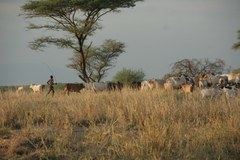
<dt><img src="http://www.mursi.org/audiovisual/image-gallery/making-a-living/herding-cattle/@@images/def30fbd-d135-4031-95fa-44aafca03df6.jpeg" alt="Herding cattle" title="Herding cattle" height="160" width="240" /></dt>
 <dd class="image-caption" style="width:240px;">Herding the cattle during the dry season, at a place called Bulu, near the Omo.</dd>
</dl></a></p>
<p style="text-align: justify; ">The Mursi (<i>Mun</i>, sg. <i>Muni</i>) live in the Lower Omo Valley of southwestern Ethiopia and number less than 10,000. Their territory of around 2,000 km<sup>2</sup> lies in the South Omo Zone of the Southern Nations, Nationalities and Peoples' Regional State (SNNPRS), roughly between the Rivers Omo (<i>Warr</i>) and Mago (<i>Mako</i>). They speak a Surmic <a class="internal-link" href="http://www.mursi.org/introducing-the-mursi/languagetugo">language</a> belonging to the Nilo-Saharan language family. They share a common language, and frequently intermarry, with the Chai, who live west of the Omo and south of Maji. <a class="internal-link" href="http://www.mursi.org/documents-and-texts/maps">See <span class="internal-link">Maps 2</span> &amp; <span class="internal-link">3</span>.</a></p>
<p style="text-align: justify; "><a class="internal-link" href="http://www.mursi.org/introducing-the-mursi/making-a-living/index_html"><dl class="image-right captioned" style="width:240px;">
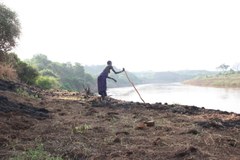
<dt><img src="http://www.mursi.org/audiovisual/image-gallery/making-a-living/planting-at-the-omo/@@images/f95f04b1-cdd2-4588-a313-e2ca14994866.jpeg" alt="Planting at the Omo" title="Planting at the Omo" height="160" width="240" /></dt>
 <dd class="image-caption" style="width:240px;">Ngatini Elmo planting her Omo garden in October 2010 after the flood had retreated.</dd>
</dl></a></p>
<p style="text-align: justify; ">The Mursi see themselves as the product of a series of migrations, all of which were part of a continuing effort to find and occupy a "cool place" (<i>bha lalini</i>), a place with riverside forest for cultivation and well watered grassland for cattle herding. Cattle continue to make a vital contribution to their diet. But although often described as 'nomads' by government officials, they lead a relatively settled life and depend heavily upon <a class="internal-link" href="http://www.mursi.org/introducing-the-mursi/making-a-living/index_html">cultivation</a>. During the dry season they live mainly along the banks of the Omo. When the rains come they return to the grasslands, east of the river, to live close to their cattle and enjoy the fresh milk.</p>
<p style="text-align: justify; "><a class="internal-link" href="http://www.mursi.org/introducing-the-mursi/duelling"><dl class="image-right captioned" style="width:240px;">
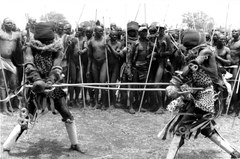
<dt><img src="http://www.mursi.org/audiovisual/image-gallery/duelling/bout-1996.jpg/@@images/bcef9bcb-427f-4f84-aca0-dce2a385a9d0.jpeg" alt="Bout (1996)" title="Bout (1996)" height="159" width="240" /></dt>
 <dd class="image-caption" style="width:240px;">A bout in progress (David Turton,  1996)</dd>
</dl></a></p>
<p style="text-align: justify; ">Life for the Mursi is often arduous and sometimes dangerous. But they have learnt to live well and there is much time for relaxation, chatting, music and gossip. They have a rich <a class="internal-link" href="http://www.mursi.org/documents-and-texts/oral-texts">oral tradition</a> through which they preserve and transmit their history, philosophical knowledge and moral stories. They have a keen aesthetic life that centres on their awareness of colour, cattle and <a class="internal-link" href="http://www.mursi.org/audiovisual/image-gallery/body-painting">body painting</a>. Two distinctive features of their society by which they have become known to outsiders, are <a class="internal-link" href="http://www.mursi.org/introducing-the-mursi/duelling">ceremonial duelling</a> (<i>sagine</i>) and the large pottery <a class="internal-link" href="http://www.mursi.org/introducing-the-mursi/lip-plates">discs or 'plates'</a> (<i>debhinya</i>) which are worn by women in their lower lips.</p>
<p style="text-align: justify; ">Dueling is a form of martial art, in which teams of men from different local divisions of the population (<a class="internal-link" href="http://www.mursi.org/introducing-the-mursi/environment"><i>bhuranyoga</i></a>) fight each other with two-metre wooden poles (<i>dongen</i>) in short but fierce bouts. The lip-plate is an expression of female social adulthood. A girl will have her lip pierced by her mother, or another woman of her local community, when she reaches the age of around fifteen. Adult men belong to named '<a class="internal-link" href="http://www.mursi.org/introducing-the-mursi/age-and-age-sets">age sets</a>' and pass through a series of 'age grades', while married women take their age status from their husbands.</p>
<p style="text-align: justify; "><a class="internal-link" href="http://www.mursi.org/introducing-the-mursi/copy_of_duelling"><dl class="image-right captioned" style="width:240px;">
<dt><img src="http://www.mursi.org/audiovisual/image-gallery/religion-and-healing/sacrificing-an-ox/@@images/7edaaa61-cc88-4f19-a7aa-77c1b97bf62d.jpeg" alt="Sacrificing an ox" title="Sacrificing an ox" height="160" width="240" /></dt>
 <dd class="image-caption" style="width:240px;">An ox is sacrificed at a communal healing ceremony in Ulumholi.</dd>
</dl></a></p>
<p style="text-align: justify; "><a class="internal-link" href="http://www.mursi.org/introducing-the-mursi/leadership">Leadership</a> is exercised by individual elders who have achieved a position of influence in the local community through their oratorical and debating skills and through their knowledge of precedent and tradition. The only formally defined leadership role is that of priest (<a class="internal-link" href="http://www.mursi.org/introducing-the-mursi/leadership/priests-komorena"><i>komoru</i></a>). Each major local division of the population (<a class="internal-link" href="http://www.mursi.org/introducing-the-mursi/local-groups-bhuranyoga"><i>bhuran</i></a>) has its priest, who embodies the well-being of the local community and acts as a means of communication between the community and God (<a class="internal-link" href="http://www.mursi.org/introducing-the-mursi/copy_of_duelling"><i>tumwi</i></a>), especially when it is threatened by such events as drought, crop pests and disease.</p>
<p style="text-align: justify; "><a class="internal-link" href="http://www.mursi.org/change-and-development/tourism/index_html"><dl class="image-right captioned" style="width:240px;">
<dt><img src="http://www.mursi.org/audiovisual/image-gallery/tourism/tourist-mago.jpg/@@images/79d81375-e5ad-41f7-8b79-ab752a56006f.jpeg" alt="Tourist" title="Tourist" height="160" width="240" /></dt>
 <dd class="image-caption" style="width:240px;">Mursi line up to be photographed by a tourist in the Mago Valley (Ben Dome, 2004)</dd>
</dl> </a></p>
<p style="text-align: justify; "><a class="internal-link" href="http://www.mursi.org/change-and-development/tourism/index_html">Religion and healing</a> are very much interconnected for the Mursi. A knowledge of illness and of the divine emerges from people's experiences of the natural and social world. Priests provide the context for a healthy community and it is the priest as well as members of other lesser ritual families (<i>e'wu</i>) who are sought out to treat epidemics, drought, and crop pests. The Mursi also have a healing tradition based around the powers of women healers (<i>ngerrêa</i>, sg. <i>ngerrê</i>).</p>
<p style="text-align: justify; ">Over the past few decades, the Mursi search for a "cool place" has come up against the much more powerful 'place making' activities of the Ethiopian state. Mursiland was first incorporated into the Ethiopian state at the end of the nineteenth century, when the Abyssinian king Menelik II expanded his kingdom southwards and established Ethiopia's modern borders with Kenya, Sudan and Somalia. But it was not until after World War II that the centre began to establish the kind of political control over the periphery that allows us to speak realistically of state incorporation.</p>
<p style="text-align: justify; ">Perhaps the most significant early step in this direction came in the 1960s with the establishment of the <a class="internal-link" href="http://www.mursi.org/change-and-development/national-parks/index_html">Omo National Park</a>. Improved transportation has also drawn the Mursi further into the market economy, where trade in cattle and increasing numbers of <a class="internal-link" href="http://www.mursi.org/change-and-development/tourism/index_html">tourists</a> provide money which the Mursi use to buy cloth, medicine, coffee, spices and agricultural tools. Today, the process of state-building in the lower Omo appears to have reached a new level of intensity, with the construction of a huge <a class="internal-link" href="http://www.mursi.org/change-and-development/the-gibe-iii-dam/the-gibe-iii-dam">hydroelectric dam</a> in its middle basin. This will eliminate the annual flood upon which the downstream population has always depended for cultivation and pastoralism and make possible large-scale commercial <a class="internal-link" href="http://www.mursi.org/change-and-development/large-scale-irrigation/large-scale-irrigation">irrigation schemes</a>.' These will require the forced displacement and resettlement of thousands of people and irrevocably transform their environment and way life.</p>]]></content:encoded>
    <dc:publisher>No publisher</dc:publisher>
    <dc:creator>admin</dc:creator>
    <dc:rights></dc:rights>
    <dc:date>2012-06-26T22:15:00Z</dc:date>
    <dc:type>Page</dc:type>
  </item>


  <item rdf:about="http://www.mursi.org/news-items/ethiopia-responds-to-unescos-world-heritage-committee-on-lake-turkana">
    <title>Ethiopia responds to UNESCO's World Heritage Committee on Lake Turkana</title>
    <link>http://www.mursi.org/news-items/ethiopia-responds-to-unescos-world-heritage-committee-on-lake-turkana</link>
    <description>UNESCO's concerns about the impact of the Gibe III dam and irrigation development on Lake Turkana are 'one sided and highly biased', says the Ethiopian Government. </description>
    <content:encoded xmlns:content="http://purl.org/rss/1.0/modules/content/"><![CDATA[<p><b> </b></p>
<p><i><span> </span></i></p>
<p><span>One of the decisions made by UNESCO’s World Heritage Committee at its 35th session in June 2011 concerned threats posed by the Gibe III Dam to Kenya’s Lake Turkana World Heritage Site.<span> </span>The decision was based principally on information contained in a letter of concern from the NGOs International Rivers and Friends of Lake Turkana and in a report commissioned by the <a href="http://www.mursi.org/pdf/Avery%20final%20report.pdf">African Development Bank </a>on the hydrological impacts of the Omo Basin on Lake  Turkana water levels and fisheries. </span></p>
<p style="text-align: justify; "><span> </span></p>
<p style="text-align: justify; "><span>The committee concluded that the dam is likely to ‘significantly alter Lake Turkana’s fragile hydrological regime’. It </span><span>expressed its concerns about the potential cumulative impacts of large-scale irrigation in the Lower Omo  Valley and of the Gibe IV and Gibe V dams, which are still at the planning stage. It urged the Ethiopian government to ‘immediately halt’ construction of the Gibe III dam and asked both the Ethiopian and Kenyan Governments to report back to it by 1 February 2012. <span> </span></span></p>
<p style="text-align: justify; "><i><span> </span></i></p>
<p style="text-align: justify; "> </p>
<p style="text-align: justify; "><b><span>Comments on the Ethiopian response</span></b><span><b> </b><br /></span></p>
<p><span>In its response, the Ethiopian Government dismissed all the committee’s concerns. Even the statement that the lake ‘draws almost 90 per cent of its inflow’ from the Omo was described as ‘difficult to establish’, on the grounds that </span><span>‘there is no information about the Kenyan part of the Basin’ (p. 5)</span><span>.<a name="_ftnref2"></a> It has long been the established scientific consensus, however, that over 80 per cent of the inflow to the lake comes from the Omo-Gibe basin. This is indicated by the following quotation from Karl Butzer’s classic 1971 study of changes in the level of Lake Turkana (then known as Rudolf).</span></p>
<p style="text-align: justify; "><span><span> </span>..<i>most of the water of Lake Rudolf – in the order of 80 to 90% - appears to be derived from the Omo River. The Turkwell and Kerio </i>[in Kenya],<i> the only other affluents of any significance, are dry in their lower courses for most of the year...Consequently the seasonal and longer-term fluctuations of Rudolf must in large part be controlled by the duration and intensity of the rainy season in highland Ethiopia</i>. (Recent History of an Ethiopian delta: the Omo River and the level of Lake Rudolf (University  of Chicago Dept. of Geography, 1971, p. 37).<span> <br /></span></span></p>
<p style="text-align: justify; "><span>The Ethiopian government also accused the committee of failing to recognise the contribution of the proposed ‘controlled flood’ to (a) maintaining the lake level (p. 6), (b) boosting the nutrient needs of the lake (p. 8) and (c) providing a ‘reliable and timely water supply for recession agriculture’ (p. 10). These points would have been worth making, if the controlled flood were indeed to become the major ‘mitigating measure’ it was described as in the 2009 <i>Economic and Social Impact Assessment, </i>commissioned by the Ethiopian Electric Power Corporation. It now seems clear, however, that this was never the intention. <br /></span></p>
<p style="text-align: justify; "><span>In the first place, <span> </span>a press release issued by the dam builder, Salini Costruttori, in March 2010 revealed that the controlled flood was intended as a temporary measure only, which would ‘enable the local people to have a transitory period of a suitable duration when it is deemed opportune to switch from flood-retreat agriculture to more modern forms of agriculture.’<span> </span>In the second place,<b> </b><span> </span><span> </span>the large-scale irrigation development in the lower basin which was announced by the Prime Minister in January 2011 <span> </span>will rule out a controlled flood of any kind, whether temporary or not.<span> </span></span></p>
<p style="text-align: justify; "><span>This leads to the most baffling aspect of the Ethiopian government’s response to the WHC, namely the way it seeks to dismiss the committee’s concerns about the impact on Lake Turkana of irrigation development in the lower Omo. <br /></span></p>
<p style="text-align: justify; "><span>The Omo Basin has long been seen as offering substantial opportunities for large scale irrigation, provided the highly seasonal flow of the Omo could be regulated. This will now be achieved, for the first time, by the Gibe III dam. As a result, the Ethiopian Sugar Corporation has already been allocated 245,000 ha. in the lower basin, of which 150,000 ha will be devoted to irrigated sugar cane production. At least another 150,000 ha have been leased to private investors for a variety of other irrigated crops. According to the AFDB study, ‘with the potential abstractions that might be implemented [through irrigation development in the lower basin] the lake could drop up to 20 metres’ (Executive Summary, <span> </span>para. 33, p. 5). </span></p>
<p style="text-align: justify; "><span><span>Despite this, the government claims in its response to the WHC that irrigation development is not relevant to the committee's concerns, because it is 'not part of the Ghibe III Dam' (p. 9). On page 7 of the response, the following passage is quoted from the AFDB study.(1)</span></span></p>
<p style="text-align: justify; "><span><span><i>Development within the Omo-Basin, which removes water for consumptive use especially through irrigation abstraction, will impact the lake through reduced inflows and a reduction in lake levers [sic], [and] associated with this, there will be a reduction in the water table. <b>Since irrigation is not part of the Ghibe III Dam, the assumed reduction will not happen </b></i>[emphasis added]<b>. </b><i>However, the extent and effect of the reduced flows have not been fully assessed, and they are to some extent offset by increasing runoff due to catchment change.</i></span></span></p>
<p style="text-align: justify; "><span>No page reference is given for this quotation but it is nearly identical to a passage on p. 4-2 of the final version of the AFDB study in which, however, the  sentence shown above in bold does not occur.(2) Wherever this sentence came from, it is clearly meaningless. It could be made meaningful, however, by adding the words ‘......as a direct result of the operation of the dam’. Any reduction in lake level due to large-scale irrigation development, in other words, will be an <i>indirect</i>, rather than direct result of the dam, since without the regulated flow sequence created by the dam, large-scale irrigation in the lower basin would not be feasible. The puzzling position of the Ethiopian government, then, appears to be that large-scale irrigation in the lower Omo should not be considered a danger to the Lake Turkana World Heritage Site, because it will be an indirect rather than a direct result of Gibe III.</span></p>
<p style="text-align: justify; "><span>The Ethiopian government’s response to<span> </span>international criticism of the Gibe III Dam project has, from the start, been highly defensive. Critics tend to be portrayed as enemies of Ethiopia who want to hold back economic development in the country and keep its citizens in a state of ‘backwardness and poverty.’(3) In the present document, the Ethiopian government not only describes the decision of the WHC as ‘one sided and highly biased’ but confesses itself unable to understand the reasons behind it, thereby hinting at ulterior motives (p. 10). This mode of response makes it difficult for a constructive dialogue to take place between the government and its critics and often makes it appear (as in this case) that government spokespersons are wilfully out of touch with reality. <span> </span></span></p>
<p style="text-align: justify; "><span><span> </span></span></p>
<p style="text-align: justify; "> </p>
<p style="text-align: justify; "><b><span>The 36th Session of the World Heritage Committee.</span></b><span><br /></span></p>
<p style="text-align: justify; "><span> </span><span>Between 14 and 22 March 2012, a joint monitoring mission from the World Heritage Centre and the IUCN visited the Lake Turkana World Heritage Site, at the invitation of the Government of Kenya. The mission had meetings with various ‘stakeholders’, including the Prime Minister. Based on the mission’s report, a draft decision has been included in the provisional agenda for the 36th session of the WHC, which would add the Lake Turkana World Heritage Site to the ‘List of World Heritage in Danger’. </span></p>
<p style="text-align: justify; "><span>The draft decision repeats the committee’s concern about the ‘potential and ascertained cumulative impacts’<span> </span>on Lake Turkana of the Gibe III dam and ‘related on-going and planned irrigation projects’; asks the Governments of Ethiopia and Kenya to carry out a ‘Strategic Environmental Assessment’ (SEA) to assess the ‘cumulative impacts of all development projects impacting on the Lake Turkana Basin’; and once again urges the Ethiopian government ‘to immediately halt all construction on the Gibe III dam and related irrigation projects until the SEA has been completed’ (Item 7B of the Provisional Agenda: <i>State of conservation of World Heritage properties,</i> WHC-12/36.COM/7B.ADD, pp. 10-16). <br /></span></p>
<p style="text-align: justify; "><span>The 36th session of the committee will be held in Saint Petersburg between 24 June and 6 July 2012. </span></p>
<p style="text-align: justify; "> </p>
<p style="text-align: justify; "><span><b>Notes</b><br /></span></p>
<p style="text-align: justify; "><span> </span></p>
<div style="text-align: justify; ">
<div id="ftn1">
<p>Posted by David Turton, 19 June 2012.<span> Email: </span>david.turton@qeh.ox.ac.uk</p>
</div>
<div id="ftn2">
<p><span>(1) Page references are to the pdf version of the response, accessible under ‘Related documents’ below. Note that the title page  is mistakenly headed ‘In response to the World Heritage Committee decision WHC 34 COM 7B.44’. This in fact was a decision taken at the 34th. meeting of the Committee (Brasilia, 25 July-3 August 2010) on the Rock Hewn Churches of Lalibela. This decision also called for a response from the Ethiopian Govt. by 1 February 2012.</span></p>
<span><span> </span></span></div>
<div id="ftn3">
<p style="text-align: justify; ">(2) <span>This passage reads: ‘Developments within the Omo Basin, which remove water for consumptive use, especially through irrigation abstraction, will impact the lake through reduced inflows and a reduction in lake levels, and associated with this, there will be a reduction in the water table. The extent and effects of the reduced flows have not been fully assessed, and they are to some extent offset by increasing runoff due to catchment change.’ </span></p>
</div>
<div id="ftn4">
<p><span>(3) See the speech by the Prime Minister, Meles Zenawi, in Jinka, 25 January 2011: ‘Even though the promoters of backwardness and poverty pretend to be environmentalists and to be concerned for pastoralists, we will continue to stay strong and stand by our development with our own resources’.<span> </span></span></p>
</div>
</div>
<p style="text-align: justify; "> </p>
<p style="text-align: justify; "><b><span>Related documents </span></b></p>
<div style="text-align: justify; ">
<div id="ftn4"><b> </b>
<p style="text-align: justify; "><a title="UNESCO WHC Decision 35 COM 7B.3" class="internal-link" href="http://www.mursi.org/pdf/decision-of-unesco2019s-world-heritage-committee-at-its-35th-session-june-2011-on-the-lake-turkana-national-parks-world-heritage-site-kenya"><span>UNESCO World Heritage Committee, Decision 35 COM 7B.3</span></a></p>
<p style="text-align: justify; "><a title="UNESCO 36 Com. Ethiopian response" class="internal-link" href="http://www.mursi.org/pdf/ethiopian-response-to-world-heritage-committee-decision"><span>Response of the Ethiopian Government</span></a></p>
<p style="text-align: justify; "><a title="UNESCO 36com. Kenyan response" class="internal-link" href="http://www.mursi.org/pdf/kenyan-response-to-world-heritage-committee-decision"><span>Response of the Kenyan Government</span></a></p>
<p style="text-align: justify; "><span><a title="UNESCO 36COM. Provisional agenda" class="internal-link" href="http://www.mursi.org/pdf/world-heritage-monitoring-mission-report">Report of the UNESCO/IUCN Monitoring Mission to Lake Turkana</a></span></p>
<p><br /><span><span> </span></span></p>
<p style="text-align: justify; "><span><span><br /></span></span></p>
</div>
</div>]]></content:encoded>
    <dc:publisher>No publisher</dc:publisher>
    <dc:creator>admin</dc:creator>
    <dc:rights></dc:rights>
    <dc:date>2012-06-19T21:45:00Z</dc:date>
    <dc:type>News Item</dc:type>
  </item>


  <item rdf:about="http://www.mursi.org/who-are-the-mursi/local-groups-bhuranyoga/index_html">
    <title>Local groups (bhuranyoga)</title>
    <link>http://www.mursi.org/who-are-the-mursi/local-groups-bhuranyoga/index_html</link>
    <description></description>
    <content:encoded xmlns:content="http://purl.org/rss/1.0/modules/content/"><![CDATA[<p><a title="Larger map of Local groups in Mursiland" class="internal-link" href="http://www.mursi.org/images/map-04.gif"><img title="Local groups in Mursiland" class="image-right" alt="Local groups (bhuranyoga) in Mursiland" src="http://www.mursi.org/images/map-04-240px.gif" /></a></p>
<p class="image-right-landscape-caption">Local groups (bhuranyoga) in Mursiland. <a title="Local groups in Mursiland" class="internal-link" href="http://www.mursi.org/images/map-04.gif">Map 5</a></p>
<p>The population is divided into five main local groups, or <em>bhuranyoga</em> (sing. <em>bhuran</em>), which are named, from north to south, Baruba, Mugjo, Biogolokare, Ariholi and Gongulobibi. Because the term <em>bhuran</em> refers to a group of co-resident people rather than to the physical space they occupy, it is not possible to draw clear cut spatial boundaries between <em>bhuranyoga.</em> What gives them their spatial definition is not that their members live within clearly bounded territorial units, but that they move back and forth, in a coordinated fashion, between the same sites for flood and rain cultivation and cattle herding. They have, in other words, territorial foci rather than territorial boundaries. (<a title="Local groups in Mursiland" class="internal-link" href="http://www.mursi.org/images/map-04.gif">Map 5</a>)</p>
<p>Some of these local divisions are relatively new, especially the two most northerly ones, Baruba and Mugjo. About 150 years ago, the ancestors of the present Mursi, coming from the west, began occupying the east bank of the Omo in a move that is seen today, in Mursi oral history, as the decisive event in creating a specifically Mursi identity.  In the early years of this century, a second migration began, northwards to the River Mara which forms the present-day northern boundary of the Mursi. Both migrations represented a Mursi expansion into territory formerly inhabited by their northern neighbours, the Bodi.</p>
<p>Before the move to the Mara, there were three Mursi <em>bhuranyoga</em>, named from north to south, Dola, Ariholi and Gongulobibi, Dola covering the area currently occupied by Biogolokare. The names Biogolokare, Mugjo and Baruba, which distinguish different sub-units of Dola, came into use only gradually, after the migration to the Mara had begun and as the population of the newly occupied area grew. Before this the Biogolokare group were known as the ‘Dola of Darthum’ (a river). It was only since the 1980s that the names Mugjo and Baruba became established in everyday speech. Before that, members of these groups were generally also identified by geographical markers - the rivers around which they built their settlements and along which they cultivated. These were the Mako (a short, westward flowing tributary of the Omo, not to be confused with the much longer southward flowing tributary of the same name) in the case of Mugjo, and the Mara in the case of Baruba.</p>
<p>Over the years, then, new identities have been created, and older ones modified as part of a constant process of northward expansion. This expansion has been fed by a continuous south-to-north migration of individuals and families, largely through intermarriage, with the result that ties of <a title="Clans (kabicho)" href="http://www.mursi.org/who-are-the-mursi/clans-kabicho/index_html">clanship</a> and affinity, embodied in economic cooperation and exchange, spread throughout the population, cutting across local group boundaries.</p>
<h3>More information</h3>
<ul>
<li>David Turton, '<a title="The meaning of place in a world of movement: lessons from long-term field research in Southern Ethiopia" href="http://www.mursi.org/pdf/workingpaper18.pdf/view">The meaning of place in the world of movement: lessons from long term field research in Southern Ethiopia</a>'. Elizabeth Colson Lecture, Refugee Studies Centre, 2004.'</li>
<li>David Turton, '<a title="A Journey Made Them: Territorial Segmentation and Ethnic Identity among the Mursi" href="http://www.mursi.org/pdf/a-journey-made-them.pdf/view">A journey made them: territorial segmentation and ethnic identity among the Mursi</a>', in Ladislav Holy (ed.) <i>Segmentary lineage systems reconsidered</i>, Department of Social Anthropology, Queen's University Papers in Social  Anthropology, Volume 4, Queen's University, Belfast, 1979, pp. 119-43. </li>
</ul>]]></content:encoded>
    <dc:publisher>No publisher</dc:publisher>
    <dc:creator>admin</dc:creator>
    <dc:rights></dc:rights>
    <dc:date>2012-06-10T23:40:00Z</dc:date>
    <dc:type>Page</dc:type>
  </item>


</rdf:RDF>