<?xml version="1.0" encoding="utf-8" ?>
<rdf:RDF xmlns:rdf="http://www.w3.org/1999/02/22-rdf-syntax-ns#" xmlns:dc="http://purl.org/dc/elements/1.1/" xmlns:syn="http://purl.org/rss/1.0/modules/syndication/" xmlns="http://purl.org/rss/1.0/">


<channel rdf:about="http://www.mursi.org/search_rss">
  <title>Mursi Online</title>
  <link>http://www.mursi.org</link>

  <description>
    
            These are the search results for the query, showing results 31 to 45.
        
  </description>


  <image rdf:resource="http://www.mursi.org/logo.png"/>

  <items>
    <rdf:Seq>
      
        <rdf:li rdf:resource="http://www.mursi.org/introducing-the-mursi/history/index_html"/>
      
      
        <rdf:li rdf:resource="http://www.mursi.org/introducing-the-mursi/environment/index_html"/>
      
      
        <rdf:li rdf:resource="http://www.mursi.org/introducing-the-mursi/duelling/copy2_of_duelling"/>
      
      
        <rdf:li rdf:resource="http://www.mursi.org/introducing-the-mursi/duelling/copy_of_duelling"/>
      
      
        <rdf:li rdf:resource="http://www.mursi.org/introducing-the-mursi/Body%20Decoration/lip-plates"/>
      
      
        <rdf:li rdf:resource="http://www.mursi.org/introducing-the-mursi/Body%20Decoration/index_html"/>
      
      
        <rdf:li rdf:resource="http://www.mursi.org/introducing-the-mursi/administration/index_html"/>
      
      
        <rdf:li rdf:resource="http://www.mursi.org/home-page"/>
      
      
        <rdf:li rdf:resource="http://www.mursi.org/who-are-the-mursi/making-a-living/index_html"/>
      
      
        <rdf:li rdf:resource="http://www.mursi.org/who-are-the-mursi/history/index_html"/>
      
      
        <rdf:li rdf:resource="http://www.mursi.org/news-items/huge-irrigation-scheme-planned-for-the-lower-omo-valley"/>
      
      
        <rdf:li rdf:resource="http://www.mursi.org/pdf/Rhetorics%20of%20local%20knowledge.pdf"/>
      
      
        <rdf:li rdf:resource="http://www.mursi.org/pdf/Temptations%20of%20war%20and%20the%20struggle%20for%20peace.pdf"/>
      
      
        <rdf:li rdf:resource="http://www.mursi.org/pdf/copy_of_lip-plates.pdf"/>
      
      
        <rdf:li rdf:resource="http://www.mursi.org/pdf/lip-plates.pdf"/>
      
    </rdf:Seq>
  </items>

</channel>


  <item rdf:about="http://www.mursi.org/introducing-the-mursi/history/index_html">
    <title>History</title>
    <link>http://www.mursi.org/introducing-the-mursi/history/index_html</link>
    <description></description>
    <content:encoded xmlns:content="http://purl.org/rss/1.0/modules/content/"><![CDATA[<p style="text-align: justify; ">The Mursi and their neighbours became part of the Ethiopian state in the last years of the nineteenth century, when the Emperor Menelik II established his control over the southwestern lowlands bordering Kenya and Sudan. This was an area inhabited by several small groups, with fluid identities, highly adaptable to environmental conditions and capable of absorbing outsiders easily. The Mursi as we know them today are the product of a large scale migratory movement of cattle herding peoples in the general direction of the Ethiopian highlands.   Three seperate movements<a><span class="internal-link"></span><span class="internal-link"></span></a><a class="internal-link" href="http://www.mursi.org/pdf/who-are-the-mursi"> </a>may be distinguished in the recent history of the Mursi, each the result of growing environmental pressure associated with the drying out of the Omo basin over the last 150-200 years.</p>
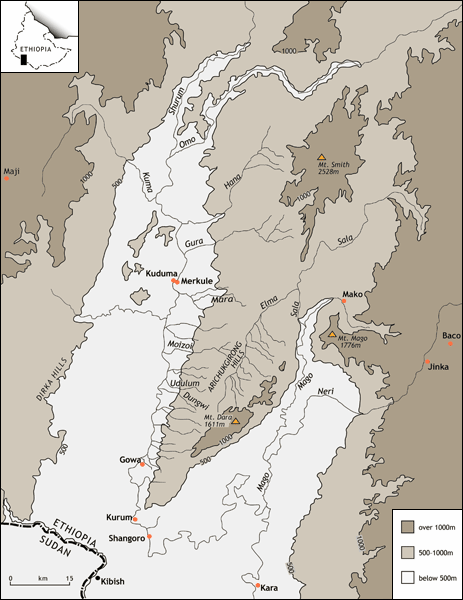
<p style="text-align: justify; ">First there was a move across the Omo, from the west, into what is now southern Mursiland, in the vicinity of Kurum (<a title="Mursiland - topography and drainage" class="internal-link" href="http://www.mursi.org/images/map-01.gif">Map 1</a>). This move took place around the mid-nineteenth century and is seen by the Mursi as a key historical event in the construction of their current political identity (see <a class="internal-link" href="http://www.mursi.org/documents-and-texts/oral-texts/copy_of_how-death-arrived">oral <span class="internal-link">text 3 and oral text 4). </span></a>Next there was a move northwards, into better watered territory, further upstream, which took place in the 1920s and 1930s. The effective northern boundary of Mursi territory was now the River Mara. (<a title="Mursiland - topography and drainage" class="internal-link" href="http://www.mursi.org/images/map-01.gif">Map 1</a>)</p>
<p style="text-align: justify; ">The third move began in 1979 and took the migrants still further into the upland plains of the lower Omo and into close and regular contact with their highland neighbours, the plough-cultivating Aari. Settlements were established in the upper Mago Valley (<a title="Mursiland - topography and drainage" class="internal-link" href="http://www.mursi.org/images/map-01.gif">Map 1</a>), which had last been occupied by the Mela (Bodi) in the early years of the last century. Ten years later, the Protestant missionary organisation SIM (Service in Mission) set up a mission station here, where it continues to provide educational, medical, agricultural and veterinary services.</p>
<p style="text-align: justify; ">Each of these moves was made, initially, by a small group of families who travelled a relatively short distance to a new place on the frontier of the settled area. As the pioneers established themselves, they were followed, over succeeding years, by a drift of individuals and families. Each move was explained by the migrants as a response to environmental pressure and as part of a continuing effort to find and occupy a cool (<i>lalini</i>) land (<i>ba</i>) or place, a place with riverside forest for cultivation and well watered grassland for cattle herding.</p>
<h3 style="text-align: justify; ">More information</h3>
<p>David Turton and Lugulointheno Jordomo, <a class="internal-link" href="http://www.mursi.org/pdf/who-are-the-mursi">'Who are the Mursi'?</a></p>
<p style="text-align: justify; ">David Turton, ‘<a title="Looking for a cool place: the Mursi, 1890s-1980s" href="http://www.mursi.org/introducing-the-mursi/pdf/cool-place.pdf/view">Looking for a Cool Place: The Mursi, 1890s - 1990s</a>’, in D. Anderson and D. Johnson (eds.) <i>The Ecology of Survival: Case Studies from Northeast African History.</i> Lester Crook Academic Publishing/Westview Press, London/Boulder, 1988, pp. 261-82.</p>
<p style="text-align: justify; ">David Turton, ‘<a title="Exploration in The Lower Omo Valley of Southwestern Ethiopia Between 1890 and 1910" href="http://www.mursi.org/introducing-the-mursi/pdf/exploration-in-the-lower-omo-valley.pdf/view">Exploration in the Lower Omo Valley of Southwestern Ethiopia</a>’, in M. Caravaglios (ed.) <i>L'Africa ai tempi di Daniele Comboni.</i><b> </b>Instituto Italo-Africano, Rome, 1981.</p>
<p style="text-align: justify; ">Jerry Carlson, '<a title="How the missionaries came to Makki" href="http://www.mursi.org/introducing-the-mursi/pdf/how-sim-came-to-makki.pdf">How the missionaries came to Makki</a>'.</p>
<p style="text-align: justify; "><b>Documentary films</b></p>
<p style="text-align: justify; ">Some of the events of recent Mursi history have been recorded in six <a class="internal-link" href="http://www.mursi.org/audiovisual/film-and-video-clips/television-documentaries">television documentaries</a> made by Leslie Woodhead and David Turton between 1974 and 2001.</p>]]></content:encoded>
    <dc:publisher>No publisher</dc:publisher>
    <dc:creator>admin</dc:creator>
    <dc:rights></dc:rights>
    <dc:date>2012-06-10T23:40:00Z</dc:date>
    <dc:type>Page</dc:type>
  </item>


  <item rdf:about="http://www.mursi.org/introducing-the-mursi/environment/index_html">
    <title>Environment</title>
    <link>http://www.mursi.org/introducing-the-mursi/environment/index_html</link>
    <description></description>
    <content:encoded xmlns:content="http://purl.org/rss/1.0/modules/content/"><![CDATA[<p style="text-align: justify; "><img title="The Omo at Kurum" class="image-right" alt="The Omo at Kurum" src="http://www.mursi.org/audiovisual/image-gallery/environment/kurum-crossing.jpg/@@images/bfa99342-e23a-4e5c-bba2-8eacc66c7d03.jpeg" /></p>
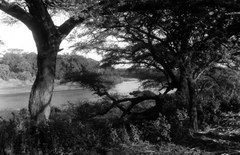
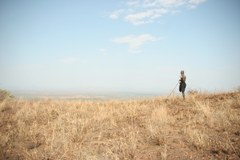
<p class="image-right-landscape-caption" style="text-align: justify; "><a class="internal-link" href="http://www.mursi.org/audiovisual/image-gallery/environment/omo-valley-and-south-sudan/view"><img title=" Omo Valley and South Sudan" class="image-right" alt=" Omo Valley and South Sudan" src="http://www.mursi.org/audiovisual/image-gallery/environment/omo-valley-and-south-sudan/@@images/a89c0f68-be2d-4b7b-8572-13a1857b6d50.jpeg" /></a>Above: The River Omo at Kurum, in the dry season (David Turton, 1991); Below: View over the lower Omo Valley into South Sudan</p>
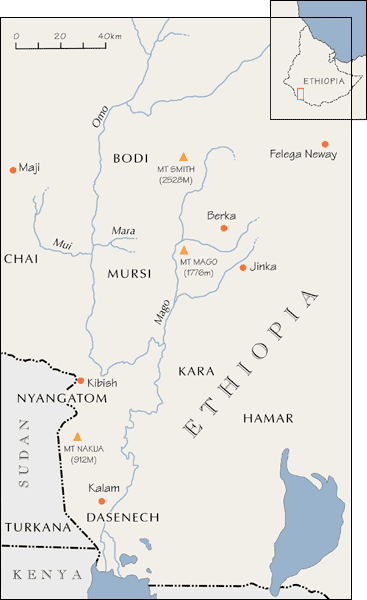
<p style="text-align: justify; ">The Mursi live in a rough oblong of territory, bounded to the west and south by the River Omo, to the east by the River Mago and to the north by the River Mara (<a title="The Mursi and their neighbours" class="internal-link" href="http://www.mursi.org/images/map-02.gif">Map 2</a>). Much of this area consists of a volcanic plain, sloping from east to west, which is being gradually lowered by the action of a large number of seasonal streams flowing westward to the River Omo and northward to the River Mago. The plain is dominated by a range of hills, running diagonally from southwest to northeast, which form a continuation of the Omo-Mago watershed and reach a height of 1,666m. in a dome-like summit, called ‘Dara’ (<a title="Upland plains of the lower Omo valley - topography and drainage" class="internal-link" href="http://www.mursi.org/images/map-01.gif">Map 1</a>). The climate is semi-arid to arid, with mean annual rainfall decreasing from about 800mm to 400mm from north to south. Most of the year’s rainfall is concentrated into two short rainy spells, one between March and April (the primary maximum, or ‘big rains’, called <i>oiyoi</i> in Mursi) and one between October and November (the ‘small rains’, or <i>loru</i>).</p>
<p style="text-align: justify; ">The Omo (<i>Warr</i> in Mursi) is one of Ethiopia’s largest rivers. It flows south for over 1000km. from the Blue Nile and Sobat watersheds, to the northern end of Lake Turkana, on the Kenyan border. Since most of its main catchment is at heights of 2000-3000m., its level rises and falls every year in response to the rainfall regime of the Ethiopian highlands. It begins to rise in April or May and reaches its maximum level in August or September, when it overflows its banks in Mursiland and, more extensively, in its lower basin. Having reached its maximum level, the river recedes rapidly during September and October, when people start preparing the recently flooded area for flood-retreat cultivation. It is at its lowest, and easily fordable at several places, by December/January, the height of the dry season (<i>su kiango</i>: literally ‘the stomach of the sun’).</p>
<p style="text-align: justify; ">Vegetation in the immediate vicinity of the Omo banks varies between large forest trees, (e.g. Ficus (<i>chamochi</i>), Diospyros (<i>kirithoi</i>), Ziziphus (<i>dangkwe</i>), Salvadora (<i>gegi</i>) and Tamarindus (<i>ragai</i>)) and dwarf shrub grassland (e.g. Tribulus (<i>kathogi</i>), Solanum (<i>turgiyai</i>), Maerua (<i>kamaloi</i>), Sporobolus (<i>keri</i>) and Ricinus (<i>balathi</i>)). Further back from the east bank in the Mursi area, and decreasing in width from north to south, is a dense belt of woody plants or ‘bushland thicket’ (e.g. Euphorbia Tirucali L. (<i>kalangarai</i>), Sarcostemma (<i>kirin kirini</i>), Cissus Quadrangulsaris L (<i>turoi</i>), Sanseviera (<i>kashoi</i>), Acacia Mellifera (<i>radi-a-kora</i>), Adenium Obesum (<i>dorbin</i>) and Plectranthus (<i>lukwe</i>)). The bushbelt gives way abruptly, along the 500m contour, to open wooded grassland, rising gradually to the Omo-Mago watershed. Here are found, scattered or in groups, such trees as Commiphora Africana (<i>olbai</i>), Comiphera penduculata (<i>lareni</i>), Combretum (<i>lalai</i>), Sclerocariya (<i>chobwe</i>), Lannea (<i>kiringeni</i>) and Grewia (<i>kalochi-a-kora</i>).</p>
<p style="text-align: justify; ">It has been estimated that the level of Lake Turkana dropped dramatically (for a ‘non-outlet’ African lake) between the late 1890s and the 1970s, due to reduced rainfall over the Omo’s highland catchment area (Butzer, 1971). This resulted in a reduced river flow and, in some cases, the drying out of the Omo’s westward flowing tributaries, leading to the growth of woody vegetation along the Omo banks. Satellite imagery shows that the Omo delta expanded by 500 sq. km during the 1980s and 1990s, suggesting that the lake level and river flows have continued to decrease up to the present (Haack, 1996).</p>
<p style="text-align: justify; "><strong>‘Landscape People and Parks’ Project (2007-2010)</strong></p>
<p style="text-align: justify; ">The ‘Landscape People and Parks’ project is the first landscape-scale attempt to understand the interaction between people and the environment in the lower Omo. The project team has been inter-disciplinary, including one historian, two anthropologists and one palaeoecologist. The project ran between 2007-2010, funded by the AHRC.  Research methods included the collection and analysis of oral histories of land use and settlement over the past two hundred years; a study of library and archival sources relating to the history of the lower Omo since the 1880s; a study of long term vegetation change, using fossil pollen and charcoal counting; and a study of vegetation structure and its immediate response to human action over the past forty years.</p>
<p style="text-align: justify; ">The overall aim of the project has been to reach a detailed understanding of the sequence of environmental changes and of the way these changes have influenced, and have been influenced by, the land-use practices and migratory movements of the human population.</p>
<p style="text-align: justify; ">Palaeoecological research, based on the analysis of fossilised pollen from hyrax middens in the northern part of the study area resulted in a 2000-year record of vegetation change. This is the first time such evidence of long term vegetation change in the lower Omo Valley has been obtained and the first time this particular method of obtaining fossilised pollen has been attempted in East Africa. Both the palaeoecological research and the study of bush encroachment in the savannah over the shorter term helped to demonstrate the wider relevance and value of integrating ecological and local knowledge of landscape change.</p>
<p style="text-align: justify; ">Oral history interviews carried out amongst the peoples of the study area, combined with a thorough examination of secondary sources, resulted in the most comprehensive and detailed account yet given of the complex processes of identity formation in the lower Omo over the past two hundred years.</p>
<p style="text-align: justify; ">In September 2009 the project brought together scholars from various disciplines (history, anthropology, palaeoecology and archaeology) who have worked in the lower Omo over the past forty years, for an international workshop on ‘Anthropology and History along the Omo.’  This workshop generated a series of <a class="internal-link" href="http://www.mursi.org/news-items/free-online-access-to-articles-on-the-lower-omo-valley-for-a-limited-period">publications </a>in the <span class="internal-link">Journal of East African Studies</span>.</p>
<p style="text-align: justify; ">As the only source of academic research data on the history of human-environmental relations in the Lower Omo, the project has had a significant, if difficult to quantify, impact on two controversial policy debates concerning the future of river basin development in the lower Omo: the future of state-sponsored conservation and the investment in hydro-power and large-scale commercial irrigation schemes. Project members have contributed to these debates through conference papers and presentations, media interviews and frequent discussions with politicians, administrators, human rights activists and aid officials.</p>
<h3 style="text-align: justify; ">More information</h3>
<p class="EndNoteBibliography"><span>For the analysis of a two thousand year record of vegetation change in Mursiland, obtained from a fossil hyrax midden (a method never before employed in East Africa), see Graciela Gil-Romera, Henry F. Lamb, David Turton, Miguel Sevilla-Callejo and  Mohammed Umer,</span> '<a class="external-link" href="http://www.academia.edu/7125520/Long-term_resilience_bush_encroachment_patterns_and_local_knowledge_in_a_Northeast_African_savanna">Long-term resilience, bush encroachment patterns and local knowledge in a Northeast African savanna</a>'. <i>Global Environmental Change,</i> 20<strong>,</strong> 2010 pp. 612-626.</p>
<p class="EndNoteBibliography"><span style="text-align: justify; ">For a rare study of vegetation dynamics in the grassland plain west of the Omo (north of lat. 5 30N), see Michael J. Jacobs and Catherine A. Schloeder, ‘</span><a href="http://www.worldcat.org/oclc/193893162" style="text-align: justify; " title="WorldCat: Fire frequency and species associations in perennial grasslands in south-west Ethiopia">Fire frequency and species associations in perennial grasslands in south-west Ethiopia</a><span style="text-align: justify; ">’, </span><i style="text-align: justify; ">African Journal of Ecology</i><span style="text-align: justify; ">, 40, 2002, pp. 1-9.</span></p>
<p class="EndNoteBibliography"><span style="text-align: justify; "><span style="text-align: justify; ">For a discussion of the growth of the Omo River delta, using satellite imagery, see Barry Haack, ‘</span><a href="http://www.worldcat.org/oclc/204266203" style="text-align: justify; " title="WorldCat: Monitoring wetland changes with remote sensing">Monitoring wetland changes with remote sensing: an East African example</a><span style="text-align: justify; ">’, </span><i style="text-align: justify; ">Environmental Management</i><span style="text-align: justify; ">, 20:3, 1996, pp. 411-419.</span></span></p>
<p style="text-align: justify; ">For information on the geomorphology and ecology of the lower basin of the Omo see (1) Karl Butzer, <i><a href="http://books.google.com/books?id=rWKeAAAACAAJ&amp;dq" title="Google Books: Recent History of an Ethiopian Delta">Recent History of an Ethiopian Delta: the Omo River and the Level of Lake Rudolf</a>,</i> Research Paper 136, Department of Geography, University of Chicago, 1971; and (2) Claudia Carr, <i><a href="http://books.google.com/books?id=NitkAAAAIAAJ" title="Google Books: Pastoralism in Crisis">Pastoralism in Crisis: the Dassanetch and their Ethiopian Lands</a>,</i> Research Paper No. 180, Department of Geography, University of Chicago, 1977.</p>]]></content:encoded>
    <dc:publisher>No publisher</dc:publisher>
    <dc:creator>admin</dc:creator>
    <dc:rights></dc:rights>
    <dc:date>2012-06-10T23:40:00Z</dc:date>
    <dc:type>Page</dc:type>
  </item>


  <item rdf:about="http://www.mursi.org/introducing-the-mursi/duelling/copy2_of_duelling">
    <title>Pole fighting (donga)</title>
    <link>http://www.mursi.org/introducing-the-mursi/duelling/copy2_of_duelling</link>
    <description></description>
    <content:encoded xmlns:content="http://purl.org/rss/1.0/modules/content/"><![CDATA[<p><img class="image-right captioned" src="../../resolveuid/f48484ca-3b2c-44bb-8be4-a789e8c03434/@@images/image/MursiLandscape" /></p>
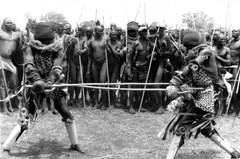
<p style="text-align: justify; ">The duelling weapon is a wooden pole (donga, pl. dongen), around two meters long which is cut from one of two species of tree of the genus Grewia (kalochi). In the attacking position the donga is gripped at its base with both hands, the left above the right, the aim being to land a blow with the shaft (never with the point) on any part of the opponent’s body, including the head, with sufficient force to knock him over. Blows are parried by continuing to grip the base of the donga with the right hand, while sliding the left hand up the shaft to a point above that at which the blow is received. Each contestant wears a duelling 'kit' (tumoga) which is both protective and decorative. It includes a basket-work hand guard for the right hand, shin guards made from animal skin, rings of plaited sisal cord to protect the elbows and knees, a leopard skin over the front of the torso, a hide skirt, cut into strips, and a cattle bell tied round the waist. The head is protected by wrapping round it long swathes of cotton cloth. Bouts are controlled by one or more referees (kwethana, sing. kwethani).</p>
<p style="text-align: justify; ">The duelling weapon is a wooden pole (<i>donga</i>, pl.<i> dongen</i>), around two meters long which is cut from one of two species of tree of the genus Grewia (<i>kalochi</i>). In the attacking position the <i>donga </i>is gripped at its base with both hands, the left above the right, the aim being to land a blow with the shaft (never with the point) on any part of the opponent’s body, including the head, with sufficient force to knock him over. Blows are parried by continuing to grip the base of the<i> donga </i>with the right hand, while sliding the left hand up the shaft to a point above that at which the blow is received. Each contestant wears a duelling 'kit' (<i>tumoga</i>) which is both protective and decorative. It includes a basket-work hand guard for the right hand, shin guards made from animal skin, rings of plaited sisal cord to protect the elbows and knees, a leopard skin over the front of the torso, a hide skirt, cut into strips, and a cattle bell tied round the waist. The head is protected by wrapping round it long swathes of cotton cloth. Bouts are controlled by one or more referees (<i>kwethana, </i>sing.<i> kwethani</i>).</p>
<p style="text-align: justify; ">For a bout to end in the victory of one of the contestants, his opponent must either fall to the ground or retire hurt (commonly because of broken or bruised fingers). In the first case, though not in the second, the victor is carried round the field on the shoulders of his local age mates and then surrounded by unmarried girls of his mother's clan, his ‘girl mothers’ (<i>dole juge</i>). They lay goat skins on the ground for him to sit on and hold cotton cloth above him, stretched on duelling poles, to provide shade. The explicit symbolism here is that of a mother protecting her baby from the sun: 'They are wrapping up their child. Doesn't one wrap up a baby to protect it from the sun?' It is probably this custom which gave rise to the popular misconception that the victor in a duelling contest can take his pick of the available marriageable girls. In fact, there is a strict prohibition on marriage between a man and a woman of his mother’s clan. It is these same 'girl mothers' who welcome a man back from war, after he has killed for the first time, with gifts of necklace beads.</p>
<p style="text-align: justify; ">A duelling contest usually takes place over several days and is carefully prepared for, often being discussed, within and between both contesting groups, for several months in advance. It is scheduled for a time of year when there is plenty of food available, so that the participants can be physically well prepared. When it eventually takes place, it is treated with the utmost seriousness, one indication of this being that it is frequently described as ‘war’ (<i>kaman</i>). And like war, duelling contests are not seen as isolated or ‘one off’ events. They are seen as part of a continuing series of events, in which each side takes it in turn to visit the other side’s ‘home ground’, at intervals of up to a year, to ‘exchange’ their ‘wounds’ (<i>chacha muloi</i>).</p>
<p style="text-align: justify; "><strong>More information</strong></p>
<p style="text-align: justify; ">Jon Abbink, ‘<a href="http://www.worldcat.org/oclc/210994782" title="WorldCat: Violence Ritual and Reproduction">Violence Ritual and Reproduction: Culture and Context in Surma Dueling</a>’, <i>Ethnology</i>, 38 1999, pp. 227-242.</p>
<p style="text-align: justify; ">David Turton, ‘The same only different: war and duelling as boundary marking rituals in Mursiland, southwestern Ethiopia’, in: T. J. Cornell and T.B. Allen (eds.) <i><a href="http://books.google.com/books?id=nQAXzSJsqKcC" title="Google Books: War and Games">War and Games</a></i>, Boydell Press, Woodbridge, Suffolk 2002, 171-92.</p>
<p style="text-align: justify; ">Tamas Regi, '<a href="http://www.mursi.org/introducing-the-mursi/pdf/duelling-by-tamas.pdf/view">Mursi Duelling: a photo essay</a>'</p>]]></content:encoded>
    <dc:publisher>No publisher</dc:publisher>
    <dc:creator>admin</dc:creator>
    <dc:rights></dc:rights>
    <dc:date>2012-06-10T23:40:00Z</dc:date>
    <dc:type>Page</dc:type>
  </item>


  <item rdf:about="http://www.mursi.org/introducing-the-mursi/duelling/copy_of_duelling">
    <title>Bracelet fighting (ula)</title>
    <link>http://www.mursi.org/introducing-the-mursi/duelling/copy_of_duelling</link>
    <description></description>
    <content:encoded xmlns:content="http://purl.org/rss/1.0/modules/content/"><![CDATA[<div>
<div style="text-align: justify; "><span>
<p class="image-right-landscape-caption" style="text-align: justify; "><dl class="image-right captioned" style="width:160px;">
<dt><a rel="lightbox" href="/audiovisual/image-gallery/bracelet-fighting-ula/bracelet-fight-ula"><img src="http://www.mursi.org/audiovisual/image-gallery/bracelet-fighting-ula/bracelet-fight-ula/@@images/cef16aa5-d228-4c44-9164-22b61c9fbcb8.jpeg" alt="'Bracelet fight' (ula)" title="'Bracelet fight' (ula)" height="107" width="160" /></a></dt>
 <dd class="image-caption" style="width:160px;">Ngahiri Barchorkuwi during an an ‘ula’ fight (Photo credit: S. LaTosky 2013:118)</dd>
</dl></p>
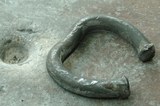
<p style="text-align: justify; ">Mun (Mursi) women often evaluate themselves and others by their strength and ability to ‘strike iron bracelets’ known as <i>ula</i>. Women also like to draw comparisons between girls’ ula competitions and men’s dônga (competitive stick dueling). In fact, it is not unusual to hear women and men refer to bracelet dueling as “dônga a dholuiny”  (girls’ dônga). The dueling weapon, or ula (pl. ulen) is made from a rod of iron and is pounded and smoothened to snugly fit a girls’ wrist. There is an opening on the inside of the wrist with two rounded nubs on either side used for striking one’s opponent. As with all girls’ and women’s bracelets (siggiyo), a slight indentation is made on the topside of the bracelet for aesthetic reasons.</p>
</span></div>
</div>
<p style="text-align: justify; "><img class="image-right captioned" src="../../resolveuid/a4e6b3bac2744de2b40bf6f664371862/@@images/image/MursiPortrait" /></p>
<p style="text-align: justify; ">As a girl grows up, ideally, she will earn a reputation as a “strong girl” (<i>dholey ôdhinêna</i>). The <i>ula </i>is thus a symbol of such strength, since only ‘strong’ girls and women are said to be worthy of wearing it. Two women, Ngatui and Nyabissê Sabakoro maintain that, “If you are a weak woman you will not wear an <i>ula</i>. Only a strong woman—a real <i>oli </i>[bull]—can wear it! If she is really powerful she will wear an <i>ula </i>on both [wrists] and have many bracelets (<i>siggiyo</i>)” (LaTosky 2013: 119). Even though other factors besides strength, such as the wealth of a girl’s family, will also determine whether a girl owns or wears an <i>ula</i>, what is interesting is how people talk about the <i>ula </i>in terms of personal strength. In the everyday narratives of women and men, the <i>ula </i>competition is discussed as a kind of performance intended primarily for a male audience. As Bamille Dorowa puts it: “If a girl’s hands are swift like a healer’s, the men will talk about her and say: ‘So-and-so’s daughter is really strong! I really want that girl. Whose girl is she?’ Olisirwa Tulla puts it in a similar way:</p>
<p style="text-align: justify; "><i>The bansanaa [‘big’ girls, i.e. have reached puberty] and nyawalalnaa [pre-pubescent girls with stretched earlobes] and ngonikongowa [young girls aged roughly 5-9] fight—all the girls! The têrro [age-grade of young men] and rora [warrior age-grade] watch them carefully—tull (::)! We will say: ‘Look, that girl will fetch water quickly. I want to marry that girl!’ The banasanaa are really strong; they are not like women who become weak after they get married” (LaTosky 2013:115).</i></p>
<p style="text-align: justify; ">Only young, unmarried girls (<i>bansanaa</i>, <i>nyawalalnaa</i> and <i>ngonikongowa</i>) practice for and compete in the <i>ula </i>competitions, which generally follow <i>dônga </i>duels. They are said to be an important part of girl’s education and a reflection of her future skills and strengths as a wife and mother. Both stick dueling and bracelet competitions depend on the success of a harvest, well-being in the community, and the participation of different clans.</p>
<p style="text-align: justify; ">Like young men, girls also have “victories” (<i>bolisay</i>), only they are not etched in trees, but recalled in personal stories. As Nyabissê Sabakoro explains:</p>
<p style="text-align: justify; "><i>We know where our scars came from and how many victories our friends have. We fight with the girls from other clans and later we become friends. If you hit a girl in the mouth, that is a win. If you hit her in the side and she bends over that is a win and the fight is over. The referee (kwethani) will raise his/her arms like this and push you apart. There is also a referee in girl’s bracelet fights—men and women can be referees. I only have one win. If the blood comes [pointing to her forehead] you are a real bansaanai (winner). A bansaanai has her lip pierced and stretched. If my lip was stretched, I would tuck it in with leaves like this or else the ula would tear it open! (LaTosky 2013:118)</i></p>
<p style="text-align: justify; ">A girl with a torn bottom lip, earlobe, or multiple scars on her forehead might therefore be taunted as being “weak,” or “like a Ngidi<i>” </i>(Kwegu, i.e. without cattle, poor), or “unfit to marry even a Chachi” (Chai) (ibid.)<i>. </i>Whenever I asked women about their abilities to fight <i>ula </i>they would often respond with the rhetorical question: “You don’t see any scars on my forehead do you?” This is because numerous scars on a woman’s body are a sign of weakness. For men, on the other hand, numerous scars on one’s body are said to be a sign of strength, since this indicates that he has participated in many <i>dônga </i>competitions.</p>
<p style="text-align: justify; ">As Abbink also explains for men’s <i>dônga </i>in Suri “displaying courage in fighting is said to be more important than winning. Wounds and scars are shown with pride” (1999: 233). Similarly, it is not uncommon to hear Mursi women refer to young men with few scars on their bodies as a “<i>loya</i>” (weakling) or a “<i>hira kobotey</i>” (someone who does not know how to protect or defend himself). Like <i>dônga</i>, <i>ula </i>competitions are an important means of conveying courage and sociability among children and adults. Just as boys are taught to fight with dueling poles from childhood, girls are taught to strike with their bracelets from a young age. This way they learn how to properly defend themselves and how to, later, be able to publicly convince themselves and others of “their suitability and strength for adulthood, marriage, and reproduction, all of which are deemed necessary for gaining higher social status” (Abbink 1999, quoted in LaTosky 2013: 119).</p>
<p style="text-align: justify; ">By Shauna LaTosky</p>
<p style="text-align: justify; "><span>More information</span></p>
<p>LaTosky, Shauna. 2013. Predicaments of Mursi Women in Ethiopia’s Rapidly Changing World. Cologne: Köppe Verlag.</p>
<p>Abbink, G. J. 1999. Violence, ritual, and reproduction: culture and context in Surma dueling. <i>Ethnology</i> 38 (3):227-242</p>]]></content:encoded>
    <dc:publisher>No publisher</dc:publisher>
    <dc:creator>admin</dc:creator>
    <dc:rights></dc:rights>
    <dc:date>2012-06-10T23:40:00Z</dc:date>
    <dc:type>Page</dc:type>
  </item>


  <item rdf:about="http://www.mursi.org/introducing-the-mursi/Body%20Decoration/lip-plates">
    <title>Lip-plates</title>
    <link>http://www.mursi.org/introducing-the-mursi/Body%20Decoration/lip-plates</link>
    <description></description>
    <content:encoded xmlns:content="http://purl.org/rss/1.0/modules/content/"><![CDATA[<p><a class="internal-link" href="http://www.mursi.org/images/nga-mokonyi-keketokenno.jpg/view"><img title="Nga Mokonyi Keketokenno" class="image-right" alt="Nga Mokonyi Keketokenno, three months after her lip had been pierced" src="http://www.mursi.org/images/nga-mokonyi-keketokenno.jpg" /></a></p>
<p class="image-right-portrait-caption">Nga Mokonyi Keketokenno, one month after her lip had been pierced. (David Turton, 1969)</p>
<p style="text-align: justify; ">The Mursi, Chai and Tirma are probably the last groups in Africa amongst whom it is still the norm for women to wear large pottery or wooden discs or ‘plates’ in their lower lips. The lip-plate (<i>dhebi a tugoin</i>) has become the chief visible distinguishing characteristic of the Mursi and made them a prime attraction for tourists. A girl’s lower lip is cut, by her mother or by another woman of her settlement, when she reaches the age of 15 or 16. The cut is held open by a wooden plug until the wound heals, which can take around 3 months. It appears to be up to the individual girl to decide how far to stretch the lip, by inserting progressively larger plugs over a period of several months. Some, but by no means all, girls persevere until their lips can take plates of 12 centimetres or more in diameter. <span></span></p>
<p style="text-align: justify; "><span><span>The Mursi are a very egalitarian community in many ways, and it is the choice of the teenage girls to have their lips pierced, and not something older women or men force upon them. Obviously, like all teenagers, they feel some degree of peer pressure, but many girls marry happily without piercing their lips, even if they sometimes change their minds and decide to go ahead with the process after they have had one or two children. So the motivations are complex. </span></span></p>
<p style="text-align: justify; "><span><span></span>Girls and boys also pierce their ears; in terms of the risk of infection, piercing and stretching of the ear lobes is of a similar risk, and since this is practiced by both sexes (albeit achieving different diameters) there is some gender equality there.</span></p>
<p style="text-align: justify; ">It is often claimed that the size of the lip plate is correlated with the size of a woman’s bridewealth. However, <a class="internal-link" href="http://www.mursi.org/documents-and-texts/published-articles/david-turton/the-people-who-take-photographs">David Turton</a> has shown this not to be the case. For example, the marriages of many girls have already been arranged, and the amount of bridewealth to be paid by their husbands’ families has already been decided, <i>before</i> their lips are cut. Another common idea is that the practice of cutting and stretching the lower lip originated as a deliberate disfigurement, designed to make women and girls less attractive to slave traders. This ignores the fact that the Mursi themselves do not give such an historical explanation and that the practice is confined neither to Africa nor to women. Amongst the Kayapo of Brazil, for example, senior men wear a saucer-like disc, some six centimetres across, in the lower lip (Turner, 1980). Like other forms of body decoration and alteration found the world over (like ear piercing, tattooing, and circumcision), the lip plate worn by Mursi women is best seen as an expression of social adulthood and reproductive potential. It is a kind of ‘bridge’ between the individual and society - between the biological ‘self’ and the social ‘self’.</p>
<p>People might also be interested to know that although the initial 3-6 months are no doubt painful for a girl, once the lip has healed (and the Mursi have very good plant based ointments to heal these wounds), there is no pain involved (unlike Chinese foot binding and FGC, when the pain continues and can harm the quality of life in very significant ways); it is common to see women stretching their lips as if to massage them, or they tenderly allow their babies to tug on their lips without it causing them any discomfort. It somewhat effects a woman's speech, changing an 's' sound to a softer 'th' sound for example, but certainly not her ability to sing or communicate. It is even possible to see girls dancing energetically while wearing their lip plates. There is no doubt, however, as <a class="internal-link" href="http://www.mursi.org/documents-and-texts/published-articles/shauna-latosky/the-lip-plates-of-mursi-women">Shauna LaTosky</a> explains, that wearing a lip-plate, like wearers of high heels, affects a woman's gait, slowing her down and thereby guaranteeing a certain grace.</p>
<h3 style="text-align: justify; ">More information</h3>
<p style="text-align: justify; ">On what the lip-plate means to Mursi women, and how it functions as a symbol of pride and identity, see: Shauna Latosky, ‘<a title="Reflections on the lip-plates of Mursi women as a source of stigma and self-esteem" href="http://www.mursi.org/introducing-the-mursi/pdf/latosky.pdf/view/">Reflections on the lip-plates of Mursi women as a source of stigma and self-esteem</a>’, in Ivo Strecker and Jean Lydall (eds.) The perils of face: Essays on cultural contact, respect and self-esteem in southern Ethiopia, Mainzer Beiträge zur Afrika-Forschung, Lit Verlag, Berlin, 2006, pp. 371-386.</p>
<p style="text-align: justify; ">On the meaning and social significance of body alteration and decoration, with special reference to the Kayapo of Brazil, see: Terence S. Turner, ‘The Social Skin’, in Jeremy Cherfas and Roger Lewin (eds.), <i><a href="http://books.google.com/books?id=pcrfAAAAMAAJ" title="Google Books: Not Work Alone">Not Work Alone: A cross-cultural view of activities superfluous to survival</a>. </i>Temple Smith, London, 1980.</p>
<p style="text-align: justify; ">On the significance of the lip-plate in the Mursi-tourist encounter, see: David Turton, ‘<a title="Lip-plates and the people who take photographs" href="http://www.mursi.org/introducing-the-mursi/pdf/lip-plates.pdf/view">Lip plates and “the people who take photographs</a>”: uneasy encounters between Mursi and tourists in southern Ethiopia’, <i>Athropology Today, 20:3, 3-8, 2004).</i>]</p>]]></content:encoded>
    <dc:publisher>No publisher</dc:publisher>
    <dc:creator>admin</dc:creator>
    <dc:rights></dc:rights>
    <dc:date>2012-06-10T23:40:00Z</dc:date>
    <dc:type>Page</dc:type>
  </item>


  <item rdf:about="http://www.mursi.org/introducing-the-mursi/Body%20Decoration/index_html">
    <title>Body Decoration</title>
    <link>http://www.mursi.org/introducing-the-mursi/Body%20Decoration/index_html</link>
    <description>The Mursi, and the neighbouring Suri (also known as Surma), are most famous for is their lip-plates, but they also have a rich tradition of scarification, body ornamentation and dress. Another well known aspect of Mursi body decoration is their body painting, although tourists and photographers rarely see the ‘real’ body painting because the Mursi gain more money by ‘dressing up’ for visitors.
</description>
    <content:encoded xmlns:content="http://purl.org/rss/1.0/modules/content/"><![CDATA[<p style="text-align: justify; "> </p>
<p style="text-align: justify; "><strong>Body decoration: </strong><span>Traditionally, the Mursi decorated with ear and lip-plates, bracelets, and through body scarification and painting. More recently, hair-styles have become quite intricate thanks to the use of razors, but also cloth and other shop-bought items have come into use in often inventive ways.</span></p>
<p style="text-align: justify; "><span>More recently, the Mursi have learned to decorate in innovative ways to attract tourists and gain money to buy important things at the market, such as cloth, medicines, soap and razors. Generally, the Mursi are very sceptical of the camera and photographs, with much care being taken to destroy photographs of the dead, for example, to prevent the spirits from hanging around and harming the living.</span></p>
<p style="text-align: justify; "><strong>Lip-plates and ear-plugs: </strong><span>Contrary to some accounts, the Mursi women have not worn lip-plates to deter slave-raiders! Rather, ear and lip-plates instil a certain type of embodied morality, and are ways in which the Mursi teach their children to become social, moral and healthy persons.</span></p>
<p style="text-align: justify; ">The mud lip-plates are traditionally worn by marriageable girls and child-bearing women. They are an indication of fertility, and may even be connected to an old <strong>folk-story</strong>.  For marriageable girls, lip-plates are often worn at dances. Married women most often wear them while milking the cattle and serving their husband meals, since the lip-plate creates a graceful and poised movement . <span>“If she had a lip [plate] she would walk slowly, she would walk like this (swaying her chin from side to side), making the sound ‘</span><i>dhes</i><span>, </span><i>dhes</i><span>, </span><i>dhes’</i><span>!  She would set the food down slowly, her long earlobes saying ‘</span><i>bhedek</i><span>, </span><i>bhedek</i><span>, </span><i>bhedek’</i><span>!”</span> (<a class="internal-link" href="http://www.mursi.org/documents-and-texts/published-articles/shauna-latosky/the-lip-plates-of-mursi-women">LaTosky, 2006</a>).</p>
<p style="text-align: justify; ">Although tourists flock to see the Mursi women wearing lip-plates as a sign of their ‘untouched’ and ‘tribal’ existence, it is ironically the Mursi’s growing dependency on money to buy things from the market that motivates women to come to the tourist spots wearing their lip-plates. In fact, women also smear their faces with clay and put baby skirts, porridge baskets or cattle decoration on their heads to look even more bizarre and gain more money from fascinated tourists (<a class="internal-link" href="http://www.mursi.org/documents-and-texts/published-articles/david-turton/the-people-who-take-photographs">Turton, 2004</a>).</p>
<p style="text-align: justify; "><i>To read more about lip-plates, follow this <a class="internal-link" href="http://www.mursi.org/introducing-the-mursi/Body%20Decoration/lip-plates">link</a>.</i></p>
<p style="text-align: justify; ">For ear-plugs,boys and girls piece their ears with a thorn or a knife cut, and then they increasingly place larger and larger pieces of wood into the hole. Boys’ ear-piercings reach about 2-3cm and for girls it can be wider. Once the opening has healed, ear-plugs are put aside and only the hole remains. It is not uncommon to find that older women’s ear-opening has ripped at some point.</p>
<p style="text-align: justify; ">As for why children’s ears are pierced, perhaps it relates to ideas of sociality and morality. After all, to understand is to listen (both terms are called <i>shiga</i>). A poorly brought up child, or a socially ‘difficult’ (<i>dhaldhali</i>), argumentative and cagey adult is often said to have ‘no ears’ (<i>nyabi nginge</i>); this expression was often accompanied by the wafting of a hand past the speaker’s ear.</p>
<p style="text-align: justify; "><strong>Jewellery: </strong><span>Bracelets are worn by all women. These brass ‘</span><span>m</span><span>’-shaped bracelets, called </span><i>siggi</i><span>, have come from the Me’en, to the north of the mursi. As many as possible are worn on the wrists, and larger ones on the ankles. Older women may also have one or two chunkier metal bracelets called </span><i>ula</i><span>. For girls and women these bracelets are used in self-defence or to settle a dispute. For young-girls, the art of fighting using wrist-slaps is practiced in duels, known as ‘bracelet duels’ (</span><i>ula uja</i><span>).</span></p>
<p style="text-align: justify; ">Young boys and older men sometimes wear chunky bracelets of wood or ivory. Although these can be used in self-defence, men do not duel with bracelets. However, in other parts of East Africa, men duel using bracelets; for example, the South-eastern Nuba (see James Faris, 1972).</p>
<p style="text-align: justify; "><strong>Scarification: </strong>As boys and girls approach their full height, they begin to cut small notches into their skin which heal as decorative scars, called <i>kitchoga</i>,  on their chest, in a single arc shape over the breasts, and an ‘<span>m</span>’ shaped double arc on the upper arm.  Cuts are made by lifting the skin with a curved thorn and then cutting the skin with a sharp razor blade; obsidian was used in the past (<a class="external-link" href="https://journals.openedition.org/imagesrevues/2501">Eczet, 2012</a>).  Girls alone had <i>kitchoga</i> on their stomach and in the past, on their back, since traces are still faintly visible on the backs of women of an older generation.  While for older boys and young men may continue making <i>kitchoga</i> after having children, the ideal age to do <i>kitchoga</i> for girls is once her breasts have formed; any earlier and people say that the <i>kitchoga</i> will fade while the girl grows and it is rarely done after having children. I came across many married women with unfinished <i>kitchoga</i>, and several such women told me it had either been too ‘painful’ (<i>waddino</i>) or they had ‘forgotten’ (<i>dhinyakayino</i>) to finish it.  Pre-menstrual girls have <i>kitchoga</i> done following an illness experience (<a class="external-link" href="https://journals.openedition.org/imagesrevues/2501">Eczet, 2012</a>).</p>
<p style="text-align: justify; "><strong>Body painting:</strong> Tourists flock to photograph the painted body of the Mursi, but away from the gaze of tourists, the Mursi rarely paint for aesthetic reasons. Aesthetic body painting is only practiced by older boys, seeking to attract the attention of the girls and of one another.</p>
<p style="text-align: justify; "><span>Generally, the Mursi paint for pragmatic rather than aesthetic reasons. Young boys who stay with the cattle all day, are taught to rub moist mud or clay all over their body to protect themselves from sun-stroke or from scratches from the thorny undergrowth. Older boys and men often cover their mouth or entire head with ash from the cattle-bryre (burnt cattle-dung), or with fresh cattle-dung, since this deters flies.</span></p>
<p style="text-align: justify; "><span>However, the most important reason the Mursi paint is as a medicine, either preventive or curative. Earths and clays are known to have ‘active’ qualities, which people try to use to their advantage. They speak of earth ‘hitting’ people, and of clays having ‘customs’, and just as one ‘eats’ food, people speak of ‘eating’ earths and clays by body painting.</span></p>
<p style="text-align: justify; "><i>To read more about body painting, follow this <a class="internal-link" href="http://www.mursi.org/introducing-the-mursi/Body%20Decoration/Body%20Painting">link</a></i></p>
<p style="text-align: justify; "> </p>
<p class="EndNoteBibliography" style="text-align: justify; ">ECZET, J.-B. 2012. <a class="external-link" href="https://journals.openedition.org/imagesrevues/2501">Les belles idées de la défigurée: à propos du plateau labial des Mursi</a> (Ethiopie). <i>Images Re-vues, EHESS,</i> 10<strong>,</strong> 1-21.</p>
<p class="EndNoteBibliography" style="text-align: justify; ">FARIS, J. 1972. <i><a class="external-link" href="https://www.worldcat.org/oclc/911317087">Nuba Personal Art</a></i>. London: Duckworth.</p>
<p class="EndNoteBibliography" style="text-align: justify; ">LATOSKY, S. 2006. Mursi women’s lip-plates as a source of stigma and self-esteem. <i>In:</i> STRECKER, I. &amp; LYDALL, J. (eds.) <i><a class="external-link" href="https://www.worldcat.org/oclc/475291527">Perils of Face: Essays on Cultural Contact, Respect and Self-Esteem in Southern Ethiopia</a>.</i> Berlin: Lit Verlag.</p>
<p class="EndNoteBibliography" style="text-align: justify; ">TURTON, D. 2004. <a class="internal-link" href="http://www.mursi.org/documents-and-texts/published-articles/david-turton/the-people-who-take-photographs">Lip-plates and 'the people who take photographs'</a>: Uneasy encounters between Mursi and tourists in southern Ethiopia. <i>Anthropology Today,</i> 20<strong>,</strong> 3-8.</p>
<p style="text-align: justify; "> </p>
<p style="text-align: justify; "><br clear="all" /></p>
<hr size="1" style="text-align: justify; " width="33%" />
<p style="text-align: justify; ">.</p>]]></content:encoded>
    <dc:publisher>No publisher</dc:publisher>
    <dc:creator>admin</dc:creator>
    <dc:rights></dc:rights>
    <dc:date>2012-06-10T23:40:00Z</dc:date>
    <dc:type>Page</dc:type>
  </item>


  <item rdf:about="http://www.mursi.org/introducing-the-mursi/administration/index_html">
    <title>Administration</title>
    <link>http://www.mursi.org/introducing-the-mursi/administration/index_html</link>
    <description></description>
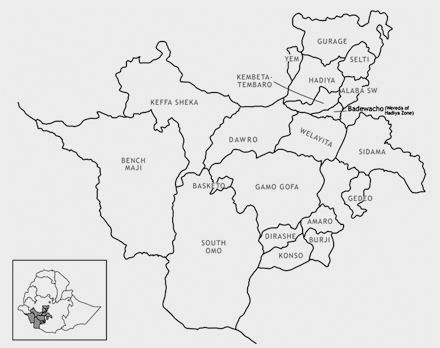
    <content:encoded xmlns:content="http://purl.org/rss/1.0/modules/content/"><![CDATA[<p style="text-align: justify; ">Since the violent overthrow of the government of Mengistu Haile Mariam (known as ‘the Derg’) in 1991, Ethiopia has been governed by the Ethiopian Peoples’ Revolutionary Democratic Front (EPRDF), led by Hailemariam Desalegn, the present Prime Minister. In 1995 the EPRDF introduced a new federal constitution, based on the principle of regional autonomy for sub-national ethno-linguistic groups. The country was divided into nine ‘regional states’. In principle, each major sub-national group was to be dominant in one, and only one, regional state, and each regional state was to be named after its dominant group. In practice, only five regional states could be formed on this principle – Tigray, Amhara, Afar, Somali and Oromiya. In the south west of the country, where there was no obvious ‘dominant group’ around which to form a regional state, a large number of smaller groups, including the Mursi, were formed into the ‘Southern Nations, Nationalities and Peoples’ Regional State’ (SNNPRS), with Awassa as its capital. Regional states are divided into zones and zones into <em>weredas</em>, or districts. Mursiland lies in the Sala Mago Wereda of South Omo Zone.</p>
<p style="text-align: justify; "><a title="Larger map of zones of the Southern Regional State" class="internal-link" href="http://www.mursi.org/images/snnprs-zones.gif"><img title="Zones of the Southern Regional State" class="image-right" alt="Zones of the Southern Regional State" src="http://www.mursi.org/images/snnprs-zones.gif" /></a></p>
<p class="image-right-caption" style="text-align: justify; ">Zones of the Southern Regional State. <a title="Zones of the Southern Regional State" class="internal-link" href="http://www.mursi.org/images/snnprs-zones.gif">Map 6</a></p>
<p style="text-align: justify; ">The capital of South Omo is Jinka, a town of around 20,000 inhabitants, 750 km from Addis and 520 km from the regional capital, Awassa. It has a hospital, a high school, two junior secondary schools, a prison and four main hotels.  The main economic activity in the town is trading, mainly in coffee, hides and skins, spices, and livestock. There is a twice weekly market (Tuesday and Saturday).</p>
<p style="text-align: justify; ">The population of Sala Mago wereda is made up of three ethnic groups, Mursi and Bodi in the Omo lowlands to the south and Dime in the northeastern highlands. In addition, approximately 7000 agriculturalists from Konso Special Wereda, in the far west of the Region, have been moved into Sala Mago since 2004 under the government’s resettlement programme. They occupy six resettlement villages between Hana, the wereda capital (in Bodi territory), and the Dime market town of Utsa. Until recently, the poor and undeveloped road system in the wereda has been partly responsible for the restricted access the Sala Mago population has had to government services, amounting to less than any other wereda in the Zone. This applies particularly to the Mursi, for whom it is a one or two day walk to reach Hana.  However, since</p>]]></content:encoded>
    <dc:publisher>No publisher</dc:publisher>
    <dc:creator>admin</dc:creator>
    <dc:rights></dc:rights>
    <dc:date>2012-06-10T23:40:00Z</dc:date>
    <dc:type>Page</dc:type>
  </item>


  <item rdf:about="http://www.mursi.org/home-page">
    <title>Welcome to Mursi Online</title>
    <link>http://www.mursi.org/home-page</link>
    <description></description>
    <content:encoded xmlns:content="http://purl.org/rss/1.0/modules/content/"><![CDATA[<p style="text-align: justify; "><span>The Mursi live in the <a href="https://www.mursi.org/documents-and-texts/maps/index_html"><span>lower valley of the River Omo </span></a>in southwestern Ethiopia and number around 10,000. This website was launched in 2007 in hopes of correcting the exoticised view of the Mursi found in guide books and travel articles. It was to do this by providing accurate and reliable information about Mursi history, culture and environment and about the pressures they and their <a href="https://www.mursi.org/neighbours/index_html"><span>neighbours</span></a> are under today. In the past decade, however, the Mursi have faced a number of  new challenges, and the website’s goals have shifted along with them. In addition to providing additional context, the site now serves as a source of information on the challenges they and their neighbours face. </span></p>
<p style="text-align: justify; "><span>The challenges stem in the first instance from the construction of the </span><a class="external-link" href="https://www.mursi.org/change-and-development/the-gibe-iii-dam"><span>Gibe III dam</span></a><span> (completed in 2016). The upstream dam has profoundly altered the flow of the River Omo, eliminating the annual flood on which the Mursi depended: the Omo flood provided water and nutrients for river-bank farming, which constituted the main source of staple grains. These problems are compounded by the Ethiopian government's plans to devote large parts of the lower Omo to commercial <a href="https://www.mursi.org/change-and-development/large-scale-irrigation/large-scale-irrigation"><span>irrigation development</span></a>.  If these plans are realised, the resident population of agro-pastoralists will be transformed into wage labourers and sedentary cultivators. </span></p>
<p style="text-align: justify; "><span>In some ways the challenges presented by the dams and plantation schemes resemble those the Mursi have faced in the past. During the twentieth century, the Ethiopian state extended its reach over the region; large areas were designated as <a href="https://www.mursi.org/change-and-development/national-parks/index_html"><span>national parks</span></a> as part of efforts to make the area attractive as a <span><a href="https://www.mursi.org/change-and-development/tourism/index_html">tourist</a> </span>destination; periodic conflicts between the lowland agro-pastoralist groups and their highland neighbours led to state intervention and arbitration. </span></p>
<p style="text-align: justify; "><span>In other ways, the current situation is more critical than anything they have faced before. The<span> mega-projects have jeopardised access to the vital resources on which they depend; </span>‘getting out of the way’ (moving to a more favourable location) is no longer an option; and the state has not provided compensation or restitution for the resources it has claimed. For this reason, the Mursi have by necessity earned a place in the global movement for social and </span><span><a class="external-link" href="https://ejatlas.org/conflict/lower-omo-valley-irrigated-agriculture-development-ethiopia">environmental justice</a></span><span>.</span></p>
<p style="text-align: justify; "><span>Mursi Online was established by David Turton, an anthropologist whose relationship with the Mursi began in 1968, and who devoted his career to the study of Mursi language, politics, and history. In 2020, the hosting of the site passed to Durham University. In its new incarnation,  the site will see expanded coverage of neighbouring groups, whose ethos, and whose struggles, much resemble those of the Mursi.  The site will continue, we hope, to serve as a point of reference for anyone interested in this part of the world and its people.</span></p>
<p style="text-align: justify; "><span>Jed Stevenson<br /> Editor, Mursi Online</span></p>]]></content:encoded>
    <dc:publisher>No publisher</dc:publisher>
    <dc:creator>admin</dc:creator>
    <dc:rights></dc:rights>
    <dc:date>2012-06-10T23:40:00Z</dc:date>
    <dc:type>Page</dc:type>
  </item>


  <item rdf:about="http://www.mursi.org/who-are-the-mursi/making-a-living/index_html">
    <title>Making a living</title>
    <link>http://www.mursi.org/who-are-the-mursi/making-a-living/index_html</link>
    <description></description>
    <content:encoded xmlns:content="http://purl.org/rss/1.0/modules/content/"><![CDATA[<img title="Thatching a grain store" class="image-right" alt="Thatching a grain store" src="http://www.mursi.org/images/thatching-grain-store.jpg" />
<p class="image-right-portrait-caption">Thatching the roof of a grain store. (Ben Dome, 2004)<br /></p>
<p>The Mursi practice hoe-cultivation and cattle herding. Cultivation accounts for well over half their diet while cattle, apart from being an important source of milk (especially for children) and meat, are a vital standby at times of crop failure, when they can be exchanged for grain in the highlands. The main crop is sorghum, of which they possess many drought-resistant varieties, but they also grow maize, beans and chick-peas. Because of their relatively low cattle numbers, the low and unpredictable local rainfall and the wide annual fluctuation in the level of the Omo and Mago floods, they must integrate all three of these activities by means of a complex cycle of seasonal movements.</p>
<p>There are two harvests each year, one along the banks of the two permanent rivers, Omo and Mago, where fertile silt is deposited by the annual flood, and one in forested areas further back from the rivers which are cleared for rain-fed, shifting cultivation. Planting takes place at the Omo and Mago in October and November, after the flood has receded and the banks have been cleared of vegetation that had grown up since the previous season. The harvest comes in January and February. River-bank land is the most valuable agricultural resource the Mursi possess. Areas liable to flood lie on both banks of the rivers, depending on the curvature of the meanders. Between October and February, when the bulk of the population is at the Omo, the cattle are kept in the wooded grasslands which rise towards the <a href="http://www.mursi.org/images/map-01.gif/image_view_fullscreen" title="Mursiland - topography and drainage">Omo-Mago watershed</a>.  The Elma valley is particularly important at this time, because it is relatively free from tsetse flies and water can usually be found at various points, even at the height of the dry season. The rain-fed crop is planted as soon as the main rains have begun, during March and April, and harvested in June or July.  The onset, duration and geographical distribution of the rains varies greatly from one year to the next. It is this unpredictability, coupled with the limited area available for flood retreat cultivation, that makes cattle a vital resource for the Mursi. Apart from providing an important source of protein, in the form of milk, blood and meat, cattle and small stock can also be exchanged for grain in the nearby highlands during times of local crop failure and may thus provide a last defence against starvation for many families.</p>
<p>Mursi attribute overwhelming cultural importance to cattle. Virtually every significant social relationship – most notably marriage - is marked and validated by the exchange of cattle. Bridewealth (ideally consisting of 38 head of cattle) is handed over by the groom’s family to the bride’s father, who has to meet the demands of a wide range of relatives, from different clans. This ensures that cattle are continually redistributed around the community, thus helping to provide for the long term economic security of individuals and families.</p>
<h3>More information</h3>
<p>David Turton, ‘<a href="http://www.mursi.org/pdf/african-affairs.pdf/view" title="Mursi Response to Drought: Some Lessons for Relief and Rehabilitation">Mursi Response to Drought: Some Lessons for Relief and Rehabilitation</a>’.<em> African Affairs</em> 84,1985, pp. 331-46</p>
<p>David Turton,<b> </b><em><a title="Google Books: Pastoral Livelihoods in Danger" href="http://books.google.com/books?id=0rRSAAAACAAJ">Pastoral Livelihoods in Danger: Cattle Disease, Drought and Wildlife Conservation in Mursiland</a>, Southwestern Ethiopia</em><b>.</b> Oxfam Research Papers No. 12, Oxfam (UK and Ireland), 1995.</p>
]]></content:encoded>
    <dc:publisher>No publisher</dc:publisher>
    <dc:creator>admin</dc:creator>
    <dc:rights></dc:rights>
    <dc:date>2012-06-10T23:38:45Z</dc:date>
    <dc:type>Page</dc:type>
  </item>


  <item rdf:about="http://www.mursi.org/who-are-the-mursi/history/index_html">
    <title>History</title>
    <link>http://www.mursi.org/who-are-the-mursi/history/index_html</link>
    <description></description>
    <content:encoded xmlns:content="http://purl.org/rss/1.0/modules/content/"><![CDATA[
<p>The Mursi and their neighbours became part of the Ethiopian state in the last years of the nineteenth century, when the Emperor Menelik II established his control over the southwestern lowlands bordering Kenya and Sudan. This was an area inhabited by several small groups, with fluid identities, highly adaptable to environmental conditions and capable of absorbing outsiders easily. The Mursi as we know them today are the product of a large scale migratory movement of cattle herding peoples in the general direction of the Ethiopian highlands. Three separate movements may be distinguished in the recent history of the Mursi, each the result of growing environmental pressure associated with the drying out of the Omo basin over the last 150-200 years.</p>
<p>First there was a move across the Omo, from the west, into what is now southern Mursiland, in the vicinity of Kurum (<a href="http://www.mursi.org/images/map-01.gif/image_view_fullscreen" title="Mursiland - topography and drainage">Map 1</a>). This move took place around the mid-nineteenth century and is seen by the Mursi as a key historical event in the construction of their current political identity.</p>
<p>Next there was a move northwards, into better watered territory, further upstream, which took place in the 1920s and 1930s. The effective northern boundary of Mursi territory was now the River Mara. (<a href="http://www.mursi.org/images/map-01.gif/image_view_fullscreen" title="Mursiland - topography and drainage">Map 1</a>)</p>
<p>The third move began in 1981/82 and took the migrants still further into the upland plains of the lower Omo and into close and regular contact with their highland neighbours, the plough-cultivating Aari. Settlements were established in the upper Mago Valley (<a href="http://www.mursi.org/images/map-01.gif/image_view_fullscreen" title="Mursiland - topography and drainage">Map 1</a>), which had last been occupied by the Mela (Bodi) in the early years of the last century.</p>
<p>Each of these moves was made, initially, by a small group of families who travelled a relatively short distance to a new place on the frontier of the settled area. As the pioneers established themselves, they were followed, over succeeding years, by a drift of individuals and families. Each move was explained by the migrants as a response to environmental pressure and as part of a continuing effort to find and occupy a cool (<em>lalini</em>) land (<em>ba</em>) or place, a place with riverside forest for cultivation and well watered grassland for cattle herding.</p>
<h3>More information</h3>
<p>David Turton, ‘<a href="http://www.mursi.org/pdf/cool-place.pdf/view" title="Looking for a cool place: the Mursi, 1890s-1980s">Looking for a Cool Place: The Mursi, 1890s - 1990s</a>’, in D. Anderson and D. Johnson (eds.) <em>The Ecology of Survival: Case Studies from Northeast African History.</em> Lester Crook Academic Publishing/Westview Press, London/Boulder, 1988, pp. 261-82.<br /></p>
<p>David Turton, ‘<a href="http://www.mursi.org/pdf/exploration-in-the-lower-omo-valley.pdf/view" title="Exploration in The Lower Omo Valley of Southwestern Ethiopia Between 1890 and 1910">Exploration in the Lower Omo Valley of Southwestern Ethiopia</a>’, in M. Caravaglios (ed.) <em>L'Africa ai tempi di Daniele Comboni.</em><b> </b>Instituto Italo-Africano, Rome, 1981.</p>
<h3>Documentary films</h3>
<p>Some of the events of recent Mursi history have been recorded in six <a href="http://www.mursi.org/film-and-video/television-documentaries/index_html" title="Television documentaries">television documentaries</a> directed by Leslie Woodhead between 1974 and 2001.</p>
]]></content:encoded>
    <dc:publisher>No publisher</dc:publisher>
    <dc:creator>admin</dc:creator>
    <dc:rights></dc:rights>
    <dc:date>2012-06-10T23:38:45Z</dc:date>
    <dc:type>Page</dc:type>
  </item>


  <item rdf:about="http://www.mursi.org/news-items/huge-irrigation-scheme-planned-for-the-lower-omo-valley">
    <title>Huge irrigation scheme planned for the Lower Omo Valley</title>
    <link>http://www.mursi.org/news-items/huge-irrigation-scheme-planned-for-the-lower-omo-valley</link>
    <description>Speaking in Jinka, capital of South Omo Zone, on 25 January 2011, Prime Minister Meles Zenawi announced plans to convert 150,000 ha. of the Lower Omo Valley into irrigated sugar cane plantations.</description>
    <content:encoded xmlns:content="http://purl.org/rss/1.0/modules/content/"><![CDATA[<p> </p>
<p><span>This will be made possible by the completion of the <a class="external-link" href="https://web.archive.org/web/20130201123131/http://www.gibe3.com.et/">Gibe III hydroelectric dam</a>, which is expected to begin operations<span> </span>in September 2013 and which will eliminate the annual flood. The reservoir is due to start filling in June 2012.</span></p>
<p style="text-align: justify; "><span> </span></p>
<p style="text-align: justify; "><span>The announcement was made during the 13th Annual Pastoralists' Day Celebrations, organised by the Ministry of Federal Affairs, the Pastoral Affairs Standing Committee of the House of Peoples' Representatives, the Southern Regional Government and the Pastoralist Forum of Ethiopia. The motto chosen for the celebrations was 'We will bring Ethiopia's renaissance to an irreversable point by realising the Growth and Transformation Plan in pastoral areas'.</span></p>
<p style="text-align: justify; "><span> </span></p>
<p style="text-align: justify; "><span><span><span><a href="http://www.survivalinternational.org/news/7194">Human rights organisations </a>have expressed concerns that the Gibe 3 dam could have a devastating impact on the livelihoods of over half a million people, in both Ethiopia and Kenya, who depend on the Omo flood and on Lake Turkana for cultivation, pastoralism and fishing. It has also been predicted that the level of the Lake, which receives most of its water from the Omo, could be drastically reduced by large-scale irrigation schemes in the lower valley.</span></span></span></p>
<p style="text-align: justify; "><span><span><span>I</span></span></span><span><span><span>n his speech, the Prime Minister dismissed such concerns, saying they came from ‘the friends of poverty and backwardness’ who wanted to keep pastoralists as ‘a case study of ancient living’ for the benefit of tourists, scientists and researchers.</span> </span></span></p>
<p style="text-align: justify; "><span> </span></p>
<p style="text-align: justify; "> </p>
<p style="text-align: justify; "><span> </span></p>
<p style="text-align: justify; "><span><strong> </strong></span></p>
<p style="text-align: justify; "><span><strong>More information</strong></span></p>
<p style="text-align: justify; "><span><span> </span></span></p>
<p style="text-align: justify; "><span><span> </span></span><a title="The speech in English" href="http://www.mursi.org/pdf/Meles%20Jinka%20speech.pdf">The Prime Minister's speech in English</a></p>
<p><a title="The downstream impact" href="http://www.mursi.org/pdf/RAS%20Talk%20-%20Copy.pdf">The downstream impact</a> (David Turton)</p>
<p><a title="The impact on Lake Turkana" href="http://www.mursi.org/pdf/Avery%20final%20report.pdf">The impact on Lake Turkana</a> (Sean Avery)</p>
<p><a title="USAID Ethiopia trip report" href="http://www.mursi.org/pdf/USAID%20Jan%202009.pdf">USAID Ethiopia trip report</a> (Leslie Johnston)</p>
<p><a title="USAID Northern Kenya trip report" href="http://www.mursi.org/pdf/USAID%20July%202010.pdf">USAID Kenya trip report</a> (Leslie Johnston)</p>]]></content:encoded>
    <dc:publisher>No publisher</dc:publisher>
    <dc:creator>David</dc:creator>
    <dc:rights></dc:rights>
    <dc:date>2011-04-21T13:55:00Z</dc:date>
    <dc:type>News Item</dc:type>
  </item>


  <item rdf:about="http://www.mursi.org/pdf/Rhetorics%20of%20local%20knowledge.pdf">
    <title>Rhetoric’s of local knowledge </title>
    <link>http://www.mursi.org/pdf/Rhetorics%20of%20local%20knowledge.pdf</link>
    <description>Ivo Strecker, Rhetoric’s of local knowledge, in Ethnographic Chiasmus: Essays on Culture, Conflict and Rhetoric. Lit Verlag, pp. pp. 289-314 (2010)
</description>
    
    <dc:publisher>No publisher</dc:publisher>
    <dc:creator>admin</dc:creator>
    <dc:rights></dc:rights>
    <dc:date>2011-01-18T12:45:00Z</dc:date>
    <dc:type>File</dc:type>
  </item>


  <item rdf:about="http://www.mursi.org/pdf/Temptations%20of%20war%20and%20the%20struggle%20for%20peace.pdf">
    <title>Temptations of war and the struggle for peace </title>
    <link>http://www.mursi.org/pdf/Temptations%20of%20war%20and%20the%20struggle%20for%20peace.pdf</link>
    <description>Ivo Strecker, Temptations of war and the struggle for peace, in Ethnographic Chiasmus: Essays on Culture, Conflict and Rhetoric. Lit Verlag, pp. pp.181-227 (2010)
</description>
    
    <dc:publisher>No publisher</dc:publisher>
    <dc:creator>admin</dc:creator>
    <dc:rights></dc:rights>
    <dc:date>2011-01-18T12:45:00Z</dc:date>
    <dc:type>File</dc:type>
  </item>


  <item rdf:about="http://www.mursi.org/pdf/copy_of_lip-plates.pdf">
    <title>‘Face’ and the person </title>
    <link>http://www.mursi.org/pdf/copy_of_lip-plates.pdf</link>
    <description>Ivo Strecker, ‘Face’ and the person, in Ethnographic Chiasmus: Essays on Culture, Conflict and Rhetoric. Lit Verlag, pp. 45-69 (2010)</description>
    
    <dc:publisher>No publisher</dc:publisher>
    <dc:creator>admin</dc:creator>
    <dc:rights></dc:rights>
    <dc:date>2011-01-18T12:45:00Z</dc:date>
    <dc:type>File</dc:type>
  </item>


  <item rdf:about="http://www.mursi.org/pdf/lip-plates.pdf">
    <title>The people who take photographs</title>
    <link>http://www.mursi.org/pdf/lip-plates.pdf</link>
    <description>' Lip-plates and the people who take photographs: uneasy encounters between Mursi and tourists in southern Ethiopia' by David Turton, Anthropology Today, 20: 2, April 2004.</description>
    
    <dc:publisher>No publisher</dc:publisher>
    <dc:creator>admin</dc:creator>
    <dc:rights></dc:rights>
    <dc:date>2011-01-18T12:45:59Z</dc:date>
    <dc:type>File</dc:type>
  </item>


</rdf:RDF>