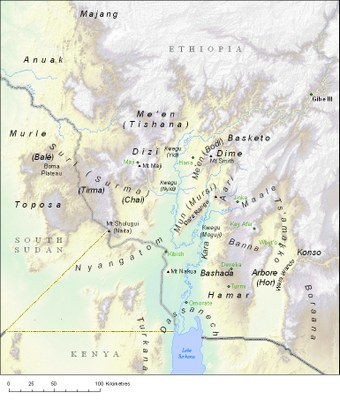
<?xml version="1.0" encoding="utf-8" ?>
<rdf:RDF xmlns:rdf="http://www.w3.org/1999/02/22-rdf-syntax-ns#" xmlns:dc="http://purl.org/dc/elements/1.1/" xmlns:syn="http://purl.org/rss/1.0/modules/syndication/" xmlns="http://purl.org/rss/1.0/">


<channel rdf:about="http://www.mursi.org/search_rss">
  <title>Mursi Online</title>
  <link>http://www.mursi.org</link>

  <description>
    
            These are the search results for the query, showing results 1 to 15.
        
  </description>


  <image rdf:resource="http://www.mursi.org/logo.png"/>

  <items>
    <rdf:Seq>
      
        <rdf:li rdf:resource="http://www.mursi.org/news-items/david-turton-1940-2023"/>
      
      
        <rdf:li rdf:resource="http://www.mursi.org/new-publication-lands-of-the-future"/>
      
      
        <rdf:li rdf:resource="http://www.mursi.org/documents-and-texts/published-articles/david-turton/aiding-and-abetting"/>
      
      
        <rdf:li rdf:resource="http://www.mursi.org/neighbours/kara"/>
      
      
        <rdf:li rdf:resource="http://www.mursi.org/neighbours/suri-chai"/>
      
      
        <rdf:li rdf:resource="http://www.mursi.org/neighbours/hamar"/>
      
      
        <rdf:li rdf:resource="http://www.mursi.org/neighbours/daasanach"/>
      
      
        <rdf:li rdf:resource="http://www.mursi.org/neighbours/neighbours"/>
      
      
        <rdf:li rdf:resource="http://www.mursi.org/neighbours/bodi-meen"/>
      
      
        <rdf:li rdf:resource="http://www.mursi.org/news-items/nobel-peace-prize-awarded-to-ethiopian-pm"/>
      
      
        <rdf:li rdf:resource="http://www.mursi.org/news-items/forced-disarmament-in-the-lower-omo-valley"/>
      
      
        <rdf:li rdf:resource="http://www.mursi.org/news-items/remembering-kirinomeri"/>
      
      
        <rdf:li rdf:resource="http://www.mursi.org/news-items/forthcoming-article-on-the-impacts-of-dislacement-and-resettlement-in-the-lower-omo-valley"/>
      
      
        <rdf:li rdf:resource="http://www.mursi.org/change-and-development/press-coverage"/>
      
      
        <rdf:li rdf:resource="http://www.mursi.org/news-items/donor-balancing-act-on-human-rights-in-the-lower-omo-valley"/>
      
    </rdf:Seq>
  </items>

</channel>


  <item rdf:about="http://www.mursi.org/news-items/david-turton-1940-2023">
    <title>David Turton (1940-2023) </title>
    <link>http://www.mursi.org/news-items/david-turton-1940-2023</link>
    <description>Obituary by Jed Stevenson</description>
    <content:encoded xmlns:content="http://purl.org/rss/1.0/modules/content/"><![CDATA[<h3>It is with great sadness that we note the death of David Turton, founder of this website. The following tribute has just been published in <i>Anthropology Today</i>.</h3>
<p>One of the first anthropologists to work in lowland Ethiopia, David Turton drew attention to peoples on the periphery and the effects on them of state and capitalist projects – notably wildlife conservation and the building of large dams. He engaged in public anthropology, feeling a duty to serve as an advocate for people whom he knew first as research participants but whom he later became friends with and whom he viewed as kindred spirits. Just four months before he died, at the age of 83, he travelled back to Ethiopia to renew friendships with people he had known for more than fifty years.</p>
<p>David was born in London in 1940. His father was a shipping agent at the London Docks and his mother a school secretary. At 18, not having the necessary O-Levels to attend university, he undertook preparatory work at a Catholic seminary. He was selected to attend the English College in Rome, where he spent three years completing his Lic. Phil. <em>cum laude</em> at the Pontifical Gregorian University. Unsure of his calling, he returned to England in 1963 having secured a rare agreement to be readmitted should he have a change of heart. He completed his missing O-Levels and went to the London School of Economics in 1964 to do a BSc in sociology, where he met his future wife, Pat. They were assigned as tutor partners for the optional course they both chose in social anthropology.</p>
<p>David went on to complete a PhD in social anthropology at the LSE under the supervision of James Woodburn, a specialist on African hunter-gatherers. Interested in going to Ethiopia, David read the work of the 19<sup>th</sup> century explorer Vittorio Bottego and was struck by a description of hunter-gatherers living on the banks of the River Omo. They were the Kwegu, and they lived in close relation to a larger group, the Mursi. In the dry season of 1968, he negotiated with the Mursi to pitch his tent beside the Omo, where they were cultivating sorghum. He stayed by the Omo, slowly learning their language, until the time came for the Mursi to leave for their cattle camps. By this time, he had learned enough of the language and gained sufficient trust to be allowed to join them on the journey to the cattle camps.</p>
<p>Living and traveling with the Mursi helped David see that their way of life was threefold, involving flood-retreat cultivation along the Omo and Mago rivers, cattle herding, and shifting rain-fed cultivation. None of these strategies on its own was sufficient but in combination they provided a livelihood. The Mursi likened these activities to the three hearth-stones that support their cooking pots, all three being vital for their well-being. David’s recognition of these patterns – as described in his 1973 <a href="https://www.mursi.org/documents-and-texts/theses/turton-david/view">doctoral thesis</a> – led to a deeper appreciation of a culture that most outsiders had hitherto misunderstood and stereotyped as purely pastoralist.</p>
<p>David took up a lectureship at Manchester University in 1971, and continued to carry out fieldwork among the Mursi, initially focusing on <a href="https://www.mursi.org/introducing-the-mursi/leadership/orators-jalaba">political oratory</a>. The Mursi used public debates to reach collective decisions, particularly at times of crisis. Perennial concerns included conflict with neighbouring groups and territorial encroachment by wildlife reserves. As well as the Omo National Park, the Mursi were significantly affected by the establishment of the Mago National Park in 1978, which incorporated the majority of Mursiland. These tensions formed the backdrop to six <a href="https://www.mursi.org/audiovisual/film-and-video-clips/television-documentaries">ethnographic films</a> that David made with director Leslie Woodhead between 1974 and 2001. In 1987, inspired by his friend and former student Dan Marks, David established the <a href="https://granadacentre.co.uk/">Granada Centre for Visual Anthropology</a> at the University of Manchester.</p>
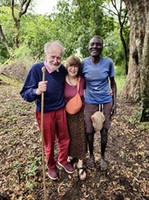
<div class="newsImageContainer"><a href="https://www.mursi.org/images/david-and-pat-turton-with-ulikoro-komoru-in-2023/image/image_view_fullscreen" id="parent-fieldname-image"> <img alt="David and Pat Turton with Ulikoro Komoru in 2023." class="newsImage" height="267" src="https://www.mursi.org/images/david-and-pat-turton-with-ulikoro-komoru-in-2023/image_mini" title="David and Pat Turton with Ulikoro Komoru in 2023." width="200" /> </a>
<p class="discreet"><span class=" kssattr-atfieldname-imageCaption kssattr-templateId-widgets/string kssattr-macro-string-field-view" id="parent-fieldname-imageCaption-18fcdf80-41a5-486b-93e6-2415626390c1"> David and Pat Turton with Ulikoro Komoru in 2023. </span></p>
</div>
<p>Although he strongly identified as an anthropologist, David did not define himself by his job. He was grateful that he had the opportunity to be do what he loved and believed to be meaningful, and to be led by his curiosity. It was in this spirit that he took early retirement from Manchester University in 1990 to have more time to pursue his fieldwork and other interests. He often joked that after his retirement he had “never been busier!”</p>
<p>Through the 1980s and 1990s David served on committees for Oxfam, the Windle Trust, and various professional associations; he also served as editor of the <em>Journal of the Royal Anthropological Institute</em> (1983-86) and the journal <em>Disasters</em> (1989-95). In 1996, he became director of the <a href="https://www.rsc.ox.ac.uk/">Refugee Studies Centre</a> at Oxford University, where he had a transformative impact – leading the expansion of its summer school and establishing its Master’s programme.</p>
<p>In the early 2000s David was galvanised into a new phase of activity as plans were announced for the building of the Gibe III dam on the Omo. He scoured reports of engineers and hydrologists to appraise the implications of the dam and associated sugar plantations for the peoples of the region. In an <a href="https://www.mursi.org/pdf/RAS%20Talk%20-%20Copy.pdf/">address at SOAS</a> in 2010, he skewered the studies carried out by the dam’s backers and laid out the consequences of disrupting the Omo’s annual flood for the 100,000 people living downstream. Of the three “hearth-stones” on which local people depended, the flood was the most important. If the project proceeded as planned, it would undermine the entire subsistence economy.</p>
<p>David was not opposed to the dam itself. Rather, his concern was that the costs and benefits of the project were <a href="https://riviste-clueb.online/index.php/anpub/article/view/127">unfairly distributed</a>. No compensation was offered to the Mursi and their neighbours, either for the loss of the flood or for lands seized for plantations. In contrast to the open debates practiced by the Mursi, the government announced its plan as a <em>fait accompli</em> with scant efforts made to consult “project-affected people”. The Mursi referred to the architects of the project as “people who keep their mouths shut”. Refusing to stay quiet himself, David penned op-eds and supported all those calling for justice. Given a choice between gentle backchannel pressure or shouting injustice from the rooftops, David was unequivocal: “I’m with the shouters”.</p>
<p>In practice, David rarely raised his voice. His words were always measured and imbued with sympathy for the marginalised. As a scholar and as a person he was unfailingly generous. David and Pat’s home served as a meeting-place for scholars and practitioners, and many formative conversations were held on their couch and around their dinner table. His legacies include the <a href="https://www.canr.msu.edu/oturn/">Omo-Turkana Research Network</a>, an international consortium of social and environmental scientists focused on the region, and <a href="https://www.mursi.org/">Mursi Online</a>, which continues to publicise the challenges faced by the peoples of the Lower Omo Valley.</p>
<p>He is survived by his wife Pat, son Danny, daughter-in-law Lisa, and two grandsons, Zed and Asa.</p>
<p><em>A version of this obituary was published in Anthropology Today, Vol 40, No 1 (February 2024)</em></p>]]></content:encoded>
    <dc:publisher>No publisher</dc:publisher>
    <dc:creator>admin</dc:creator>
    <dc:rights></dc:rights>
    <dc:date>2024-03-04T20:00:00Z</dc:date>
    <dc:type>News Item</dc:type>
  </item>


  <item rdf:about="http://www.mursi.org/new-publication-lands-of-the-future">
    <title>New publication: Lands of the Future </title>
    <link>http://www.mursi.org/new-publication-lands-of-the-future</link>
    <description>A new edited volume on pastoralism, land deals, and tropes of modernity in Eastern Africa</description>
    <content:encoded xmlns:content="http://purl.org/rss/1.0/modules/content/"><![CDATA[<p><i>Lands of the Future</i>, an edited volume on  challenges facing pastoralist communities in East Africa, considers the position of pastoralists at the intersection of competing projects of 'future-making' -- including projects of expropriation, large-scale land transfers, and hydropower projects.</p>
<p>"Rangeland, forests and riverine landscapes of pastoral communities in  Eastern Africa," the editors note, "are increasingly under threat. Abetted by states who  think that outsiders can better use the lands than the people who have  lived there for centuries, outside commercial interests have displaced  indigenous dwellers from pastoral territories. This volume presents case studies  from Eastern Africa, based on long-term field research, that vividly  illustrate the struggles and strategies of those who face dispossession  and also discredit ideological false modernist tropes like  ‘backwardness’ and ‘primitiveness’."</p>
<p>Five of the book's thirteen chapters focus on the Lower Omo, including Shauna LaTosky on Mun (Mursi) customary land use and FPIC, Lucie Buffavand on the Mela (Bodi) experience of 'the brunt of state power', Fana Gebresenbet on villagization in Ethiopia's lowlands, and Jed Stevenson &amp; Benedikt Kamski on hydropower and irrigation development in the Omo-Turkana basin. An overview chapter by David Turton, 'Breaking every rule in the book', tells the story of river basin development in the Lower Omo Valley.</p>
<p>Other chapters (notably those by Jonah Wedekind on "investment failure and land conflicts on the Oromia-Somali frontier," and by Maknun Ashami &amp; Jean Lydall on the Awash Valley) provide useful counterpoints to events in the region.</p>
<p>The book is available to order from the <a class="external-link" href="https://www.berghahnbooks.com/title/GabbertLands">Berghahn</a> <span class="external-link">website</span>, where Echi Gabbert's <a class="external-link" href="https://www.berghahnbooks.com/downloads/intros/GabbertLands_intro.pdf">introduction</a> -- "Future-making with pastoralists" is also available as a free download.</p>
<p>Until 28 February 2021, a 50% reduction on the price of the book is available with the code GAB907.</p>
<p><i>Lands of the future: Anthropological perspectives on pastoralism, land deals, and tropes of modernity in Eastern Africa</i>. Edited by Echi Christina Gabbert, Fana Gebresenbet, John G. Galaty, and Günther Schlee. Oxford: Berghahn (January, 2021)</p>]]></content:encoded>
    <dc:publisher>No publisher</dc:publisher>
    <dc:creator>Edward (Jed) Stevenson</dc:creator>
    <dc:rights></dc:rights>
    <dc:date>2021-02-07T16:56:09Z</dc:date>
    <dc:type>News Item</dc:type>
  </item>


  <item rdf:about="http://www.mursi.org/documents-and-texts/published-articles/david-turton/aiding-and-abetting">
    <title>Aiding and Abetting</title>
    <link>http://www.mursi.org/documents-and-texts/published-articles/david-turton/aiding-and-abetting</link>
    <description>'Aiding and Abetting: UK and US Complicity in Ethiopia's Mass Displacement', Think Africa Press (4 November 2013)</description>
    
    <dc:publisher>No publisher</dc:publisher>
    <dc:creator>admin</dc:creator>
    <dc:rights></dc:rights>
    <dc:date>2020-07-22T11:03:29Z</dc:date>
    <dc:type>Link</dc:type>
  </item>


  <item rdf:about="http://www.mursi.org/neighbours/kara">
    <title>Kara</title>
    <link>http://www.mursi.org/neighbours/kara</link>
    <description></description>
    <content:encoded xmlns:content="http://purl.org/rss/1.0/modules/content/"><![CDATA[<p style="text-align: justify; ">The Kara (often called 'Karo' by outsiders) are a population of about 1,500 people living on the east bank of the Omo River. In spite of their small numbers, they form an important element in the political and economic system of the Lower Omo. In the more distant past, the Kara were traders and middlemen, and occupied a key position in the web of trade routes that extended into today’s Kenya and South Sudan.</p>
<p style="text-align: justify; ">Today the Kara are clustered around three major villages - from North to South Labuk, Duss and Korcho - with some particularly important farming areas interspersed with smaller hamlets. In former times, the Kara were also settled on the west bank of the Omo and they still maintain a claim to these lands. However, over the last 20 years all permanent villages on the west bank have been abandoned, as this area has been encroached upon by the more numerous and better armed Nyangatom. Very few Kara have permanently out-migrated, but there are numerous Kara school children to be found in the nearby market towns, as well as young Kara men attending college much further away.</p>
<p style="text-align: justify; ">This otherwise stable population is ethnically heterogeneous. While the majority of members are categorized as (true) “Kara”, there are also people identified as Bogudo, Gomba, Nyangatom and Moguji, as well as some individual immigrants from as far away as Toposa. The “Kara”, therefore, are first and foremost a political group of diverse origins which attempts to maintain social cohesion along the fertile banks of the Omo. The very heterogeneity of this polity is downplayed in everyday affairs, to support the appearance of unity, but a number of ritual constraints influence the relations between the dominant “true Kara” and the progressively lower-ranked Bogudo, Gomba, and Moguji.</p>
<p style="text-align: justify; ">The Kara are segmented into patrilineal and exogamous clans, which act collectively during marriages and other rituals, or in the distribution of property. However, the household remains the central social unit. Genealogical memory is shallow, rarely extending beyond two generations. The age-set system is of decisive relevance in the day-to-day affairs of most men. While there are also age-sets for women, these have much less public relevance, as women are constrained in their associations with others beyond family or neighbourhood. A man’s main peers are his age-mates, and these very egalitarian and “horizontal” alliances are cherished and cultivated, at times even at the expense of kin relations. The Kara are acephalous, with self-appointed committees of elders guiding political discourse and decision-making, a process from which women are largely excluded.</p>
<p style="text-align: justify; ">Linguistically and culturally, the Kara can be considered part of the “Hamar-Banna-Bashada cluster”. The Hamar, Banna and Bashada communities are found further east, spreading up into the hills. These three closely-related neighbours are often called “the mountain people” by the Kara. Their languages  are mutually intelligible, although many Kara are multilingual. The fact that Kara can speak the Hamar language can obscure some very real differences between Kara and Hamar. The older Kara often understand and speak Nyangatom, and some also have good Dassanech or Mursi language skills. Amharic is generally understood by adults, but this ability is often denied or downplayed. Together with the Hamar and the Arbore, the Kara belong to the administrative distract called the <i>Hamar Woreda</i>.</p>
<p style="text-align: justify; ">Kara religious practice is also similar to Hamar-Banna-Bashada. It is low on cosmology beyond the acceptance of a creator and source of good fortune, <i>barriyo</i>, and focuses on rituals of cursing and blessing. Both sorcery and witchcraft are acknowledged and feared. The religious leaders of the Kara, the <i>bitti</i>, have the task of securing communal wellbeing and clearing up disturbances in the social and natural environment. Many of these religious practices can be found in very similar form throughout the region. Generally speaking, the main difference lies in the apparent adapting of Hamar-Banna-Bashada rituals to their very different ecology and forms of livelihood. For example, the extreme emphasis of the “mountain people” on cattle pastoralism is not matched in the river valley, as the Kara themselves have very few cattle, keeping mainly goats and sheep. Instead, ritual life is to a great extent aligned with the rise and fall of the Omo River, which governs the yearly cycle of subsistence activities and seasonal movements. The main crop is sorghum, which grows well on the river banks after the water level has subsided, and on the flood plains further inland which are inundated when there is a particularly good flood. Rain-fed agriculture is of distinctly secondary importance to the Kara.</p>
<p style="text-align: justify; ">Their ability to maintain their position in this ecologically extremely viable niche along the Omo, producing enough food within a six-months farming season to support the population for the rest of the year, is a pillar of the Kara’s identity and self-esteem. In defence of their territory, they have – over the last 30 years – regularly engaged in warfare with their western neighbours, the Nyangatom, who are encroaching on the river as they themselves are being pushed out of their pastoral grounds further west. The Kara pride themselves on their general resourcefulness and their ability to hold their own amongst larger populations, having been neither militarily defeated by the Nyangatom nor assimilated by the Hamar.</p>
<p style="text-align: justify; ">The ethnohistory of place and people is shallow, as there are particularly few records and no travellers’ reports predating the 1880s. The discursive practices of the Kara show little evidence of the trauma of conquest or the shock of contact. Instead, they tend to frame the past very much in terms of the present. This presentist orientation enables them to engage with current challenges and to “modernise” on their own terms. Exemplary are their great success in dealing with tourists, the younger generation’s commitment to education,  among both young men and women, and the Kara’s attempt to gracefully abolish the practice of infanticide in their own way in recent years, after over 100 years of admonition from the Ethiopian state and other actors.</p>
<p style="text-align: justify; ">The more recent creation of industrial plantations in the Kara’s traditional grazing areas, as well as an increase in protestant missionary activity, makes it difficult to assess what the future holds for the Kara. Meanwhile the Gibe III dam, due to be finished within the next few years, poses  a severe threat to Kara livelihoods and thus threatens their very identity. Its completion will permanently change the hydrology of the Omo and the capacity of even the Kara to deal constructively with such an apocalyptic transformation is questionable. We can only say that their future is uncertain.</p>
<p class="MsoNormalCxSpFirst" style="text-align:justify; ">FELIX GIRKE,<strong> </strong><i><span class="SubtleEmphasis"><span>Zentrum für Interdisziplinäre Regionalstudien (ZIRS), Martin-Luther-Universität Halle-Wittenberg</span></span></i></p>
<h3 style="text-align: justify; "></h3>
<p> </p>
<h3 style="text-align: justify; ">More information</h3>
<p style="text-align: justify; ">Felix Girke, '<a class="internal-link" href="http://www.mursi.org/documents-and-texts/published-articles/Girke%2C%20Felix/place-making-in-the-lower-omo">Homeland, boundary, resource: the collision of place-making projects on the Lower Omo River, Ethiopia</a>', <span class="Italic"><i>Working papers / Max-Planck-Institute for Social Anthropology,</i></span> 2013, <span class="Italic"><i>148,</i> pp. 1-24.</span></p>
<p style="text-align: justify; "><span> </span>Felix Girke, 'Plato on the Omo: reflections on decision-making among the Kara of southern Ethiopia'. <i>Journal of Eastern African Studies</i>, 2011, 5<strong>,</strong> pp. 177-194.</p>
<p style="text-align: justify; ">Felix Girke, '<span><a class="internal-link" href="http://www.mursi.org/documents-and-texts/published-articles/Girke%2C%20Felix/kara-bondfriendship">Bondfriendship in the cultural neighborhood. Dyadic ties and their public appreciation in South Omo</a></span>', in Echi Gabbert and Sophia Thubauville (eds.) <i>To Live with Others: </i><i>Essays on Cultural Neighborhood in Southern Ethiopia, </i>Köln: Köppe, 2010, pp. 68-98.</p>
<p style="text-align: justify; ">Felix Girke, '<a class="internal-link" href="http://www.mursi.org/documents-and-texts/published-articles/Girke%2C%20Felix/the-kara-nyangatom-war">The Kara-Nyangatom War of 2006-07: dynamics of escalating violence in the tribal zone</a>', in <span style="text-align: justify; ">Eva-Maria</span> Bruchhaus and Monika Sommer (eds.) <i>Hot Spot Revisited: Trials to Make Sense of Conflict</i>. Münster: Lit, 2008, <span>pp. 192-207.</span></p>]]></content:encoded>
    <dc:publisher>No publisher</dc:publisher>
    <dc:creator>admin</dc:creator>
    <dc:rights></dc:rights>
    <dc:date>2020-07-22T07:55:00Z</dc:date>
    <dc:type>Page</dc:type>
  </item>


  <item rdf:about="http://www.mursi.org/neighbours/suri-chai">
    <title>Suri (Chai)</title>
    <link>http://www.mursi.org/neighbours/suri-chai</link>
    <description></description>
    <content:encoded xmlns:content="http://purl.org/rss/1.0/modules/content/"><![CDATA[<p><dl class="image-right captioned" style="width:200px;">
<dt><a rel="lightbox" href="/audiovisual/image-gallery/neighbours/Suri%20%28Chai%29/daasanach-night-guard-house-in-commercial-farm"><img src="http://www.mursi.org/audiovisual/image-gallery/neighbours/Suri%20%28Chai%29/daasanach-night-guard-house-in-commercial-farm/@@images/b48b3008-72b4-43aa-89cd-8267246bcf89.jpeg" alt="Women and children watching an argument between men" title="Women and children watching an argument between men" height="132" width="200" /></a></dt>
 <dd class="image-caption" style="width:200px;">Women and children watching an argument between men</dd>
</dl></p>
<p style="text-align: justify; ">To the west of the Mursi, across the Omo River, live two groups of agro-pastoralists called Tirmaga and Chai, who are together called ‘Suri’. This is their self-name in the context of ethnic relations in Southwest Ethiopia and South Sudan. A third group, speaking a somewhat different language, are the Baale (or ‘Balesi’, or ‘Kachipo’), who also live partly in the Republic of South Sudan and move regularly across the border, following interests dictated by trade, intermarriage, or the occasional search for better pastures in the dry season.</p>
<p style="text-align: justify; ">There are some 34,000 Suri in the Southwest of Ethiopia. The two Suri groups have a somewhat different internal composition and descent system, with the Tirmaga tracing more links with the highland Dizi (called ‘Su’), and the Chai, the larger group, having more of a Sudan connection and also being much closer to the Mursi with whom they intermarry and share agricultural areas near the Omo. The Kibish River runs across Suri territory from north to south, ending in Nyangatom territory, towards Lake Turkana.</p>
<p style="text-align: justify; ">The Suri area was conquered by imperial Ethiopian troops in 1897. The region was then formally incorporated into Ethiopia, and was the frequent target of cattle raids by highlanders and imperial troops based in the newly established villages (<i>katama</i>s).</p>
<p style="text-align: justify; ">The social and cultural similarity of Suri with the Mursi and to a lesser extent with the Didinga and Larim in South Sudan is notable, and can be recognized in a similar kinship organization, in birth, marriage and funeral customs, in a patrilineal clan structure and in age grades and initiation rites for age-sets. All Suri groups together with the Mursi have a similar age-set structure, and initiations into a new set ideally occur every 20 years in a series from west to east, i.e., first the Baale and last the Mursi. This sequence was, however, disturbed in 1991, a time of upheaval.</p>
<p><dl class="image-right captioned" style="width:169px;">
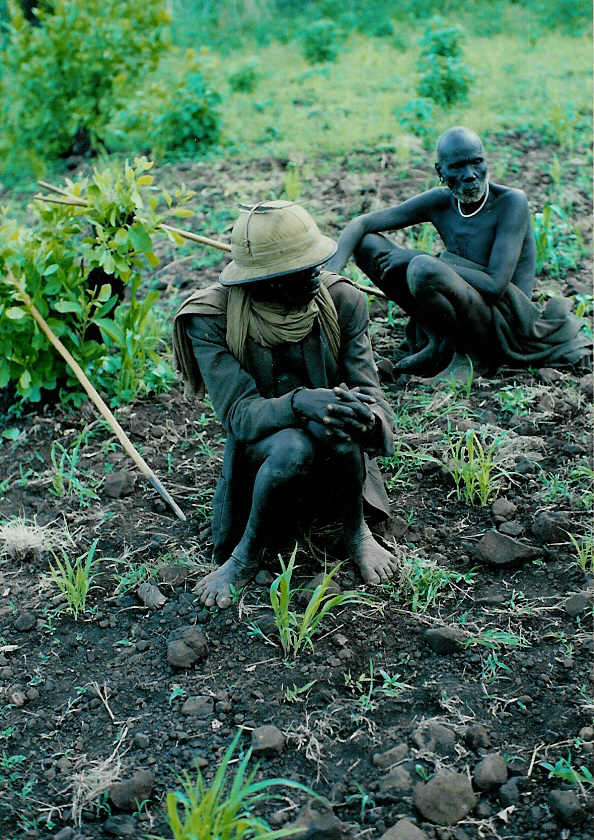
<dt><a rel="lightbox" href="/audiovisual/image-gallery/neighbours/Suri%20%28Chai%29/Harvest%20Time%20in%20Floodplain.JPG"><img src="http://www.mursi.org/audiovisual/image-gallery/neighbours/Suri%20%28Chai%29/Harvest%20Time%20in%20Floodplain.JPG/@@images/5759795d-d7e1-4adb-8f7a-695863d91fa6.jpeg" alt="Famous Suri Priest (Komoru Bolegid'angi)" title="Famous Suri Priest (Komoru Bolegid'angi)" height="240" width="169" /></a></dt>
 <dd class="image-caption" style="width:169px;">The late Bolegid'angi was a Tirmaga komoru in the 1990s.</dd>
</dl></p>
<p style="text-align: justify; ">Their society, while now more integrated into national Ethiopian structures of administration and more under the control of the state, previously had a fairly autonomous political structure, headed by the elders of the reigning age-grade as well as a few ritual chiefs or ‘priests’, called<i> komoru</i>, as among the Mursi.</p>
<p style="text-align: justify; ">The Suri have a traditional belief system with a supreme sky deity called <i>Tumu</i>. The <i>komoru </i>is a mediator between humans and Tumu, acting as a contact point with the sky god that brings rain and fertility. But Suri have no public religious services of any kind dedictaed to Tumu. Ancestors of clan-lines are also recognized as having powers and as influencing the health and destiny of living people. In the past 15 years, Evangelical Christianity has gained adherents among the Suri (some 200-300), notably among those in the town of Kibish and those that left the area to study.</p>
<p style="text-align: justify; ">The Suri have lived in the Ethio-Sudan border area for many generations, successfully surviving through a combination of livetsock hearding (cattle, goats and sheep), some hunting and gathering, rain-fed cultivation of a variety of field crops like millet, corn, and sorghum, and the garden cultivation of legumes, spice plants, peas and beans. Migration has been restricted due to armed conflict, state pressure and some very serious droughts which have led to food shortages and even famines in the past few decades. Since the late 1980s the Suri have also gained cash income from the sale of alluvial gold to highland traders in nearby villages. During the last five to seven years, this trade has suffered from strong competition from highlanders and army–related people, who have tended to push the Syuri out of business.</p>
<p style="text-align: justify; ">The post-1991 ‘ethnic–federal’ Ethiopian regime has formally accorded the Suri political autonomy in a separate ‘<i>woreda</i>’ (district) but the leadership of this district is carefully groomed and controlled by the authorities. The state does not really consult the Suri community leaders on any matter and has appointed its own advisors. Specially trained Suri youths were appointed as new leaders. There is a Suri (Chai) member of parliament and also one Baale member, but they have hardly any influence.</p>
<p><dl class="image-right captioned" style="width:200px;">
<dt><a rel="lightbox" href="/audiovisual/image-gallery/neighbours/Suri%20%28Chai%29/daasanach-women-building-investors-cattle-kraal"><img src="http://www.mursi.org/audiovisual/image-gallery/neighbours/Suri%20%28Chai%29/daasanach-women-building-investors-cattle-kraal/@@images/8f76ac85-e3df-4527-9b32-8ff480f5db1e.jpeg" alt="Suri woman with her children" title="Suri woman with her children" height="132" width="200" /></a></dt>
 <dd class="image-caption" style="width:200px;">Suri woman with her children</dd>
</dl></p>
<p style="text-align: justify; ">The Suri are a very interesting and tough people, who have had their share of problems with neighbouring peoples, like the Nyangatom (‘Bume’), the Anywa (Anuak), and the Dizi (an Omotic-speaking group of cultivators in the highlands around Maji, Tum and Jeba towns) who are closer to the government. Tensions also existed with the Toposa in South Sudan, allies of the Nyangatom, who frequently raided their cattle. There have also been violent clashes with the Tishana Me’en. Most problems in recent decades, however, have been with the authorities. The village highlanders, of mixed descent, tend to look down upon the Suri ‘nomads’. There is a dramatic history of conflicts and clashes of Suri with highlanders and national government officials, who have a deep distrust of the Suri and saw them always as uncivilized lowlanders ‘without religion’. This started under the <i>Derg</i> regime (1974-1991). Since about 1994 the Ethiopian state has stationed a military contingent among the Suri, allegedly for border patrol but, as it seems, primarily to intimidate the Suri. They have rarely helped the Suri in repelling the (cattle) raids of the Toposa coming from South Sudan into Ethiopia, although in 2007 a kind of truce was achieved. In recent years the consistent aim of the army has been to disarm the Suri, despite the fact that it has not guaranteed the security of the Suri vis-à-vis predations from neighbouring groups, including those from South Sudan.</p>
<p style="text-align: justify; ">Beyond recognizing them as a ‘nationality’ (or <i>behéreseb </i>in Amharic) and giving them a nominal administration, the post-1991 Ethiopian government has done little for the Suri, apart from taking over a missionary school for primary education, building a basic health clinic and giving occasional veterinary services. Support for agro-pastoralism or agrarian activities has not been visible.</p>
<p style="text-align: justify; ">The small but growing town of Kibish features as the capital of the Surma district and has some government services. New roads are being built in the area, to open it up for trade and business by highlanders and foreign investors. A large new Malaysian–owned plantation was recently built in the Koka Plains, north of the small town of Tum, using part of the Suri grazing areas which are now off-limits to them.</p>
<p style="text-align: justify; ">Local people assert that the government does not recognize the right of Suri to pursue their own culture and way of life – and they point to the campaigns to prohibit ceremonial stick duelling (a kind of sport), the culture of body decorations (e.g., ochre in the hair of females, the making of incisions in the skin, and the insertion of lip and ear discs by women), and the imposed changes in their livelihood system and herding practices.</p>
<p style="text-align: justify; ">Hundreds of tourists, travellers, photographers and film-makers have visited the Suri since the early 1990s and published popular articles and produced films on them. Women's lip plates and the stick duelling called <i>thagine, </i>a characteristic and cherished Suri institution which features prominently in their self-image,<i> </i>have been popular subjects of these articles and films.<i> </i></p>
<p style="text-align: justify; ">Suri history and society have been described by a number of scholars, among them Ethiopian medical researchers, the French author Christan Bader, Dutch ethno-historian Jon Abbink, and some others. As to language studies, the Tirmaga dialect was described by linguist Michael Bryant (1999). Some global press journalists and Ethiopian human rights reporters have written pieces on the recent problems and threats to Suri livelihoods in recent years.</p>
<p style="text-align: justify; ">The Suri economy and culture is under threat from outside forces such as the <a class="internal-link" href="http://www.mursi.org/change-and-development/large-scale-irrigation/large-scale-irrigation">new investment schemes by the Ethiopian government and some foreign companies</a>, which lead to land confiscations, resource pressure and the pushing out of the Suri from their traditional alluvial gold panning activities. They are also more and more forbidden to move around with their livestock and a limit was even  imposed on the size of their  cattle herds. One aim of the land alienation since 2010 has been to concentrate Suri together into new villages and have them give up cattle herding. In a predictable move, the government wants to make them into easily controllable farmers, settled in one spot, which ignores the potential of this area for extensive livestock-keeping. This is deeply resented by the Suri as it does not make economic or social sense to them to live huddled together in villages with no amenities and no room for cattle. They see it also as humiliating; all the more so because they were not consulted on anything and feel discriminated. Many violent incidents have already occurred in the area of the plantation. The Suri feel that their rights are not respected. This is even asserted by the few Suri ‘leaders’ (spokesmen) in the regional administration in Awasa (capital of the Southern Nations, Nationalities and Peoples’ Regional State) or in the national parliament – who are members of the ruling party. The Ethiopian federal government seems to have an unimaginative ‘one-size-fits-all’ top-down approach to land use and development. The confiscation of local lands and  the suppression of agro-pastoralism have endangered local systems of food security and group relations. Suri also see no attractive prospect in becoming low-paid labourers on the new foreign plantations, as this would make them dependent and marginalized. Like the other local peoples, the Suri are resilient and not against change, but cooperation in developmental ventures and better groups relations will only be favoured if overall policies of the administration – and those of ‘donor countries’ - improve substantially.</p>
<p><i><br /></i></p>
<p><strong>More Information<br /></strong></p>
<p>Abbink, Jon 2009 Conflict and social change on the south-west Ethiopian frontier: an analysis of Suri society. <i>Journal of Eastern African Studies</i> 39 (1): 22-41.</p>
<p>Abbink, Jon, Michael Bryant &amp; Daniel Bambu 2013 <i>Suri Orature</i><i>. </i>Cologne (Ger.): R. Koeppe Verlag.</p>
<p>Bader, Christian 2002 <i>Les Guerriers Nus. Aux Confins de l’Éthiopie</i><i>. </i>Paris: Payot &amp; Rivages.</p>
<p>Bryant, Michael 1999  <i>Aspects of Tirmaga Grammar</i><i> </i>. Arlington: University of Texas at Arlington (M.A. Thesis in Linguistics).</p>
<p>Feron, Benoît 2008  <i>Surma, Faces &amp; Bodies. </i>Bruxelles: La Renaissance du Livre.</p>
<p>Yetmgeta Eyayou, Yemane Berhane &amp; Legesse Zerihun  2004  Socio-cultural factors in decisions related to fertility in remotely located communities: The case of the Suri ethnic group. <i>Ethiopian Journal of Health Development</i> 18 (3): 171-174.</p>]]></content:encoded>
    <dc:publisher>No publisher</dc:publisher>
    <dc:creator>admin</dc:creator>
    <dc:rights></dc:rights>
    <dc:date>2020-07-22T07:55:00Z</dc:date>
    <dc:type>Page</dc:type>
  </item>


  <item rdf:about="http://www.mursi.org/neighbours/hamar">
    <title>Hamar</title>
    <link>http://www.mursi.org/neighbours/hamar</link>
    <description></description>
    <content:encoded xmlns:content="http://purl.org/rss/1.0/modules/content/"><![CDATA[<p class="Standa1" style="text-align: justify; ">HAMAR VIS-À-VIS MURSI</p>
<p class="Standa1" style="text-align: justify; "><strong>Origins and movements</strong></p>
<p class="Standa1" style="text-align: justify; ">Many of the myths of creation that have been collected from all over the world assert that the people who live in particular habitats have fallen from the sky, have popped up from the earth, have materialised as part of some extraordinary metamorphosis, and the like. So one might expect to find similar myths in southern Ethiopia. But neither the Hamar nor the Mursi have recourse to any extravagant myth making when it comes to these topics. On the contrary, all the stories they tell about their origins seem sober and plausible to a contemporary western mind, even though they are at times quite colourful and not necessarily true.</p>
<p class="Standa1" style="text-align: justify; ">The Mursi and Hamar live in the rugged terrain of the South Ethiopian Rift Valley. The mountains rise to the North until they vanish almost completely in the clouds that cover the cool highlands of Gofa and Gamo, and to the South they slope down to seemingly endless plains that vanish from view in the haze that hovers over the hot Omo valley.</p>
<p class="Standa1" style="text-align: justify; ">Like the proverbial grass that is always greener on the other side, people have found both the mountains and the plains alluring and worth exploring as possible new habitats. So it is not surprising that population movements towards the mountains (north) and towards the plains (south) have characterised the history of the region. The Mursi provide an example of northward movement "in search of cool ground" as David Turton has called it. The Hamar on the other side exemplify a movement towards the South; they chose their mountains as a stronghold from which they could use the lowlands that extend southward for grazing, hunting and raiding deep into what is now Kenyan territory. Baldambe - Balambaras Aike Berinas – has recalled this as follows:</p>
<p class="Standa1" style="text-align: justify; "><i>Long ago, in the time of the ancestors, the Hamar had two bitta (ritual leaders). One was Banki Maro, one was Elto. The first ancestor of Banki Maro came from Ari and settled in the Hamar mountains. He, the bitta, made fire, and seeing this fire people came, many from Ari, others from Male, others from Tsamai, others from Konso, others from Kara, others from Bume and others from Ale which lies beyond Konso. Many came from Ale. The bitta was the first to make fire in Hamar and he said: 'I am the bitta, the owner of the land am I, the first to take hold of the land. Now may you become my subjects, may you be my dependents, may you be the ones I command<sup>'  - </sup></i><i>(Lydall and Strecker 1979: 2).</i></p>
<p class="Standa1" style="text-align: justify; ">According to Baldambe, at this time the <i>bitta</i> categorized the Mursi (Mursu) as enemies saying: "I will keep away your enemies; your enemies the Borana, your enemies the Korre, your enemies the Bume, your enemies the Mursu, your enemies the Male, your enemies the Karmit. If war comes I will quell it. My name Banki Maro means ‘the one who stops war’" (Lydall and Streecker 1979: 5). Baldambe went on,</p>
<p class="Standa1" style="text-align: justify; "><i>The country of the Mursu is far and lies across a river, so our ancestors did not know them. It was my father Berinas who started the war with the Mursu. Dedjasmatch Biru who was governor at Bako called Berinas, “Berinas!” “Woi!” “The Mursu are Menelik’s enemies, fight them! When the police come to them they kill them. When the Hamar come to them they kill them. When the Amhara come they kill them. Fight them!” Then Berinas showed Biru the way to Mursu. In olden times the Hamar would only look at the fires on the mountains of Mursu. It was Berinas who started the fighting and it was Dedjasmatch Biru who ordered him to do so"  - </i><i style="text-align: right; ">(Lydall and Strecker 1979: 25-26).</i></p>
<p class="Standa1" style="text-align: justify; ">The southward movement that led to the constitution of Hamar was enhanced by the Ethiopian conquest, which drove the Hamar into the lowlands and caused them to raid deep into Kenya. I have summarized these dramatic events elsewhere as follows.</p>
<p class="Standa1" style="text-align: justify; "><i>The Hamar past lies in the dark. Mythical traditions indicate that they originated as an amalgamation of immigrants from northern, eastern and western tribes (Banna, Kara, Bume, Ari, Male, Tsamai, Konso) but we do not know when they developed their distinctive cultural features. It is certain, however, that by the middle of the nineteenth century the Hamar had taken possession of the fortress-like mountains north of Lake Turkana (Lake Rudolph). They lived from agriculture (sorghum, beans, gourds, salads), stock-raising (cattle, sheep, goats, donkeys), apiculture, hunting and gathering.</i></p>
<p><i> </i></p>
<p class="Standa1" style="text-align: justify; "><i>The first Europeans (big game hunters, explorers) arrived at the turn of the century. They brought with them smallpox and rinderpest, and consequently, along with other tribes in southern Ethiopia and northern Kenya, the Hamar lost a number of their human and animal populations.</i></p>
<p><i> </i></p>
<p class="Standa1" style="text-align: justify; "><i>After the Europeans the Ethiopian army arrived. Emperor Menelik II occupied the whole of the South and West of contemporary Ethiopia in order to counteract the colonial ambitions of Italy and England in the area. The Hamar did not submit freely and fighting ensued in which many Hamar lost their lives or were enslaved. Those who escaped fled to the impenetrable forests along the rivers in the lowlands and at the shores of Lake Turkana and Lake Stephanie (Chew Bahir).</i></p>
<p><i> </i></p>
<p class="Standa1" style="text-align: justify; "><i>As a result of the conquest the Hamar lost some of their traditional institutions, and while they were in exile they adopted some customs of their hosts, but they never lost their identity. Some of the most determined and strong-willed soon began to establish themselves in a no-man’s-land that extended between the (unhealthy) lowlands where the independent tribes lived and the (healthy) highlands where Menelik’s troops had established themselves. They lived a semi-nomadic life there, which was free from the degradations of exile or enslavement. From then on the community with its institutions (e.g. the age-set system) did not count much but rather each man was for himself. Each made up his mind about what was best for him to do, where and when. He decided which rites he had to perform in order to ensure the good luck of his family and his herds, and he lived his life without subordinating himself to anyone. He concentrated on stock-raising but did not engage in agriculture, as this would have made his whereabouts predictable and would have exposed him to the Ethiopian slave raiders. In order to replenish his herds he raided the Gabare and Borana in Kenya.</i></p>
<p><i> </i></p>
<p class="Standa1" style="text-align: justify; "><i>The heroic and successful determination of a powerful personality became the basis of an individualistic view of society, which is characteristic of contemporary Hamar. Today, men still recall the admirable deeds of their fathers, and until today, the raiding of livestock has remained the highest societal goal and the most convincing expression of personal achievement" (Strecker 1979: 1).</i></p>
<p class="Standa1" style="text-align: justify; "><strong>Flood irrigation and rain fed agriculture</strong></p>
<p class="Standa1" style="text-align: justify; ">Like the Mursi, the Hamar use the floods that rush down during the rainy season from the highlands into the South Ethiopian Rift Valleys and saturate the banks of both the Omo and the Woito rivers. However, the Hamar have only limited access to these precious field sites. At the Omo it is mainly at Diba where they cultivate fields side by side with the Kara, and where on occasion they also meet Mursi who have come in search of grain. Along the Woito it is only at Tulae that the Hamar cultivate fields, often side by side with the Arbore, but there are stretches further up the valley where in earlier days – and hopefully also in the future – the Hamar would make fields close to the Tsamai.</p>
<p class="Standa1" style="text-align: justify; ">Having their home in the mountains the Hamar rely more than the Mursi on rain fed agriculture. Let us listen again at length to Baldambe, to share his knowledge and savor his lively exposition of Hamar economy and ecology:</p>
<p class="Standa1" style="text-align: justify; "><i>Hamar country is dry, its people are rooks, they are tough. Living between the rocks, and drying up, they dig fields and make beehives. That’s Hamar. The maz used to strum the lyre together with the elders: “Our father’s land, Bitta, Banki Maro’s land, when the rain will fail it is not told. Our father’s land has no enemy, only the wombo tree is our enemy.”</i></p>
<p><i> </i></p>
<p class="Standa1" style="text-align: justify; "><i>So the lyre used to be strummed kurr, kurr, kurr! The sorghum may get lost, but the Borana don’t climb up the mountains, the Korre don’t climb up into the mountains. The Korre kill men at Sambala, they kill down at the Kaeske. The Male kill men in the open plains. They kill men at Sabin Turrin. They kill men at Bapho. They kill men over at Dimeka. No one climbs into the mountains. No one climbs into the mountains to kill. In the mountains, however, there is a tree called wombo (Ficus sp.) which has a trunk which reaches high up. When the fruits ripen at the top, when one’s stomach is grabbed with hunger, then one climbs up the ripe tree. Having climbed up one eats, eats, eats, eats, eats, eats, until one is swollen with food, and one’s arms and legs are shortened. The way down is lost. So one sits in the branches and sleeps, and as one sleeps one falls wurrp! dosh! one is dead. “Our fathers’ land, you have no enemies, only the wombo tree is your enemy.”</i></p>
<p><i> </i></p>
<p class="Standa1" style="text-align: justify; "><i>For us Hamar the wombo is our enemy. Our father’s land, Sabots land, Elto’s land, Banki Maro’’s land, Kotsa’s land. In Garsho’s land, rain never used to fail. Our bitta never told of its failure. Our grandfathers did not tell, our forefathers did not tell. There was rain. Nowadays the months when your fail are many. In the month of kile kila you left us dry, in the month of dalba you left us dry, in the two months of mingi you left us dry, in the two months of shulal you left us dry. Altogether that’s seven months when you left us dry. Then in barre you made us crazy and drove men to Galeba, and drove men to Ari, and drove men to Ulde. Barre means being crazy. Men getting crazy are lost. It was not told that you would pass by our fatherland. You will come. So in the month of surr it rains a little. Down at the borders there are rains kurr, kurr, kurr! It rains just for the gazelle, just for the oryx, just for the gerenuk, just for the zebra, just for the buffalo, it rains just for the warthog, the father of the tusk bracelets.</i></p>
<p><i> </i></p>
<p class="Standa1" style="text-align: justify; "><i>“Let us plant! When will you fall? Come to plant our sorghum! Plant it!” Saying which, the rain comes and plants the sorghum into the ground. The wet season. Then when it has rained in that month there comes the month of puta when the sorghum flowers. When puta finishes there comes zako. Then the country is held by cloud, the blanketing cloud and the black clouds, which bring no rain, and the clouds which drizzle. It is simply cold everywhere. There is no cloth, so having put on skin capes, everyone sits at the fire and shivers. Zako means hugging the fire thus, that’s the month of zako. The clouds are all clouds, the sun is not seen. The rain drip drip dripping brings only sickness. Hugging, hugging, hugging the fire your thighs get cooked and blotched like the spotted leopard. While you hug the fire the baboons eat the field clean. The pigeons eat the sorghum clean. That’s zako. After zako come two months of alati when the country dries, the plants turn yellow, some ripen, and the grass dies off; kai and naja and gorrin are the first plants to lose their leaves. One month of alati is karna-agai when the sorghum down in the lowlands is ripe, up in the mountains it has yet to ripen. In the next month, agai-phana, the sorghum is ripe in the mountains. Then again come the months of no rain, shulal, mingi, dalba, kile kila and barre. These are the Hamar months" (Lydall and Strecker 1979: 157-159).</i></p>
<p class="Standa1" style="text-align: justify; "><span> </span></p>
<p class="Standa1" style="text-align: justify; "><strong>Glorification of cattle and goats</strong></p>
<p class="Standa1" style="text-align: justify; ">The dry and stony terrain between the two branches of the South Ethiopian Rift Valley is particularly well suited for goats. So it is not surprising that the Hamar possess and skillfully manage large herds of goats. <i>Kuli edi zani ne</i>, they say: "Goat herders are ropes", their life will not snap, they will not die of starvation because the goats will tide them over the most difficult times of the year. As in Mursi, cattle play also an important role in the economy and social life of Hamar. This is why cattle are adorned and glorified in many ways. However, the Hamar glorify not only their cattle but also their goats. Here is how Baldambe has described this curious custom.</p>
<p class="Standa1" style="text-align: justify; "><i>When a Hamar boy has become a fully-grown youth he will say: “I will sing about the goat, and singing about the goat, because of the goat, I will kill a lion. Because of the goat, I will kill a rhinoceros. Because of the goat I will kill a leopard. When I really know the words I will go and dance on the boaka and the girl who likes me, if she is a tsangaza, I will marry her; if she is of my moiety, I will make love with her.” So the goat is sung about. The goat is glorified. Another youth does not know how to sing. In his case the appearance of the goat will be praised only when it goes down to the waterhole. “Kai! whose kamara<sup> </sup>goat is that?” “It belongs to so-and-so.”</i></p>
<p><i> </i></p>
<p class="Standa1" style="text-align: justify; "><i>The kamara goat is his child. If it is red he will be called father of the red, if it is grey he will be called father of the grey. These are then his names: Tilazia if his goat is white, Lopado if it is black and white like the stork. This is now his new name, signifying that he has become a youth. Later, when he jumps over the cattle he gets his garo name and after that when children are born to him he will be called after his children’s names. But before this he is called after his goat or after his ox, for these are his children" (Lydall and Strecker 1979: 104).</i></p>
<p class="Standa1" style="text-align: justify; "><strong> </strong></p>
<p class="Standa1" style="text-align: justify; "><strong>Ritual characteristics</strong></p>
<p class="Standa1" style="text-align: justify; ">The ingenuity with which the peoples of southern Ethiopia create their rituals have made them famous all over the world so that tourists come in ever growing numbers to witness, photograph and occasionally even take part in them. In Mursi the <i>donga</i> – competitive stick dueling of men - and the <i>ula</i> – competitive bracelet dueling of women – are the most dramatic events and have been documented both in writing and in film. In Hamar the <i>ukuli</i> – male initiation rite – is the most outstanding and widely known. It has also been documented in writing and film.</p>
<p class="Standa1" style="text-align: justify; ">The <i>ukuli</i> rite is extremely complex and comprises more that fifty episodes, which accomplish the symbolic metamorphosis of the initiate from a 'defiled' state of youth to a 'pure' state of adulthood in which a man may marry and legitimately beget children. Baldambe has given us a very detailed account of the performance and meanings of the various episodes. As there is not enough room here I select only two passages where Baldambe describes first the motivation of the initiate and second the climax of this rite of passage, the ‘leap over the cattle’. Note that the ritual potentially reaches out to the Mursi because they are – or rather were - counted among those groups whom the Hamar youths were encouraged to attack and kill in order to show their prowess and legitimize their claim to adulthood. First, then, the motivation of the initiate.</p>
<p class="Standa1" style="text-align: justify; "><i>That man has killed an elephant. That one has killed a lion. That one has killed a rhinoceros. That one has killed a man, maybe a Borana, maybe a Korre, maybe a Mursu, maybe a Male, maybe a Karmit. After he has killed some fierce animal or a man, then: “Take the boko stick” (short staff with a rounded head symbolizing the ukuli, initiate, literally 'donkey'). Otherwise: “A, a! I have not killed a hyena, I have not killed a lion, so I will not marry a woman. Only when I have killed a hyena will I marry. Only when I have killed a lion will I marry. Only when I have killed a leopard will I marry. Only when I kill an elephant will I marry.” So saying he will seek a wild animal, buffalo or elephant, or leopard or rhinoceros, and when he has killed one, then he will take the boko (Lydall and Strecker 1979: 74-75).</i></p>
<p class="Standa1" style="text-align: justify; ">After many days – often even months – of preparation in which the young man is stripped of all his possessions, has his forehead shaved, is given certain paraphernalia that signify his status as <i>ululi</i> and has announced when he will leap over the cattle, eventually the day comes when relatives arrive from all over Hamar bringing some of their cattle with them.</p>
<p class="Standa1" style="text-align: justify; "><i>The people gather on the ridge and the girls dance around the cattle. The men keep the cattle from running away. “Ukuli, come and enter the cattle.” So the ukuli comes and stands among the cattle, naked like a dead man. The cows bellow and the father’s son stands there like a dead man and the father’s cattle stand there as at a burial. “The inventors of this ordeal are the maz (the initiates who have already leapt over the cattle and have the task to "beget" new initiates), let us kick them, let us punch them so that they may whip us” say the girls. They dance and sing: “The father of the spotted cow is standing up. This is our father’s son’s kalma<sup> </sup>(oxen standing at both ends of the row of cattle).” Singing they push the maz and the elders point out if they push the wrong maz. “Eh, eh! This maz is your relative, he should not hit you. The one who may hit you is this one, he is your tsangaza, the one whom you can marry.”</i></p>
<p><i> </i></p>
<p><i> </i></p>
<p class="Standa1" style="text-align: justify; "><i>Tsangaza means the homestead into which our women marry. When our ukuli jumps, our girls are whipped by those maz whose girls we whipped before. This is the whipping of the girls by the maz. They whip, whip, whip.</i></p>
<p><i> </i></p>
<p class="Standa1" style="text-align: justify; "><i>“Stop girls, stop, so that the maz can walk around the cattle.” First the maz squat down and sing: “Now here are the cattle bought by our forefather of BA (clan name). The debt he has to pay now is eight. The wild dog has crossed the outskirts of his forefather’s settlement. Weo, weo, walane, walane, wobero wobero” (the meaning of all this is obscure).</i></p>
<p><i> </i></p>
<p class="Standa1" style="text-align: justify; "><i>Then the maz encircle the cattle. First in line walks a maz smeared with charcoal, he has just become a maz. Throwing a gali (ipumea spathulata) leaf towards the cattle he goes ahead. After him follows the senior-most maz and behind him follows another, after him another and after him another. They walk once around the cattle and then the one in front is told to go at the end and now the senior-most maz leads them and they encircle the cattle four times. Then: “Take hold of the cattle!” When this is said the maz-father of the ukuli grabs the garo calf (It will stand at the front of the row of cattle, and its color pattern will provide the new name for the initiate). The senior-most maz grabs an ox to put at the beginning of the row, and then other cattle, male and female, are caught and pulled into line. Cows who have served as garo calves before are not allowed. Also big bulls are separated and driven away… At the end of the row of cattle stands another ox called kalma. Before the cattle are caught and put into line the ukuli leaves them and stands aside at some distance. Then: “Ukuli, come, come, come!”</i></p>
<p><i> </i></p>
<p class="Standa1" style="text-align: justify; "><i>Upon this he runs towards the cattle. First he steps up on to the back of the garo calf, then he steps on the back of the first kalma, then stepping on the backs of all the cattle in the row he jumps down on the other end. He returns again stepping first on the kalma at the other end and stepping, stepping across the cattle he comes down on this side, the side of the garo. Again he returns and crosses the cattle, all in all four times, twice from this side, twice from the other side. When he has finished jumping, his mansange (ritual assistant) grabs him and another maz bites off the baraza (grewia mollis) bark straps, which he is wearing across his chest.</i></p>
<p><i> </i></p>
<p class="Standa1" style="text-align: justify; "><i>Having cut the bark, the maz takes the phallus from the ukuli and two bracelets which the ukuli’s unmarried younger sister hands him. She has been standing by and holding the ear of the garo calf while her older brother was jumping. First the maz lets the baraza bark fall to the ground, then he inserts the phallus into the cleft of the hoof of the garo’s right foreleg. When he gets up he throws the two bracelets skywards and lets the people pick them up when they come down. While he was jumping, the ukuli’s mother’s brothers and his mother’s sisters were holding their staffs horizontally above their heads, so that he may not fall, that he may cross the backs of the cattle well, that if he should fall no stick should jab into him, that he may not hurt himself on a stone. For this reason they hold their sticks up horizontally.</i></p>
<p><i> </i></p>
<p class="Standa1" style="text-align: justify; "><i>After the jumping, the maz bless the ukuli and the cattle with a spraying of their lips. When the cattle have left, the mother’s brothers and the mother’s sisters also bless him while he looks towards the mountains of Hamar. They bless him and call barjo (wellbeing, luck, good fortune) and when they have done this and left, the women and girls of the village also bless the ukuli. This is all" (Lydall and Strecker 1979: 84-87).</i></p>
<p class="Standa1" style="text-align: justify; "><span> </span></p>
<p class="Standa1" style="text-align: justify; "><strong><span> </span></strong></p>
<p class="Standa1"><strong>Invitation to comparison</strong></p>
<p class="Standa1" style="text-align: justify; "><strong> </strong></p>
<p class="Standa1" style="text-align: justify; ">This brief sketch of contrasting cultural features is meant to renew my old call for comparative anthropological work in southern Ethiopia. In the past decades, several masterly ethnographies of individual groups like the Mursi, Hamar, Maale, Tsamai, Arbore, Konso, Borana, Dassanech and others were produced. However, comparative studies have been conspicuously missing. This is why some twenty years ago - together with others - I founded the South Omo Research Center (SORC) in Jinka. Yet, after initial efforts, which involved several workshops on topics like cultural contact, gender, local history and material culture, comparative research on basic anthropological topics has ground to a halt. I think this is sad and does not need to be so. But where are the young scholars who will infuse SORC with new life and new comparative research agendas?</p>
<p class="Standa1" style="text-align: justify; ">IVO STRECKER, <i>Emeritus Professor, Johannes Gutenberg University, Mainz</i></p>
<p class="Standa1" style="text-align: justify; "><span> </span></p>
<p class="Standa1" style="text-align: justify; "> </p>
<p class="Standa1" style="text-align: justify; "><strong>References</strong></p>
<p class="Standa1" style="text-align: justify; ">Lydall, Jean and Ivo Strecker 1979: <i>Baldambe Explains. The Hamar of Southern Ethiopia.</i> Vol. II. Renner Verlag, Hohenschaeftlarn</p>
<p class="Standa1" style="text-align: justify; ">Strecker, Ivo 1979: <i>Music of the Hamar</i>. <i>Commentary.</i> Museum Collection. Berlin</p>
<p class="Standa1" style="text-align: justify; "><strong>More information</strong></p>
<p class="Standa1" style="text-align: justify; "><strong> </strong></p>
<p class="Standa1" style="text-align: justify; ">See the following from Ivo Strecker's collected essays<i>, Ethnographic Chiasmus: Essays on Culture, Conflict and Rhetoric.</i> Lit Verlag 2010</p>
<ul style="text-align: justify; ">
<li><a class="internal-link" href="http://www.mursi.org/pdf/copy_of_lip-plates.pdf">‘Face’ and the person</a><span class="internal-link"> (pp. 45-69)</span></li>
<li><a class="internal-link" href="http://www.mursi.org/pdf/Political%20discourse%20in%20an%20egalitarian%20society%20.pdf">Political discourse in an egalitarian society</a> (pp. 123-133)</li>
<li><a class="internal-link" href="http://www.mursi.org/pdf/Lomotors%20talk%2C%20or%20the%20imperial%20gerund.pdf">Lomotor’s talk, or the imperial gerund</a> (pp.157-168)</li>
<li><a class="internal-link" href="http://www.mursi.org/pdf/Temptations%20of%20war%20and%20the%20struggle%20for%20peace.pdf">Temptations of war and the struggle for peace</a> (pp.181-227)</li>
<li><a class="internal-link" href="http://www.mursi.org/pdf/Rhetorics%20of%20local%20knowledge.pdf">Rhetoric’s of local knowledge</a> (pp. 289-314)</li>
</ul>]]></content:encoded>
    <dc:publisher>No publisher</dc:publisher>
    <dc:creator>admin</dc:creator>
    <dc:rights></dc:rights>
    <dc:date>2020-07-22T07:51:01Z</dc:date>
    <dc:type>Page</dc:type>
  </item>


  <item rdf:about="http://www.mursi.org/neighbours/daasanach">
    <title>Daasanach</title>
    <link>http://www.mursi.org/neighbours/daasanach</link>
    <description></description>
    <content:encoded xmlns:content="http://purl.org/rss/1.0/modules/content/"><![CDATA[<p style="text-align: justify; ">The Daasanach (some authors write 'Dassanetch', 'Dasanech', 'Daasanech', or 'Daasanetch') speak an East Cushitic language and live in the semi-arid area around the Lower Omo Valley and the northern shore of Lake Turkana. They have also been referred to as 'Geleb' in Ethiopia and are known as 'Merile' and 'Shangilla' in Kenya. According to the 2007 Ethiopian census, the Daasanach in Ethiopia then numbered just over 48,000. In addition, some thousands of Daasanach live in northwestern Kenya.</p>
<h3>Subsistence activities</h3>
<p style="text-align: justify; "><dl class="image-right captioned" style="width:240px;">
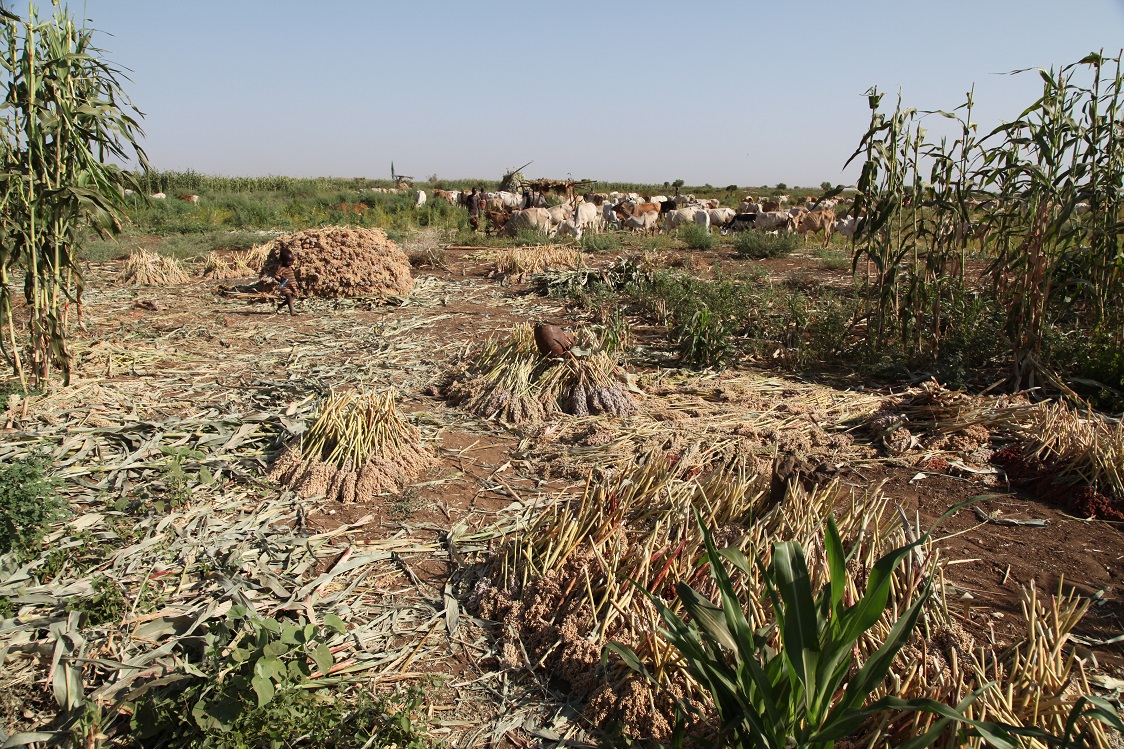
<dt><a rel="lightbox" href="/audiovisual/image-gallery/neighbours/daasanach/Harvest%20Time%20in%20Floodplain.JPG"><img src="http://www.mursi.org/audiovisual/image-gallery/neighbours/daasanach/Harvest%20Time%20in%20Floodplain.JPG/@@images/ff1bd29c-121c-4a16-b599-5f076a4dd3b3.jpeg" alt="Harvest Time in Floodplain.JPG" title="Harvest Time in Floodplain.JPG" height="159" width="240" /></a></dt>
 <dd class="image-caption" style="width:240px;">Harvest time in the floodplain (Sagawa 2010)</dd>
</dl></p>
<p style="text-align: justify; ">The main subsistence activities of the Daasanach are pastoralism, flood-retreat cultivation, and fishing. They keep cattle, sheep, goats, donkeys and camels and live a semi-nomadic life. According to the 2000 census of what was then known as the Kuraz <i>wereda</i> (district) - it is now known as Daasanach <i>wereda</i> - they owned 4.4 cattle, 4.9 sheep and 5.2 goats per capita. The Omo River normally floods in July each year. The floodwater brings fertile silts from the Ethiopian highlands and renews the productivity of land for pasture and cultivation. Crops (mainly sorghum) are planted along the banks of the river and in the floodplain as the flood recedes, and harvested in the main dry season. The first harvest comes in December and the second in February. A study of one household in 2003 showed that home-produced sorghum made up about 68.8 per cent of the household's meals in May and about 38.1% in August, which is a hard dry season. Average rainfall recorded at Omerate, the capital of Daasanach wereda, between 1996 and 2000, was only 363 mm. Nevertheless, the annual flood enables the Daasanach to produce abundant and reliable crops, compared to neighbouring pastoral groups. Fishing has traditionally been despised by the Daasanach as a subsistence activity fit only for the poor, who have no livestock, but it has recently become a valued source of cash-income.</p>
<p style="text-align: justify; ">The basic unit of production and consumption is a household (<i>bil</i>), consisting of a married man, his wife and their unmarried children. When a man marries a second wife, she builds a new house for herself and the husband moves between his wives' houses every other day or every two days. He distributes livestock and arable land to his wives and each wife milks her own livestock, cultivates her land, stores crops, and cooks and eats meals separately with her children.</p>
<h3>Social organization</h3>
<p style="text-align: justify; ">The Daasanach are made up of eight roughly co-residential territorial groups (<i>en</i>) which conduct many rituals together. The Inkabelo, the largest of these groups, live at the centre of Daasanachland, on both sides of the Omo and its delta, along with three smaller groups, the Oro, the Kuoro and the Riele. The Randal and the Elele live in the northwestern part of Daasanachland. The Inkoria live on the northeastern shore of Lake Turkana, on the Kenyan side of the border. The Ngaritch are located to the north of the Inkoria.</p>
<p style="text-align: justify; ">According to oral tradition, many of these groups are the descendants of migrants who came to the Omo from various directions to escape such problems as famine and conflict and who thereby constructed 'Daasanach' society. For example, the Inkabelo and the Inkoria (together known as Shiir) lived at a place called Ger or Gerio, probably around the Kerio River on the southwestern side of Lake Turkana, along with the Nyube, or Pokot. When the Turkana (some elders told me the attackers were the Kuoro) attacked them in the early 19th century, the Nyube escaped southward to present Pokotland while the Inkabelo and Inkoria escaped northward, to present Daasanachland. The Randal and the Kuoro originated from the Rendille and the Samburu of northwestern Kenya. They moved to Daasanachland because of natural disasters in the last two decade of the 19th century.</p>
<p style="text-align: justify; ">Amongst the Daasanach, patrilineal clans (<i>tuuro</i>) or other kin groups do not function as co-resident groups. Although there is no fixed residential pattern for a village, it often consists of influential older men and their cognates, affines, age-mates, and friends. On the eastern side of the Omo there are generally between five and thirty houses per village while on the western side, where people are afraid of attack from neighbouring groups, there are generally more than fifty. The distance between villages on both sides of the river is more than several hundred metres.</p>
<p style="text-align: justify; ">All Daasanach men belong to a generation-set (<i>haari</i>). A man joins his set between the ages of fifteen and twenty through an initiation ceremony, after which he moves from the status of boy (<i>nyigeny</i>) to adolescent (<i>kabana</i>). After initiation men are able to marry and most are married before they are thirty. Girls marry between the ages of fifteen and twenty. When a couple's first daughter reaches the age of approximately ten years they go through a ceremony known as <i>dimi,</i> after which they are recognized as social elders (<i>karsich</i>).</p>
<h3>Relations with neighbouring peoples</h3>
<p style="text-align: justify; ">Six ethnic groups live around the Daasanach. The Kara, to the north, and the Arbore, to the northeast, are classified as "our people" (<i>gaal kinnyo</i>) and have friendly relations with the Daasanach. The Turkana, to the southwest, the Nyangatom, to the northwest, the Hamar, to the northeast, and the Gabra, to the southeast, all of whom depend mainly on pastoralism, are classified as "enemies" (<i>kiz</i>) and have fought with the Daasanach intermittently for many years.</p>
<p style="text-align: justify; "><dl class="image-right captioned" style="width:240px;">
<dt><a rel="lightbox" href="/audiovisual/image-gallery/neighbours/daasanach/daasanach-women-building-investors-cattle-kraal"><img src="http://www.mursi.org/audiovisual/image-gallery/neighbours/daasanach/daasanach-women-building-investors-cattle-kraal/@@images/54a5e4dd-67cc-4c3e-ad06-c4e21d75cbd1.jpeg" alt="Daasanach Women Building  Investor's Cattle Kraal" title="Daasanach Women Building  Investor's Cattle Kraal" height="160" width="240" /></a></dt>
 <dd class="image-caption" style="width:240px;">Women building  an investor's cattle-kraal (Sagawa 2012)</dd>
</dl></p>
<p style="text-align: justify; ">The Daasanach were incorporated into the Ethiopian empire at the end of 19th century. Since then, the Ethiopian and Kenyan governments have had a negative impact on their survival and their relations with other groups in the following ways. First, arbitrarily formed international and domestic borders have disturbed their migration routes and discouraged trans-ethnic mutual visiting. Second, Ethiopian administrators (from the 1900s to the 1930s) and Italian administrators (from 1936 to 1941) organized the Daasanach into raiding parties or border security forces against the British East African Protectorate, so that Daasanach were encouraged or even compelled to fight against Kenyan pastoralists, such as the Turkana and Gabra. Third, rifles were introduced to the area by Ethiopian traders in the early 20th century and the intensity of violence has increased since then. In addition, the proliferation of automatic rifles caused by political upheavals in Uganda, Sudan, Somalia, and Ethiopia has worsened the situation since the late 1970s. It should be emphasized that, despite these negative influences, the pastoralists of the region have maintained amicable trans-ethnic friendship and kinship relations, which have helped them restore peace after outbreaks of violence.</p>
<h3>The current situation</h3>
<p style="text-align: justify; "><dl class="image-right captioned" style="width:240px;">
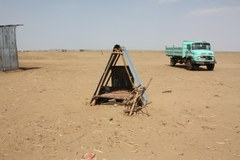
<dt><a rel="lightbox" href="/audiovisual/image-gallery/neighbours/daasanach/daasanach-night-guard-house-in-commercial-farm"><img src="http://www.mursi.org/audiovisual/image-gallery/neighbours/daasanach/daasanach-night-guard-house-in-commercial-farm/@@images/44d682c8-d09e-4b61-bd94-b0a856f6e3ba.jpeg" alt="Daasanach Night Guard 'House' in Commercial Farm" title="Daasanach Night Guard 'House' in Commercial Farm" height="160" width="240" /></a></dt>
 <dd class="image-caption" style="width:240px;">A night guard's shelter on a commercial farm (Sagawa 2012)</dd>
</dl></p>
<p style="text-align: justify; ">Uri Almagor, who conducted anthropological fieldwork amongst the Daasanach in 1968 and 1969, described the Lower Omo Valley as one of the most inaccessible areas in East Africa. This was no longer the case by the turn of the 20th century. The area is now in the front line of investment by international and state corporations. Three large-scale development projects are in progress. First there is the construction of the Gibe III hydroelectric dam in the middle basin of the Omo. This will regulate the flow of the river and reduce the scale and frequency of flooding, which is the lifeblood of the Daasanach economy. Second, the government has leased huge areas of land to foreign and domestic investors who plan to establish large-scale commercial farms, largely for the production of export crops. Italian (since 2007), Indian (since 2013) and Tigrayan (since 2009) owned farms have started to operate in Daasanach territory and many people have been displaced from their land without compensation, although some elders received a few thousands birr from local administrators and investors as a 'gift'. Conflicts have arisen between workers on the commercial farms and the Daasanach living around the farm. And third, oil exploration by Tullow Oil PLC began in 2013. In addition, the local government plans to sedentalize about 2,600 Daasanach households.</p>
<p style="text-align: justify; "><dl class="image-right captioned" style="width:240px;">
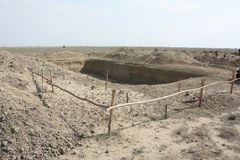
<dt><a rel="lightbox" href="/audiovisual/image-gallery/neighbours/daasanach/daasanach-site-of-indian-commercial-farm-under-construction"><img src="http://www.mursi.org/audiovisual/image-gallery/neighbours/daasanach/daasanach-site-of-indian-commercial-farm-under-construction/@@images/36faee40-d94d-4283-b197-fdd1badf08e1.jpeg" alt="Daasanach Site of Indian Commercial Farm under Construction" title="Daasanach Site of Indian Commercial Farm under Construction" height="160" width="240" /></a></dt>
 <dd class="image-caption" style="width:240px;">An Indian commercial farm under construction (Sagawa 2012)</dd>
</dl></p>
<p style="text-align: justify; ">Daasanach responses to these projects vary according to a person's generation, gender, place of residence and economic status. Generally speaking, those living in the district (<i>wereda</i>) capital (Omerate) and who have graduated from secondary or high school, expect these projects to provide them with good opportunities for employment. On the other hand, other Daasanach - around 97 per cent of the population - complain bitterly about current developments and express anxiety about the future. This applies especially to young men with responsibility for the welfare of livestock, some of whom insist that 'we are people of livestock (<i>gaal aaniet)</i> and do not need Highlander's farms which make livestock herding impossible'. A few young men, who own little or no livestock, have been employed on commercial farms. They often complain about their low wages and the bad behaviour of Highland workers, but not about the existence of the farms themselves. Some elders in the village have been treated as community leaders by the local administration and set up as proponents of projects. When the investors and local administration started to found commercial farms, they gave small amounts of money to some elders and made them bless investors in public meetings in order to persuade other Daasanach to give away their land to investors. As a result, tensions have run high between the younger generation and the elders. More observation and analysis is needed of the way the government is attempting to reconcile 'democratic developmentalism' with local interests.</p>
<p style="text-align: justify; ">TORU SAGAWA, Keio University, JAPAN</p>
<p style="text-align: justify; "> </p>
<p style="text-align: justify; "><strong>More information</strong></p>
<p style="text-align: justify; "><a class="internal-link" href="http://www.mursi.org/pdf/copy_of_pastoral-livelihoods.pdf">Sagawa, Toru 2010 War experiences and self-determination of the Daasanach in the conflict-ridden area of northeastern Africa. <i>Nilo-Ethiopian Studies</i> 14: 19-37.</a></p>
<p style="text-align: justify; "><a class="internal-link" href="http://www.mursi.org/pdf/copy2_of_pastoral-livelihoods.pdf">Sagawa, Toru 2006 Wives' domestic and political activities at home: The space of coffee drinking among the Daasanetch of southwestern Ethiopia. <i>African Study Monographs</i> 27-2: 63-86.</a></p>]]></content:encoded>
    <dc:publisher>No publisher</dc:publisher>
    <dc:creator>admin</dc:creator>
    <dc:rights></dc:rights>
    <dc:date>2020-07-21T21:05:00Z</dc:date>
    <dc:type>Page</dc:type>
  </item>


  <item rdf:about="http://www.mursi.org/neighbours/neighbours">
    <title>Neighbours</title>
    <link>http://www.mursi.org/neighbours/neighbours</link>
    <description></description>
    <content:encoded xmlns:content="http://purl.org/rss/1.0/modules/content/"><![CDATA[<p style="text-align: justify; "><a class="internal-link" href="http://www.mursi.org/images/copy_of_the-mursi-and-their-neighbours-b/image_view_fullscreen"><img alt="The Mursi and their neighbours (b)" title="The Mursi and their neighbours (b)" class="image-right" style="text-align: justify; " src="http://www.mursi.org/images/copy_of_the-mursi-and-their-neighbours-b/@@images/00836b98-cd1c-4f15-b32a-652234940ddc.jpeg" /></a></p>
<p style="text-align: justify; "><span style="text-align: justify; "><span>The Lower Omo Valley is inhabited by several small groups, a few thousand strong, who speak languages belonging to three major African language families: Nilo-Saharan (Mursi, Chai, Tirma, <span style="text-align: justify; ">Balé,</span> Me’en, Nyangatom and Kwegu (or Koegu)), Omotic (Aari, Kara, Banna, Bashada and Hamar) and Cushitic (Dassanetch). The closest linguistic and cultural links of the Mursi are with the Chai and Tirma, who  live west of the Omo and south of Maji. The Chai and Tirma together number about 28,000. They and the <span style="text-align: justify; ">Balé </span>have a joint self-name, Suri, and are known as Surma in the nearby highlands. The Mursi, Chai and Tirma speak the same Surmic language with differences of dialect only, and intermarriage between Mursi and Chai  is common. The Me’en consist of seven territorial groups, two of which, Mela and Chirim, live east of the Omo. These two groups are together called ‘Tumura’ by the Mursi and ‘Bodi’ by government officials and other outsiders. The Mursi call the Aari and Dizzi ‘Su’, the Kara ‘Kera’, the Hamar ‘Hamari’, the Nyangatom ‘Bume’ and the Dassanech ‘Geleba’. They have peaceful relations with the Chai, and intermittently hostile ones with the Bodi and Nyangatom, with whom they do not intermarry. </span><span></span></span></p>
<p style="text-align: justify; ">The Kara and Kwegu number no more than a few hundred respectively. The Kara speak the same language as the Hamar and live south of the Omo-Mago junction. The Kwegu also live along the Omo, amongst the Bodi, Mursi and Kara. The Kwegu are called ‘Nydi’ (sg. ‘Nyidini’) by the Mursi and ‘Muguji’ by Kara and Hamar). Although their language belongs to the Nilo-Saharan family, it is not mutually intelligible with Mursi, Bodi or Nyangatom.</p>
<h3 style="text-align: justify; ">More information</h3>
<p style="text-align: justify; ">A comprehensive list of anthropologists and others who have worked amongst the peoples of the lower Omo, and more widely in southern Ethiopia, may be found on the website of the <a class="external-link" href="https://web.archive.org/web/20060509002308/http://www.uni-mainz.de:80/Organisationen/SORC/">South Omo Research Center</a>.</p>]]></content:encoded>
    <dc:publisher>No publisher</dc:publisher>
    <dc:creator>admin</dc:creator>
    <dc:rights></dc:rights>
    <dc:date>2020-07-21T21:05:00Z</dc:date>
    <dc:type>Page</dc:type>
  </item>


  <item rdf:about="http://www.mursi.org/neighbours/bodi-meen">
    <title>Bodi (Me'en)</title>
    <link>http://www.mursi.org/neighbours/bodi-meen</link>
    <description></description>
    <content:encoded xmlns:content="http://purl.org/rss/1.0/modules/content/"><![CDATA[<p style="text-align: justify; ">The Bodi live in the Omo valley north of the Mursi. They number about 10,000 people. They speak the Me’en language (<i>Me’enen</i> or <i>tuk de Me’enuny</i>) and call themselves Me’en. The Me’en are composed of several local groups of about 70,000 people whose territory stretches from the Omo River to the highlands north and northeast of Maji.  Two groups of Me’en, the Mela and the Chirim, live in the lowlands east of the Omo and are known to the administration and foreigners as ‘Bodi’.</p>
<p style="text-align: justify; ">The Bodi, and more specifically the Mela, are considered by other Me’en as the ‘purest’ Me’en, who have followed the pastoral livelihood and values of their ancestors. The Bodi recount that the forebears of their most prestigious clans used to live west of the Omo and first crossed the river some twelve generations ago. During the nineteenth century, pushed by droughts and cattle epidemics, some Me’en crossed the Omo again to settle closer to the northern highlands, adopting a more agrarian way of life and forming new Me’en groups. Contacts between the Bodi and the remote agricultural Me’en groups are maintained most notably through inter-marriage.</p>
<p style="text-align: justify; ">The livelihood strategies of the Bodi are much the same as those of the Mursi: they practice cultivation and herd cattle and small stock. Their territory is crossed from east to west by two rivers, the Hana and the Gura, which originate in the Dime highlands and flow most of the year. These reliable sources of water mean that the Bodi have to move less often than their Mursi neighbours.</p>
<p style="text-align: justify; ">As amongst other East African pastoralists, Bodi livelihoods and cultural expression revolve around cattle. The late Katsuyoshi Fukui, an anthropologist who conducted research in Bodi from the 1970s until his death in 2008, has described the refinement of the Bodi classification of cattle colours which he found goes “beyond the capacity of modern genetics”. Maintaining herds with a wide range of colours is important for the Bodi because their ritual sacrifices rely on the symbolism of colour. For instance, each portion of their land is associated with a specific cattle colour. Before the use of a new water-point or the clearing of a new area for cultivation, a stock animal of the right colour has to be sacrificed.</p>
<p style="text-align: justify; ">The Bodi and the Mursi have many cultural features in common. Regarding bodily decoration, the most notable difference is that Bodi women wear a lip-plug, and not a lip-plate. Another difference is that Mursi girls pierce and stretch their lower lips upon reaching puberty, while Bodi women cut their lower lips only after they have given birth to two or three children.  A Bodi woman then stretches her lip so that she can insert a finely carved wooden plug, generally the size of a coin. Rather than sexual maturity, the Bodi lip-plug signals a woman's achievement of the role of mature mother. The plug, worn all the time, is coated with butter and red ochre, and pierced in the centre with a small wooden spike. The Bodi also wear the lip-plug to serve as an identity marker and they often refer to themselves in public debates as ‘the people who pierce the lip-plug’.</p>
<p style="text-align: justify; ">The Bodi have earned some local fame for their annual ceremony, the <i>ke’êl</i>. When the Pleiades constellation (<i>ke’êl</i>) disappears to the east, around mid-June, the Bodi celebrate the beginning of a new year. Men of various ages feed themselves exclusively with milk and blood for several months in order to have fat but firm bodies with protruding bellies. The community gathers at the place of the local priest (<i>komorut</i>) and the men who have undergone this bodily transformation dance in circles, each local group being represented by one or more circles of men. They sing songs to glorify their priest and the fierceness of their group. Each Mela <i>komorut</i> holds the <i>ke’êl</i> dance successively. This is an important moment of festivities for the whole community. It is tinged with competition between the local groups because everyone assesses the participants, who are valued for the fatness and impressiveness of their bodies. The local administration, hoping to attract tourists, has recently turned the <i>ke’êl</i> of Hana into a competitive event, setting up a fee for visitors and awarding the biggest man of the ceremony with a cup. After the ceremony, men resume a normal diet and lose weight rapidly since, in daily life, a fat body is recognized to be an impediment to general health and fitness. Outside of the context of the <i>ke’êl</i>, women and girls generally value a man’s beauty based on his height or stature.</p>
<p style="text-align: justify; ">The town of Hana in the heart of Bodiland began as a police post, established in the early 1970s. With the government’s plans for commercial irrigation schemes in the Omo valley, its population has grown exponentially. The Bodi have seen thousands of daily labourers coming from other parts of Ethiopia to work in the sugar-cane plantation which is developing along the Omo. Huge tracts of bush-land have been cleared to give way to roads, plantations, canals, a processing-plant and housing for the workers. Part of the Bodi population have been resettled in permanent villages and have had their first experience of irrigated agriculture. These dramatic changes have not only permanently altered the landscape and restricted the access of the Bodi to natural resources but have also deeply undermined their self-esteem and confidence and left them with a very uncertain future.</p>
<p style="text-align: justify; "> </p>
<h3 style="text-align: justify; ">More information</h3>
<p style="text-align: justify; "><span>Jon Abbink, ‘An Ethno-Historical Perspective on Me’en Territorial Organization’. </span><i>Anthropos</i><span>, 87, pp. 351-364 (1992)</span></p>
<p>Jon Abbink, Michael Bryant and Daniel Bambu,  'Suri Orature: introduction to the society, language and oral culture of the Suri people (Southwest Ethiopia)', Köln: Rüdiger Köppe Verlag, 2013.</p>
<p style="text-align: justify; "><span>Katsuyoshi Fukui, ‘Co-evolution Between Humans and Domesticates: The Cultural Selection of Animal Coat-Colour Diversity Among the Bodi’, in Roy Ellen &amp; Katsuyoshi Fukui (eds.), </span><i>Redefining Nature: Ecology, Culture and Domestication</i><span>. Oxford: Berg, pp. 319-385 (1996)</span></p>
<p style="text-align: justify; "><a class="external-link" href="http://www.janestudies.org/drupal-jp/sites/default/files/NES_no7%282001%29_Fukui.pdf"><span>Katsuyoshi Fukui, ‘Socio-Political Characteristics of Pastoral Nomadism: Flexibility among the Bodi (Mela-Me’en) in Southwest Ethiopia’. </span><i>Nilo-Ethiopian Studies</i><span>, 7, pp. 1-21 (2001)</span></a></p>]]></content:encoded>
    <dc:publisher>No publisher</dc:publisher>
    <dc:creator>admin</dc:creator>
    <dc:rights></dc:rights>
    <dc:date>2020-07-21T21:04:39Z</dc:date>
    <dc:type>Page</dc:type>
  </item>


  <item rdf:about="http://www.mursi.org/news-items/nobel-peace-prize-awarded-to-ethiopian-pm">
    <title>Nobel Peace Prize awarded to Ethiopian PM</title>
    <link>http://www.mursi.org/news-items/nobel-peace-prize-awarded-to-ethiopian-pm</link>
    <description>Wed 30 Oct 2019</description>
    <content:encoded xmlns:content="http://purl.org/rss/1.0/modules/content/"><![CDATA[<p>The award of the Nobel Peace Prize to Dr Abiy Ahmed is a fitting recognition of his efforts to promote peaceful relations, not only between Ethiopia and Eritrea but also between different ethnic groups within Ethiopia. Unfortunately, however, the occasion has been marred by reports of indiscriminate and dehumanising violence being used by Ethiopian army units against their fellow citizens in the Omo Valley. Click here to read an opinion piece on this subject by Dr Jed Stevenson and Dr Felix GIrke that appeared in The Guardian on 21 October 2019.</p>
<p><a href="https://www.theguardian.com/global-development/2019/oct/21/the-nobel-peace-prize-can-inspire-abiy-ahmed-to-new-heights-in-ethiopia">https://www.theguardian.com/global-development/2019/oct/21/the-nobel-peace-prize-can-inspire-abiy-ahmed-to-new-heights-in-ethiopia</a></p>]]></content:encoded>
    <dc:publisher>No publisher</dc:publisher>
    <dc:creator>Mursi Online Editor</dc:creator>
    <dc:rights></dc:rights>
    <dc:date>2019-11-11T09:01:00Z</dc:date>
    <dc:type>News Item</dc:type>
  </item>


  <item rdf:about="http://www.mursi.org/news-items/forced-disarmament-in-the-lower-omo-valley">
    <title>Forced disarmament in the Lower Omo Valley</title>
    <link>http://www.mursi.org/news-items/forced-disarmament-in-the-lower-omo-valley</link>
    <description>Wed 30 Oct 2019</description>
    <content:encoded xmlns:content="http://purl.org/rss/1.0/modules/content/"><![CDATA[<p> </p>
<div id="_mcePaste">Over the past few weeks we’ve been hearing reports of what sounds like excessive violence being used by Ethiopian army units against local people in the Lower Omo Valley, with the aim, apparently, of confiscating their firearms. Click here to read the first media coverage of these reports which was provided by the AFP journalist Robbie Corey-Boulet   in an article in the Mail and Guardian on 17 October.</div>
<div id="_mcePaste"><span><a class="external-link" href="https://mg.co.za/article/2019-10-17-00-killing-without-any-reason-deaths-in-rural-ethiopia-spark-outcry">https://mg.co.za/article/2019-10-17-00-killing-without-any-reason-deaths-in-rural-ethiopia-spark-outcry</a></span></div>
<p> </p>]]></content:encoded>
    <dc:publisher>No publisher</dc:publisher>
    <dc:creator>Mursi Online Editor</dc:creator>
    <dc:rights></dc:rights>
    <dc:date>2019-11-03T08:59:35Z</dc:date>
    <dc:type>News Item</dc:type>
  </item>


  <item rdf:about="http://www.mursi.org/news-items/remembering-kirinomeri">
    <title>Remembering Kirinomeri</title>
    <link>http://www.mursi.org/news-items/remembering-kirinomeri</link>
    <description>We are very sorry to have to record the recent death, at Makki, of Kirinomeri (Ulikuri) Tuku, one of the most respected and influential leaders of the northern Mursi during the past forty years. He died on 22 Dec 2017. He will be remembered best, perhaps, for motivating and inspiring the successful migration of members of the Baruba bhuran to Makki in 1979/80, an achievement  that will secure his place as a major figure in Mursi history. The following is a personal tribute to Kirinomeri from the anthropologist, Dr Shauna LaTosky (Ngamargo).</description>
    <content:encoded xmlns:content="http://purl.org/rss/1.0/modules/content/"><![CDATA[<p> </p>
<p>News item <span>August 28 2018</span></p>
<p>Dear friends, colleagues and family members of Kirinomeri,</p>
<p>It is with great sadness that I learned about the death of this great man.</p>
<p>I had the privilege of getting to know Kirinomeri during the course of repeated visits to Makki between 2003 and 2014. He was a gentle, tall and slender man, with several missing teeth. Although I never asked him, I would imagine that some were lost during the many <i>donga</i> (stick duelling) fights of his youth. He was a loved and loving family man with a soft voice and a deep, hearty laugh which will forever bring back fond and  funny memories, in particular of a collective ritual whipping ceremony (<i>koma kodha</i>) that I once attended in 2004 and of which Kirinomeri always loved to remind me. He would laugh out loud whenever he recalled the story and arrived at the part about me screaming while running into the bushes “as <i>only</i> a child would”. I always wondered if he was somehow behind the joke to scare me into believing that the elders would really whip me too. Well, I fell for it - quite literally - as I dove into the bushes, camera and all.</p>
<p>Kirinomeri was the first elder that I met when I arrived in Makki in December 2003. Having worked as a young man with anthropologist David Turton, he was supportive of my wish to work with Mun (Mursi) women and introduced me to Ngatui and her widowed mother Bikalumi and her co-wives, insisting that they take care of me as they would their own daughter. It is thanks to them, but especially to Kirinomeri’s openness and generosity that I was able to participate freely in the daily lives of Mun girls and women in Makki between 2004-2005 and, again, for shorter visits in 2006, 2008, 2010, 2011, 2012 and 2014. While there were no conditions attached to our oral agreement about doing research on the life stories of women in Makki - other than of course those expectations that any elder would expect after being consulted (e.g. small gifts of tobacco, money, cloth or household items for his wives), he did frequently make one request. It was a request typical of any father in his situation: to visit his son in prison whenever I returned to Jinka (roughly 40 kilometres from Makki). It was out of this common concern for the well-being of his son, the late Bagaha, that our friendship grew.</p>
<p>Bagaha had been falsely accused of homicide during a retaliatory attack by the Mun on an Ari village following the murder of his sister-in-law, Kereramai. She had been sleeping overnight with other Mun on the way back from the market town of Belamer, when a drunk Ari man attacked and killed her (for more on this see the film “<span style="text-decoration: underline;"><a class="external-link" href="http://www.youtube.com/watch?v=5DCLB3nr-tM&amp;t=4s">Fire Will Eat Us</a></span>”). According to Mun customary law, compensation must be paid to the family, but with the killers at large and no hope for compensation, Mun men attacked Belamer in retaliation. It should be mentioned here that the general framing of “retaliation” as “crime” was absent for the Mun, but not in Ariland, which had already been incorporated into the legal structure of Ethiopian civil and public law.</p>
<p>It was against this backdrop - i.e. the drama of Bagaha’s case - that I would come to know Kirinomeri and his family. In fact, many people who visited me in Jinka at the South Omo Research Centre between 2004 and 2005, were either related to Bagaha or were there to relay a message to him on behalf of his family. His case reflected the new criminalization mechanisms being introduced in northern Munland and used, as Bagaha would often explain, “as a way to gain control over elders”. Elders like Kirinomeri were often feared by the local authorities as having the power to incite violence, like the retaliatory attack in Belamer market.</p>
<p>It was not only the tragic story of his daughter-in-law and the equally tragic fate of his son (who died of an illness only months after finally being released from prison) that blighted Kirinomeri’s last years, but also the uncertain future of his community as a result of large-scale agro-development and forced villagisation plans that began to unfold in 2010. During one of our last conversations there was an irony in his apparent optimism about government plans to build irrigation ditches and a permanent village in Makki, along the Mago River. As he put it, “They [the government] will come - I guess it’s good. But then they will go again, like all the other times. That’s also good.”</p>
<p>Kirinomeri had made a name for himself, especially at the former SIM mission in Makki, as a somewhat progressive elder, who was open to working with foreigners, and, indeed he was always open to new ideas - from HIV prevention campaigns and community-based tourism, to mother-tongue learning and teacher training in Makki. In hindsight, his openness to foreigners and new ideas is also what likely made him more vulnerable to the suspicion and accusatorial rhetoric of the authorities.</p>
<p>His strength and humility were no doubt, in part, a result of the unimaginable tragedies he faced before and during the time that I knew him. Unfortunately, diabetes was his most difficult struggle in the end.</p>
<p>My heartfelt condolences go out to his family.</p>
<p> </p>
<p>Sincerely yours,</p>
<p>Ngamargo</p>]]></content:encoded>
    <dc:publisher>No publisher</dc:publisher>
    <dc:creator>John</dc:creator>
    <dc:rights></dc:rights>
    <dc:date>2018-08-28T18:45:00Z</dc:date>
    <dc:type>News Item</dc:type>
  </item>


  <item rdf:about="http://www.mursi.org/news-items/forthcoming-article-on-the-impacts-of-dislacement-and-resettlement-in-the-lower-omo-valley">
    <title>Forthcoming article on the impacts of displacement and resettlement in the Lower Omo Valley</title>
    <link>http://www.mursi.org/news-items/forthcoming-article-on-the-impacts-of-dislacement-and-resettlement-in-the-lower-omo-valley</link>
    <description>The lower Omo is set to become the largest irrigation complex in Ethiopia, with the Ethiopian Sugar Corporation’s ‘Kuraz Sugar Development Project’ as its centrepiece. This will require the forced displacement and ‘villagization’ of thousands of agro-pastoralists. Since villagization began in 2012, Edward (Jed) Stevenson and Lucie Buffavand have been studying its impacts on the food security and well-being of the resettlers, using both household surveys and long term ethnographic research.</description>
    <content:encoded xmlns:content="http://purl.org/rss/1.0/modules/content/"><![CDATA[<p>They are now about to present the first results of this work in an article entitled <i>Do our bodies know their ways?:Villagization, food insecurity and ill-being in Ethiopia's Lower Omo Valley. </i>The article has been accepted for publication in the <i>African Studies Review </i>and is made available here, in pre-publication form, with the permission of the editors.</p>
<h3>ABSTRACT</h3>
<p><i>This paper investigates food security in the context of development-forced displacement. In southwest Ethiopia a large hydro-electric dam and plantation schemes have forced people to cede communal lands to the state and business speculators and indigenous communities have been targeted for resettlement in  noe, consolidated villages. We carried out a food access survey in new villages and communities not yet subjected to villagization; we complement this with ethnographic research. Survey data suggest that household food insecurity was high in both places, but lower in villagization sites than in communities not subjected to villagization. Ethnography paints a very different picture. Settlers were unable to feed themselves, and depended on food aid. The salient features of villagization were heat, indignity and bodily discomfort. We discuss the contrast between the information generated by the different research methods, and ask how surveys might mistake the precarious  state in which the settlers found themselves for the stable and continuing state implied by food security. We highlight the potential of survey research to mislead and stress the importance of taking local context into account. The impacts of villagization in the Lower Omo cannot be understood apart from wider forces that are changing both the way people live and the landscape around them.</i></p>
<p><a class="internal-link" href="http://www.mursi.org/pdf/do-our-bodies-know-their-ways/view">Click here to view the published text</a></p>]]></content:encoded>
    <dc:publisher>No publisher</dc:publisher>
    <dc:creator>David</dc:creator>
    <dc:rights></dc:rights>
    <dc:date>2017-06-14T21:55:00Z</dc:date>
    <dc:type>News Item</dc:type>
  </item>


  <item rdf:about="http://www.mursi.org/change-and-development/press-coverage">
    <title>Press and Media</title>
    <link>http://www.mursi.org/change-and-development/press-coverage</link>
    <description>The articles listed below have been selected because of their relevance to change and development in the Omo Valley. The inclusion of an article in the list, however, should not be seen as a blanket endorsement by Mursi Online of the facts reported and opinions expressed.</description>
    <content:encoded xmlns:content="http://purl.org/rss/1.0/modules/content/"><![CDATA[<h2></h2>
<h3></h3>
<h3><strong>EU diplomats reveal devastating impact of Ethiopia dam project on remote tribes</strong></h3>
<p>John Vidal, The Guardian, 3 September 2015</p>
<p><a class="external-link" href="http://www.theguardian.com/environment/2015/sep/03/eu-diplomats-reveal-devastating-impact-of-ethiopia-dam-project-on-remote-tribes">http://www.theguardian.com/environment/2015/sep/03/eu-diplomats-reveal-devastating-impact-of-ethiopia-dam-project-on-remote-tribes</a></p>
<p>A controversial World Bank-funded scheme to dam a major Ethiopian river  and import up to 500,000 people to work in what is planned to be one of  the world’s largest sugar plantations has led to tens of thousands of  Africa’s most <span class="u-underline ">remote and vulnerable people being insensitively resettled</span>.</p>
<h3><strong>US, UK, World Bank among aid donors complicit in Ethiopia's war on indigenous tribes<br /></strong></h3>
<h3></h3>
<p class="subheading2">Will Hurd, The Ecologist, 22 July 2015</p>
<p class="subheading2"><a class="external-link" href="http://www.theecologist.org/News/news_analysis/2951671/us_uk_world_bank_among_aid_donors_complicit_in_ethiopias_war_on_indigenous_tribes.html">http://www.theecologist.org/News/news_analysis/2951671/us_uk_world_bank_among_aid_donors_complicit_in_ethiopias_war_on_indigenous_tribes.html</a></p>
<p>USAID, the UK's DFID and the World Bank are among those covering up for severe human rights abuses against indigenous peoples in Ethiopia's Omo Valley, inflicted during forced evictions to make way for huge plantations, writes Will Hurd. Their complicity in these crimes appears to be rooted in US and UK partnership with Ethiopia in the 'war on terror'.</p>
<h3><strong>How photographing the Omo Valley people changed their lives<br /></strong></h3>
<p>Matilda Temperley, The Guardian, 24 May 2015</p>
<p><a class="external-link" href="http://www.theguardian.com/artanddesign/2015/may/24/photographing-the-omo-valley-people">http://www.theguardian.com/artanddesign/2015/may/24/photographing-the-omo-valley-people</a></p>
<p>'The people of the Omo  Valley are incredibly photogenic. But tourism is turning their lives into a daily fancy dress parade....While modernisation is inevitable, in the Omo it appears to be at the expense of the locals rather than at their hands.'</p>
<h3></h3>
<h3></h3>
<h3><strong>World Bank's Conference on Land &amp; Poverty is a cruel farce</strong></h3>
<p>Oliver Tickell, The Ecologist, 20 March 2015</p>
<p><a href="http://www.theecologist.org/News/news_analysis/2796500/world_banks_conference_on_land_poverty_is_a_cruel_farce.html">http://www.theecologist.org/News/news_analysis/2796500/world_banks_conference_on_land_poverty_is_a_cruel_farce.html</a></p>
<p>'On Monday the World Bank's Conference on Land and Poverty begins in the US. But farmer organizations, indigenous groups, trade unions and others denounce the whole exercise as a sham that, in tandem with other Bank initiatives, is all about accelerating corporate land grabs and robbing the poor that the Bank was founded to assist.'</p>
<h3><strong>British support for Ethiopian scheme withdrawn amid abuse allegations<br /></strong></h3>
<p>Sam Jones and Mark Anderson, The Guardin, 27 February 2015</p>
<p><a href="http://www.theguardian.com/global-development/2015/feb/27/british-support-for-ethiopia-scheme-withdrawn-amid-abuse-allegations">http://www.theguardian.com/global-development/2015/feb/27/british-support-for-ethiopia-scheme-withdrawn-amid-abuse-allegations</a></p>
<p>'The UK has ended its financial support for a controversial development  project alleged to have helped the Ethiopian government fund a brutal  resettlement programme.'</p>
<h3><strong>Villagization cannot be carried out without voluntarism: Premier <br /></strong></h3>
<p>Walta Information Center (WIC), Addis Ababa, 28 January, 2015</p>
<p>[There appears to be a problem with the link below. The article can be seen <a class="internal-link" href="http://www.mursi.org/pdf/villagization-must-be-voluntary">here</a> instead- Ed. 23 June 2015]</p>
<p>http://waltainfo.com/index.php?option=com_content&amp;view=article&amp;id=17297:villagization-cannot-be-carried-out-without-voluntarism-premier&amp;catid=52:national-news&amp;Itemid=291</p>
<p>'Prime Minister Hailemariam Dessalegn said that the Villagization  Program that has been implemented in the pastoral areas is carried out  only with the free will of the pastoralists.'</p>
<h3><strong>Leaked report says World Bank violated own rules in Ethiopia</strong></h3>
<p>Shasha Chavkin, International Committee of Investigative Journalism (ICIJ), 20 January, 2015</p>
<p><a href="http://www.icij.org/blog/2015/01/leaked-report-says-world-bank-violated-own-rules-ethiopia">http://www.icij.org/blog/2015/01/leaked-report-says-world-bank-violated-own-rules-ethiopia</a></p>
<p>'Internal watchdog finds link between World Bank financing and Ethiopian government's mass resettlement of indigenous group.'</p>
<p><strong> </strong></p>
<h3><strong>Ethiopia</strong><strong>: human rights groups criticise UK-funded development programme</strong></h3>
<p>Harry Davies and James Ball, <i>The Guardian, </i>20 January 2015</p>
<p><a class="external-link" href="http://www.theguardian.com/world/2015/jan/20/ethiopia-human-rights-groups-development-programme-world-bank-villagisation">http://www.theguardian.com/world/2015/jan/20/ethiopia-human-rights-groups-development-programme-world-bank-villagisation</a></p>
<p>'A major UK- and World Bank-funded development programme in Ethiopia may have contributed to the violent resettlement of a minority ethnic group, a leaked report reveals.'</p>
<p><strong> </strong></p>
<h3><strong>Ethiopia</strong><strong> dam will turn Lake Turkana into 'endless battlefield', locals warn</strong></h3>
<p>John Vidal, <i>The Guardian</i>, 13 January 2015</p>
<p><a class="external-link" href="http://www.theguardian.com/global-development/2015/jan/13/ethiopia-gibe-iii-dam-kenya?CMP=share_btn_tw">http://www.theguardian.com/global-development/2015/jan/13/ethiopia-gibe-iii-dam-kenya?CMP=share_btn_tw</a></p>
<p>'People living near Lake Turkana in northern Kenya have little understanding that the fresh water essential to their development is likely to dry up when a huge hydoelectric dam in neighbouring Ethiopia is completed.'</p>
<h3><strong>The people pushed out of Ethiopia’s fertile farmland</strong></h3>
<p>Matthew Newsome, <i>BBC News Magazine</i>, 6 January 2015</p>
<p><a class="external-link" href="http://www.bbc.co.uk/news/magazine-30623571">http://www.bbc.co.uk/news/magazine-30623571</a></p>
<p><span>'The construction of a huge dam in Ethiopia and the introduction of large-scale agricultural businesses has been controversial - finding out what local people think can be hard, but with the help of a bottle of rum nothing is impossible.'</span></p>
<h3><strong>Ethiopian tribes' ancient ways threatened by UK-backed sugar project</strong></h3>
<p class="subheading1">Matthew Newsome, <i>The Ecologist</i>, 10 October 2014</p>
<p><a class="external-link" href="http://www.theecologist.org/News/news_analysis/2581007/ethiopian_tribes_ancient_ways_threatened_by_ukbacked_sugar_project.html">http://www.theecologist.org/News/news_analysis/2581007/ethiopian_tribes_ancient_ways_threatened_by_ukbacked_sugar_project.html</a></p>
<p>'A massive sugar plantation and up to 700,000 migrant workers will occupy almost 2,000 sq.km of Ethiopia's Omo Valley, with the help of British aid finance. But the valley's native inhabitants have been given no choice in the matter, and are being forced to abandon their homes, lands, cattle, and entire way of life, or go to jail.'</p>
<h3><strong>Ethiopian dam's ecological and human fallout could echo Aral Sea disaster</strong></h3>
<p>John Vidal, <i>The Guardian</i>, 5 March 2014</p>
<p><a href="http://www.theguardian.com/global-development/2014/mar/05/ethiopian-dam-gibe-iii-aral-sea-disaster"><strong>http://www.theguardian.com/global-development/2014/mar/05/ethiopian-dam-gibe-iii-aral-sea-disaster</strong></a></p>
<p>'Africa's fourth-largest lake could drop by 20 metres, causing an ecological and human disaster to rival the shrinking of the Aral Sea in central Asia, if Ethiopia goes ahead with massive irrigation projects linked to a giant dam, according to a university paper.'</p>
<h3><strong>Ethiopian dam project rides rooughshod over heritage of local tribespeople<br /></strong></h3>
<h3><strong> </strong></h3>
<p>John Vidal, The Guardian, 23 February 2012<strong><br /></strong></p>
<p><a class="external-link" href="http://www.theguardian.com/global-development/2012/feb/23/ethiopia-dam-project-resettlement-concerns">http://www.theguardian.com/global-development/2012/feb/23/ethiopia-dam-project-resettlement-concerns</a></p>
<p>Thousands of semi-nomadic tribespeople are being forcibly moved from  their traditional lands in southern Ethiopia to make way for European  and Indian sugar cane and biofuel plantations, <span class="u-underline ">according to testimonies collected by Survival International</span> researchers.</p>]]></content:encoded>
    <dc:publisher>No publisher</dc:publisher>
    <dc:creator>John</dc:creator>
    <dc:rights></dc:rights>
    <dc:date>2015-02-01T17:40:00Z</dc:date>
    <dc:type>Collection</dc:type>
  </item>


  <item rdf:about="http://www.mursi.org/news-items/donor-balancing-act-on-human-rights-in-the-lower-omo-valley">
    <title>Donor balancing act on human rights in the Lower Omo Valley</title>
    <link>http://www.mursi.org/news-items/donor-balancing-act-on-human-rights-in-the-lower-omo-valley</link>
    <description>The Development Assistance Group (DAG), a body of 27 development agencies working in Ethiopia, has written to the Ethiopian Government about assessment visits it has made over the past two years to resettlement sites in the west, south and east of the country, including the Lower Omo Valley. The letter manages a delicate balancing act. </description>
    <content:encoded xmlns:content="http://purl.org/rss/1.0/modules/content/"><![CDATA[<p> </p>
<p>On the one hand, it lists six basic rules of best practice in development-forced displacement and resettlement which DAG officials  must know have not been followed in the past and are unlikely to be in the foreseeable future. On the other hand, the overall tone of the letter is supportive of the government's resettlement programme or, as it is now called, 'Commune Development Programme' .The signatories (Mr Denis Weller, USAID Ethiopia Mission Director and Mr Guang Z. Chen, World Bank Ethiopia Country Director) admit that they have heard reports of human rights abuses, but deny that the reported abuses have been either ‘systematic’ or ‘widespread’.</p>
<p>In the Lower Omo, thousands of agro-pastoralists are being forcibly evicted from their most valuable agricultural land to make way for government-run sugar plantations. No compensation, benefit sharing or livelihood reconstruction schemes have been announced and no feasibility studies or impact assessments have been released for public discussion. DAG officials, who have visited the Lower  Omo four times since January 2012, presumably know this.</p>
<p>They must also know that by flouting the lessons learned from over fifty years of research on development-forced displacement and resettlement, the Ethiopian Government is needlessly putting at risk the economic well-being and physical and mental health of the affected population. It is difficult not to see this as a ‘systematic’ and ‘widespread’ abuse of human rights in the name of development and, in the words of Michael Cernea, formerly Senior Advisor for Social Policy at the Word Bank,  a ‘disgracing stain on development itself’ (Cernea, 2008, p. 1).</p>
<p><i>Posted by David Turton, 25 June 2014</i></p>
<p><i> </i></p>
<p><b>More information</b></p>
<p><a class="internal-link" href="http://www.mursi.org/pdf/dag-letter-to-goe-18-march-2014"><span class="external-link">The DAG letter</span></a></p>
<p><a class="internal-link" href="http://www.mursi.org/pdf/goe-reply-to-dag-letter-of-18-march-2014"><span class="external-link">The Ethiopian Government’s reply </span></a></p>
<p><span> </span></p>
<p><b>Reference</b></p>
<p><b> </b></p>
<p>Cernea, Michael, (2008)  ‘<a class="external-link" href="https://www.amazon.co.uk/Can-Compensation-Prevent-Impoverishment-Resettlement/dp/0195687132/">Reforming the foundations of involuntary resettlement: Introduction’</a> in Michael M. Cernea and Hari Mohan Mathur (eds.), <i>Can compensation prevent impoverishment? Reforming resettlement through investment and benefit-sharing, </i>Oxford University Press, Oxford.</p>]]></content:encoded>
    <dc:publisher>No publisher</dc:publisher>
    <dc:creator>Mursi Online Trainee</dc:creator>
    <dc:rights></dc:rights>
    <dc:date>2014-06-25T17:10:00Z</dc:date>
    <dc:type>News Item</dc:type>
  </item>


</rdf:RDF>