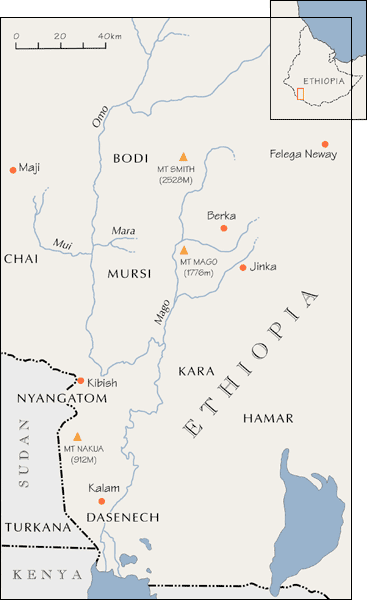
<?xml version="1.0" encoding="utf-8" ?>
<rdf:RDF xmlns:rdf="http://www.w3.org/1999/02/22-rdf-syntax-ns#" xmlns:dc="http://purl.org/dc/elements/1.1/" xmlns:syn="http://purl.org/rss/1.0/modules/syndication/" xmlns="http://purl.org/rss/1.0/">


<channel rdf:about="http://www.mursi.org/search_rss">
  <title>Mursi Online</title>
  <link>http://www.mursi.org</link>

  <description>
    
            These are the search results for the query, showing results 31 to 45.
        
  </description>


  <image rdf:resource="http://www.mursi.org/logo.png"/>

  <items>
    <rdf:Seq>
      
        <rdf:li rdf:resource="http://www.mursi.org/audiovisual/film-and-video-clips/film-clips-and-video-footage/index_html"/>
      
      
        <rdf:li rdf:resource="http://www.mursi.org/audiovisual/film-and-video-clips/television-documentaries/making-the-mursi"/>
      
      
        <rdf:li rdf:resource="http://www.mursi.org/audiovisual/film-and-video-clips/television-documentaries/index_html"/>
      
      
        <rdf:li rdf:resource="http://www.mursi.org/documents-and-texts/oral-texts/oral-text-2-kirinomeri-on-his-ancestors"/>
      
      
        <rdf:li rdf:resource="http://www.mursi.org/documents-and-texts/oral-texts/oral-text-1-how-the-buma-clan-claimed-dirka-by-means-of-a-trick"/>
      
      
        <rdf:li rdf:resource="http://www.mursi.org/change-and-development/tourism/index_html"/>
      
      
        <rdf:li rdf:resource="http://www.mursi.org/change-and-development/national-parks/index_html"/>
      
      
        <rdf:li rdf:resource="http://www.mursi.org/introducing-the-mursi/links"/>
      
      
        <rdf:li rdf:resource="http://www.mursi.org/introducing-the-mursi/making-a-living/index_html"/>
      
      
        <rdf:li rdf:resource="http://www.mursi.org/introducing-the-mursi/local-groups-bhuranyoga/index_html"/>
      
      
        <rdf:li rdf:resource="http://www.mursi.org/introducing-the-mursi/leadership/priests-komorena"/>
      
      
        <rdf:li rdf:resource="http://www.mursi.org/introducing-the-mursi/history/index_html"/>
      
      
        <rdf:li rdf:resource="http://www.mursi.org/introducing-the-mursi/environment/index_html"/>
      
      
        <rdf:li rdf:resource="http://www.mursi.org/introducing-the-mursi/clans-kabicho/index_html"/>
      
      
        <rdf:li rdf:resource="http://www.mursi.org/introducing-the-mursi/age-and-age-sets"/>
      
    </rdf:Seq>
  </items>

</channel>


  <item rdf:about="http://www.mursi.org/audiovisual/film-and-video-clips/film-clips-and-video-footage/index_html">
    <title>Film clips and video footage</title>
    <link>http://www.mursi.org/audiovisual/film-and-video-clips/film-clips-and-video-footage/index_html</link>
    <description></description>
    <content:encoded xmlns:content="http://purl.org/rss/1.0/modules/content/"><![CDATA[<ul class="films">
<li id="people"><a title="People and parks" href="http://www.mursi.org/audiovisual/film-and-video-clips/film-clips-and-video-footage/people-and-parks"><img src="http://www.mursi.org/images/people-and-parks-thumb.jpg" alt="Still taken from People and parks" title="Still taken from People and parks" /></a>
<h3><a title="People and parks" href="http://www.mursi.org/audiovisual/film-and-video-clips/film-clips-and-video-footage/people-and-parks">People and parks</a>, 2006</h3>
<p>In 2006, the conservation organisation, <a href="http://www.africanparks-conservation.com/apffoundation/" title="African Parks Network Website">African Parks Foundation</a>, took over the Omo National Park on a 25 year lease. It left two years later. In this clip from the film '<a href="http://www.shootingwithmursi.com/" title="Shooting With Mursi website">Shooting with Mursi</a>' (a DFID/UK AID film made by Ben Young with Olisarali Olibui), Mursi give their side of the story.</p>
</li>
<li id="interview"><a title="Interview with Komor-a-kora, Bio-iton-giga and Aringatuin" href="http://www.mursi.org/audiovisual/film-and-video-clips/film-clips-and-video-footage/interview-with-komor-a-kora-bio-iton-giga-and-aringatuin"><img src="http://www.mursi.org/images/interview-thumb.jpg" alt="Still taken from Interview with Komor-a-kora, Bio-iton-giga and Arinyatuin" title="Still taken from Interview with Komor-a-kora, Bio-iton-giga and Arinyatuin" /></a>
<h3><a title="Interview with Komor-a-kora, Bio-iton-giga and Aringatuin" href="http://www.mursi.org/audiovisual/film-and-video-clips/film-clips-and-video-footage/interview-with-komor-a-kora-bio-iton-giga-and-aringatuin">Interview with Komor-a-kora, Bio-iton-giga and Arinyatuin</a>, 1991</h3>
<p>Unedited footage from an interview shot in northern Mursiland, during the making of the films ‘The Land is Bad’ and ‘Nitha’. The three men were asked to give their views on the foreign tourists who had become regular visitors to their country in recent years.</p>
</li>
<li id="tourists"><a title="Tourists at the bridge" href="http://www.mursi.org/audiovisual/film-and-video-clips/film-clips-and-video-footage/tourists-at-the-bridge"><img src="http://www.mursi.org/images/tourists-thumb.jpg" alt="Still taken from Tourists at the bridge" title="Still taken from Tourists at the bridge" /></a>
<h3><a title="Tourists at the bridge" href="http://www.mursi.org/audiovisual/film-and-video-clips/film-clips-and-video-footage/tourists-at-the-bridge">Tourists at the bridge</a>, 2001</h3>
<p>Unedited footage shot during the making of the film 'Fire will eat us' (Woodhead and Turton) in January 2001. The tourists shown were from 'Discovery Expeditions' of Antwerp, Belgium. They were filmed meeting a group of Mursi at the bridge over the River Mago.</p>
</li>
<li id="nitha"><a title="The Nitha" href="http://www.mursi.org/audiovisual/film-and-video-clips/film-clips-and-video-footage/the-nitha"><img src="http://www.mursi.org/images/nitha-thumb.jpg" alt="Still taken from The Nitha" title="Still taken from The Nitha" /></a>
<h3><a title="The Nitha" href="http://www.mursi.org/audiovisual/film-and-video-clips/film-clips-and-video-footage/the-nitha">The Nitha</a>, 1991</h3>
<p>A clip from the film 'Nitha' (Woodhead and Turton), showing the culmination of the Ariholi age-set ceremony, held at Kurum in southern Mursiland in 1991. In the very early morning, the new set is given its name ('Geleba') by the presiding elder, Ulijeholi Garana. This was the first age set to be formed since 1961.</p>
</li>
<li id="conversation"><a title="Conversation in the grain store" href="http://www.mursi.org/audiovisual/film-and-video-clips/film-clips-and-video-footage/conversation-in-the-grain-store"><img src="http://www.mursi.org/images/conversation-thumb.jpg" alt="Still taken from Conversation in the grain store" title="Still taken from Conversation in the grain store" /></a>
<h3><a title="Conversation in the grain store" href="http://www.mursi.org/audiovisual/film-and-video-clips/film-clips-and-video-footage/conversation-in-the-grain-store">Conversation in the grain store</a>, 2001</h3>
<p>A clip from the film 'Fire will eat us' (Woodhead and Turton). Bedameri, a Mursi government official, explains to his listeners the latest twist in the story of the government's demands that the Mursi young men who took part in a raid on the Aari in January 1999 should give themselves up to the police.</p>
</li>
</ul>]]></content:encoded>
    <dc:publisher>No publisher</dc:publisher>
    <dc:creator>admin</dc:creator>
    <dc:rights></dc:rights>
    <dc:date>2012-06-10T23:40:00Z</dc:date>
    <dc:type>Page</dc:type>
  </item>


  <item rdf:about="http://www.mursi.org/audiovisual/film-and-video-clips/television-documentaries/making-the-mursi">
    <title>Making 'The Mursi'</title>
    <link>http://www.mursi.org/audiovisual/film-and-video-clips/television-documentaries/making-the-mursi</link>
    <description>By Leslie Woodhead</description>
    <content:encoded xmlns:content="http://purl.org/rss/1.0/modules/content/"><![CDATA[<p>“Being with the Mursi has become the most absorbing business of my life”. I wrote that in my diary 33 years ago, and today it feels more true than ever. The documentaries I have made alongside David Turton with the Mursi, half a dozen now since 1974, continue to occupy a unique place in my professional and personal life. Over the years, filming with the Mursi has become much more than another episode in a documentary career which stretches back now to the 1960s. In recording the evolving story of how a small group of cattle herders in South West Ethiopia are dealing with the increasing challenges of the world beyond their horizon, I have also been confronted with uncomfortable realities about the condition of all our lives in the 21st century.</p>
<p>My first involvement with the Mursi was an accident. In 1974, Granada TV’s pioneering series of Anthropological documentaries DISAPPEARING WORLD was planning to make a film with a people called the Mursi. Manchester University Anthropologist David Turton, who had worked with the Mursi for half a dozen years, advised that we should focus our film on the remarkable public debates through which the group resolves important issues. Granada asked a colleague with experience in making films about conflict resolution to work on the film. A sensible man, he asked that a doctor should be part of the team in Ethiopia’s remote Omo valley. Since it was judged this was logistically impractical, I was asked to step in. Naive and foolhardy, I agreed. I had no idea what awaited me.</p>
<p>I had never spent a night in a tent. It was, I quickly discovered, the least of my problems. Within days of arriving on the edge of Mursi country, my little team - cameraman, sound recordist, and researcher - were scattered across miles of bush, trying to ferry our equipment through a tribal war between the Mursi and their neighbours, the Bodi. It rained endlessly. The very idea of making a film seemed remote.</p>
<p>And film-making in those pre-digital days was a cumbersome business. We shot on 16 mm film, each roll lasting just over 10 minutes. As a consequence, we had to slog 80 metal film cans along with camera, tape recorder and tape stock, heavy wooden tripod,batteries and generator, plus food and camping equipment for our 6 weeks on location - around 600 kilos in all. We had flown in an ancient jeep, hoping to transport us and our burdens, but it promptly expired, leaving us with a 30 mile trek through enemy territory into Mursi country. In the end as so often during later films, we were rescued by the Mursi. Turton recruited dozens of men, and they helped to porter our chaotic band into the heart - or “stomach” as they called it - of Mursi country.</p>
<p>At last, after days of confusion, we were able to start filming. I had recruited my favourite documentary crew, Mike Dodds and Christian Wangler who had filmed with me in many tough spots. The Mursi were something else. I will never forget the spectacle of that first debate, an orderly succession of elegant blue-black men, striding up and down addressing dozens of others sitting under a huge shade tree.The subject, Turton whispered, was the war, and where to move the precious Mursi cattle for safety. Several speakers emphasised their words with a spear. Women, with their distinctive lip plates, sat together at a distance.</p>
<p>For me, the excitements, problems and frustrations of filming that debate were to become familiar over my 3 decades of filming with the Mursi. First, there was the fact that I had no idea what was being said. There was the scramble to reload film magazines without allowing light to leak in and fog the footage, and the struggle to keep the lens free from condensation and insects. And there was the inevitable documentary dilemma - how to film an event without changing its nature.</p>
<p>In fact, my concerns about intrusion were soon alleviated. The Mursi were far more interested in their debate than our filming antics - which must have been unfathomable anyway. There were moments over the following weeks when people fretted about the presence of the camera - “ the eye” the Mursi called it- and the microphone - “the ear “. Mostly, though, they seemed to look at us us with an amused tolerance. We were people with no cattle and bad feet. As we were with Turton, they were prepared to put up with our strange contortions with the eye and the ear.</p>
<p>I knew within minutes I had to find a new way of film making. For a decade, I had been an itinerant documentary nomad, dipping into the world’s hotspots in Africa and Asia and South America as a Producer/ Director for Granada’s WORLD IN ACTION series. All of us on WORLD IN ACTION were well-supplied with the arrogance of young television folk then and now. I was accustomed to total control over my films - directing, researching, interviewing, editing, scripting , narrating. Filming with the Mursi, it was immediately clear that this way of working would be impossible. I didn’t understand what was happening , what they were saying, how they were thinking, what they might do next. For all of this, I would have to work closely with Turton.</p>
<p>David has always been uncomfortable with the contrivances of film making. Working alone for years, encumbered by no more than a notebook, he inevitably found the practicalities of documentary cumbersome and frustrating. Our basic tools were the Eclair Camera and Nagra tape recorder, which had revolutionised documentary making since the mid 60s. Lightweight, and enabling fluid hand-held observation, they had liberated film makers from the limitations of tripods and static setups. But for Turton, we still seemed sometimes to be missing the natural flow of events and imposing our own technical priorities.</p>
<p>Our need to get camera and microphone close to the people and the action unsettled him; synchronsing picture and sound with a clapper board made him wince. And my fumbling to find a narrative coherence in the things we were shooting sometimes seemed to him an artificial imposition.</p>
<p>But over the days and weeks , film maker and anthropologist evolved a way of working together which has matured over 30 years and 5 further films. I tried to modify old documentary habits, and David worked to keep me aware of what the Mursi were saying and doing. Each evening, I asked him to talk about what we had been filming that day, and his comments became a soundtrack for the edited film. On that first collaboration, we trekked between 19 campsites, following the debates and the war. It rained every day, and I couldn’t imagine it would ever end. But it was consumingly interesting, and I was hooked.</p>
<p>Back at last in the Manchester studios, I began the daunting job of distilling 15 hours of film into a 52 minute television documentary. Editing has always been my favourite part of the documentary process, a time when the messy realities of shooting are safely stored on film, and a coherent shape can be evolved.</p>
<p>But editing ’The Mursi’ meant abandoning many of my usual ways of working. I liked to shut myself away with an editor for 6 weeks, resentful of any interruption. Now I needed Turton’s daily input. His translations of the hours of debate and conversation were the lifeline of the film. The business of fitting those translations to the film involved a hugely labour-intensive process for both of us.</p>
<p>While we were shooting, David had worked tirelessly with Mursi helpers to refine his understanding of what we had filmed. Back in Manchester, he spoke a translation onto a tape recorder, alternating Mursi speech with his interpretations. In the editing room, I used David’s tapes to select the relevant material, matching the sound of Mursi talk with the film, phrase by phrase. The familiar sound of Mursi talk filled my editing room for days and weeks.</p>
<p>The final stage was to turn David’s translations into subtitles, 500 or more. Granada’s decision to pioneer on television the use of subtitles for the DISAPPEARING WORLD series in 1974 was extraordinarily bold. Seen from the perspective of television in the early 21st century, it seems barely credible - particularly since DISAPPEARING WORLD was broadcast in peak time at 8pm after Coronation Street . Brian Moser, the originator and Editor of the series, persuaded Granada that, since the central idea of DISAPPEARING WORLD was to allow the people filmed to speak for themselves, it was vital that their voices should he heard without intervening translator’s voices. It was a crucial innovation - but it presented major challenges to Producers and Anthropologists.</p>
<p>In the editing room, I grappled with a hard calculus, refining the permutations of letters and spaces which would convey the Mursi words as accurately as possible, while putting them on the screen at a pace which would allow viewers to read them. By trial and error, we evolved elaborate guidelines for ourselves which became our templates for subtitling over the following quarter of a century.</p>
<p>There remained of course the problem of how to actually print the words on the film. In an age when digital captioning was a science-fiction dream, subtitling the first Mursi film involved a bizarre procedure which seemed to owe more to William Caxton than to John Logie Baird. We had to send off a copy of the completed film to Sweden where a specialist constructed tiny printing blocks for each of the 500 titles and etched them onto the film. The result was pretty crude, but we had our subtitles at last.</p>
<p>A few weeks after ‘The Mursi’ was transmitted on TV in October 1974, I found that I, like my film crew, had malaria. The School of Tropical Medicine who treated us was delighted to have found a previously unknown strain.</p>
<p>I found I had also caught a virus of a rarer kind - an obsession with the Mursi. Over the three decades since that first film, I have returned to Mursi country with David Turton to make 5 more films. Life has changed dramatically for them over the years, and the ways of film making have also evolved. By the time I went back in 2001 to make “Fire will eat us”, the bulky camera and tape recorder were museum pieces. Those heavy tins holding 10 minutes of film were replaced by tiny feather light video cassettes running 40 minutes. Shooting with lightweight digital equipment, and a camera the size of a toaster, we could operate more swiftly and less intrusively. Instead of waiting anxiously for weeks until we were home to get the film back from the laboratories, we could view our material every evening after the day’s shooting, We could locate ourselves in the bush with a hand-held GPS tracker, and contact the world via a satellite phone.</p>
<p> </p>
<p>The new filming toys allowed us to record the latest chapter in Mursi’s ongoing story with greater immediacy. We were shooting as a group of Belgian tourists spilled out of land cruisers to grab photos of the Mursi - startling evidence of how the people I had struggled to reach in 1974 are now being compelled to deal with the outside world. Watching them posing grudgingly for the tourist money which would help to feed their families, I reflected on how much our filming visits might have changed the Mursi.</p>
<p>I recalled an extraordinary scene from 20 years ago when we were able for the first time to show a group of Mursi some of the films we had been making with them. We set up a little Television in a forest clearing, powered with a car battery, and fed by a VHS cassette and video player. A Mursi man explained to the audience that they would see some people who were now dead, walking and talking. He told them that some people might be distressed , and should leave. Then I started the film we had made on that first visit, and people watched intently. When it was over, one man asked David Turton: “What’s it for? You can’t eat it, and you can’t tie your bull up with it”. It was a perfect corrective, I thought, for all of us in the self-important TV trade.</p>
<p>But another man who had watched the film had a more encouraging comment. “I’m glad you’ve done this” he said, “because now that our lives are changing so quickly, our children will be able to see how we used to live.” In other words, the films have become historical documents and it’s important that we find ways of making them permanently and easily available to future generations of Mursi. I hope these recordings of their lives over three decades will give something back to a people who have allowed us to share those lives. And I hope the films may also help later generations of Mursi to hold onto a sense of their identity.</p>
<p><a class="internal-link" href="http://www.mursi.org/documents-and-texts/published-articles/woodhead-leslie/making-the-mursi"><img src="http://www.mursi.org/pdf_icon.gif" alt="Mursi Online" title="Mursi Online" /> PDF version</a><br /> <small class="discreet"><span>Size</span><span> 52.2 kB</span></small></p>]]></content:encoded>
    <dc:publisher>No publisher</dc:publisher>
    <dc:creator>admin</dc:creator>
    <dc:rights></dc:rights>
    <dc:date>2012-06-10T23:40:00Z</dc:date>
    <dc:type>Page</dc:type>
  </item>


  <item rdf:about="http://www.mursi.org/audiovisual/film-and-video-clips/television-documentaries/index_html">
    <title>Television documentaries</title>
    <link>http://www.mursi.org/audiovisual/film-and-video-clips/television-documentaries/index_html</link>
    <description></description>
    <content:encoded xmlns:content="http://purl.org/rss/1.0/modules/content/"><![CDATA[<p>Some of the events of recent Mursi history have been recorded in six television documentaries, made by <a href="http://www.lesliewoodhead.com/">Leslie Woodhead</a> and David Turton between 1974 and 2001.</p>
<ul>
<li><i>The Mursi</i> (‘Disappearing World’<i>,</i> Granada Television, Manchester, UK., 1974) follows a series of public meetings, held in northern Mursiland during July and August 1974, at which speakers debated the tactics and strategies to be adopted in a war then taking place between the Mursi and their northern neighbours, the Bodi.</li>
<li><i>The Kwegu</i> (‘Disappearing World’<i>,</i> Granada Television, Manchester, UK. 1982) focuses on the patron-client relationship between the Mursi and a small group of hunters/cultivators, the Kwegu, who live along the banks of the Omo and provide hunting and ferrying services for their Mursi patrons. Filming took place mainly at Alaka, on the right bank of the Omo, in January 1982.</li>
<li><i>The Migrants</i> (‘Disappearing World’, Granada Television, Manchester, UK. 1985) tells the story of the spontaneous, drought-induced migration that took place to the upper Mago Valley from northern Mursiland in 1981, and describes the challenges facing the migrants four years later.</li>
<li><i>The Land is Bad</i> (‘Disappearing World’, Granada Television, Manchester, UK. 1991) follows the build-up to the formation of the first age set of adult men since 1961 and describes various events (notably a devastating attack by the Nyangatom in 1987 ) which helped to convince the elders of the urgency of creating a new set</li>
<li><i>Nitha</i> (‘Disappearing World’<i>, </i>Granada Television, Manchester, UK. 1991) follows the age set ceremony (<i>nitha</i>), held by the Aroholi section at Kurum in southern Mursiland in January 1991, by which a new age-set of adult men was formed, and given the name ‘Geleba’. The main character in the film is the late Ulijeholi Garana, a senior elder of the Ariholi section who organised and presided over the ceremony.</li>
<li><i><a class="external-link" href="https://www.youtube.com/watch?v=5DCLB3nr-tM&amp;t=15s">Fire Will Eat Us</a></i> (‘True Stories’, Granada T.V. for Channel 4 Television, UK., 2001) follows the final stages of a long drawn out but ultimately successful attempt by the government to persuade Mursi who had taken part in a raid against their highland neighbours, the Aari, to give themselves up to the police. The raid had taken place in January 1999, and was in retaliation for the killing of a Mursi woman by an Aari man, on her way back from an Aari market village.</li>
</ul>
<p> </p>
<h3>More information</h3>
<ul>
<li>Leslie Woodhead, ‘<a title="Making 'The Mursi'" href="http://www.mursi.org/audiovisual/film-and-video-clips/television-documentaries/making-the-mursi">Making “The Mursi”</a>’</li>
<li>Leslie Woodhead, ‘<i>A Box Full of Spirits: Adventures of a Film-maker in Africa</i>’, Heinemann, London, 1987.</li>
</ul>]]></content:encoded>
    <dc:publisher>No publisher</dc:publisher>
    <dc:creator>admin</dc:creator>
    <dc:rights></dc:rights>
    <dc:date>2012-06-10T23:40:00Z</dc:date>
    <dc:type>Page</dc:type>
  </item>


  <item rdf:about="http://www.mursi.org/documents-and-texts/oral-texts/oral-text-2-kirinomeri-on-his-ancestors">
    <title>Oral Text 2: Kirinomeri on his ancestors</title>
    <link>http://www.mursi.org/documents-and-texts/oral-texts/oral-text-2-kirinomeri-on-his-ancestors</link>
    <description>Ulikuri (Kirinomeri) Turku, Waran (Maganto), 1996</description>
    <content:encoded xmlns:content="http://purl.org/rss/1.0/modules/content/"><![CDATA[<p> </p>
<p><i>Baba irichinyana tano, bai ke Ngarr Ngarri<sup>1</sup>.</i><br />My father was born on the other side [west] of the Omo, at Ngarr Ngarri.</p>
<p><i>A bha nau.</i><br />It’s our<sup>2</sup> country.</p>
<p><i>Ulitulla shune a nene keli ke Ulikoro....</i><br />Ulitulla’s<sup>3</sup> father was called Ulikoro…</p>
<p><i>.....irichinyana bai ke Debi a Chaga.</i><br />he [Ulikoro] was born at Debi a Chaga.<sup>4</sup></p>
<p><i>Ulikoro shune a Uligidangi – a karui ti ke Girimalukora.</i><br />Ulikoro’s father was Uligidangi, who was known as Girimalukora.</p>
<p><i>Bag nga bha Debi a Chaga,</i><br />He [Uligidangi] lived at Debi a Chaga,</p>
<p><i>kwo Mako -</i><br />and cultivated along the Mago (Mako) –</p>
<p><i>bikinging kwohe Mako.</i><br />years ago they cultivated in the Mago valley.</p>
<p><i>Na huli shune kon kuchumba -</i><br />When the Kuchumba killed [Ulikoro’s] father –</p>
<p><i>Uligidangi loma nga gala ngamea kolomi nga – </i><br />Uligidangi, who wore a <i>gal</i> [necklace] like the one I’m wearing now –</p>
<p><i>kon bha ke Debi a Chaga.</i><br />they killed him at Debi a Chaga,</p>
<p><i>Holoni nga tana.</i><br />This side of the Holoni River.</p>
<p><i>Wheni irichinyana ngabunu.</i><br />The child (Ulikoro) was born there.</p>
<p><i>Uligidangi nong ka a bwi</i><br />Uligidangi was big [born a long time ago]</p>
<p><i>na ngani kishiko.</i><br />and I never heard [where he was born].</p>
<p><i>Zuo when when ngai,</i><br />When the people were coming from there (Zaleb<sup>5</sup>),</p>
<p><i>kokung a nau irridono nga zuktunu</i><br />our ancestor, who fathered all these people,</p>
<p><i>a hiri ko Gunatulla.</i><br />was a man called Gunatulla.</p>
<p><i>Ana kuno Zalabo na kun Bel Morai</i><br />He came from Zaleb and arrived at Bel Morai –</p>
<p><i>bainunu ke Dirkai-bhwe keli ke Bel Morai ihe.</i><br />over there at Dirka<sup>6</sup> there’s a place called Bel Morai.</p>
<p><i>Zuo wone tana nga.</i><br />The people were moving on the other [west] side [of the Omo].</p>
<p><i>Dogune bai ke Ture Kede ne when na when Dirka.</i><br />They went through Ture Kede<sup>7</sup> and came to Dirka.</p>
<p><i>Te Dirkaye, hiri oinyo.</i><br />When he got to Dirka the man [Gunatulla] washed.</p>
<p><i>Oinyo na ilagi nga chalaita ko gal nga – ilak kio tuno.</i><br />He washed, and hung this <i>gal </i>necklace [like the one I’m wearing] in a tree.</p>
<p><i>Na huli gwiny bai – garabwe.</i><br />When he looked around, it was gone.</p>
<p><i>Huli garathi, se a ke ‘Ka, go morrai so’.</i><br />When he couldn’t see it, he said [to himself] ‘It must have been swallowed by a calf’.</p>
<p><i>‘Morra gia ela nga ungusse na da gwo morra’.</i><br />‘These calves sleeping here must have swallowed it.’</p>
<p><i>Oku ibu morrai.</i><br />He went and got hold of a calf.</p>
<p><i>Inabhwe hash, belu kiango.</i><br />He killed it and opened its stomach’</p>
<p><i>Gwini – chalai gara.</i><br />He looked inside, but there was no necklace.</p>
<p><i>Ni ina hash, bel kiango - chalai gara.</i><br />He killed<sup>8</sup> another and opened its stomach – there was no necklace.</p>
<p><i>Inu morra tui tui – kare morra huin.</i><br />He killed them all - all the calves that were still sucking.</p>
<p><i>‘Deyau bio wheya – </i><br />[The people said] ‘You are finishing off the calves.’</p>
<p><i>‘Gunatulla, deyau bio wheya so’.</i><br />‘Gunatulla, you are destroying all the calves!’</p>
<p><i>‘eee’</i><br />[He said] ‘OK’.</p>
<p><i>Huli kuni, </i><br />When he got back [to his house]</p>
<p><i>oku bhwe hiri barari ko ngere.</i><br />he went to see a powerful diviner.</p>
<p><i>Se ke ‘ogo na gwoin rimwe - i ma tui.' </i><br />The diviner said ‘Go and look at the reflection - it's in the water'.</p>
<p><i> </i><i>‘Ana illagine kio tuno.’</i><br />‘[You’ll see it] hanging in the tree.’</p>
<p><i>Joya kio tuno – dha illag kio tuno.</i><br />He [Gunatulla] went and found [the necklace] hanging in the tree.</p>
<p><i>Na ibana na kunionyi.</i><br />So he took it and went home.</p>
<p><i>Kun na ni bi.</i><br />He came [home] and killed a stock animal</p>
<p><i>na oinya chalai a ga - </i><br />and washed the necklace [in the blood and chime of the animal] -</p>
<p><i>a chalai ti ke gal.</i><br />it was a <i>gal </i>necklace.</p>
<p><i>A hiri ke Gunatulla</i><br />That was Gunatulla.</p>
<p><br /><br /></p>
<p><sup>1</sup> Ngarr Ngarri is on the west bank of the Omo, just north of Gowa.<br /><sup>2</sup> He refers here to his lineage (Turku) of the Bumai clan, which claimed ownership of Ngarr Ngarri when the first Mursi clans arrived at the Omo.<br /><sup>3</sup> Kirinomeri’s father’s name was Ulitulla.<br /><sup>4</sup> About 15 km. northwest of the summit of the Dara range and about 5 km. west of the Mago (Mako)<br /><sup>5</sup> The mythical place of origin of the clans (including Kirinomeri’s clan, the Buma) around which the current Mursi identity has been formed.<br /><sup>6</sup> West of the Omo.<br /><sup>7</sup> A pass southwest of Maji, near the present town of Tulgit, in Tirma territory.<br /><sup>8</sup> With a stone blow to the head.</p>]]></content:encoded>
    <dc:publisher>No publisher</dc:publisher>
    <dc:creator>admin</dc:creator>
    <dc:rights></dc:rights>
    <dc:date>2012-06-10T23:40:00Z</dc:date>
    <dc:type>Page</dc:type>
  </item>


  <item rdf:about="http://www.mursi.org/documents-and-texts/oral-texts/oral-text-1-how-the-buma-clan-claimed-dirka-by-means-of-a-trick">
    <title>Oral Text 1: How the Bumai clan claimed Dirka by means of a trick</title>
    <link>http://www.mursi.org/documents-and-texts/oral-texts/oral-text-1-how-the-buma-clan-claimed-dirka-by-means-of-a-trick</link>
    <description>Ulijeholi (Bio-iton-giga) Konyonomora, Jinka, December 1970.</description>
    <content:encoded xmlns:content="http://purl.org/rss/1.0/modules/content/"><![CDATA[<p> </p>
<p><i>Zugo ojono ros bai chuk Jinka bhuyo.</i><br />The dog put the people down<sup>1</sup> well behind (to the east of) Jinka.</p>
<p><i>When nga irrese ma warroiny tuno.</i><br />They came [in this direction] and crossed the Omo upstream.</p>
<p><i>Na hey na ibe Kasha</i><br />Then they went [south] and passed Kasha</p>
<p><i>na ibe Maaji.</i><br />and Maji.</p>
<p><i>Na hey Gegolo.</i><br />And then they went to Gegol<sup>2</sup>.</p>
<p><i>Na hey na hey Dirkaye; na bage baa.</i><br />And they went on to Dirka<sup>3</sup>, where they stopped.</p>
<p><i>Huli bage bai, Chai el bai.</i><br />When they settled down there, the Chai were already there.</p>
<p><i>Na Chai wheno na Mun nise bi.</i><br />So the Chai came and the Mursi killed a stock animal.</p>
<p><i>Na belesene morr na chibesene Chai.</i><br />They cut the peritoneum<sup>4</sup> into strips and tied the strips round the necks of the Chai.</p>
<p><i>Gia chibesene rehi a ge.</i><br />The Chai did the same to the Mursi.</p>
<p><i>Komoru se ke (Komoru a Konyonomora song:</i><br />The Priest (the only Priest was Konyonomora) said:</p>
<p><i>“Chai a gwodinaanano, a zuaganyo”;</i><br />“The Chai are my brothers, they are my people”;</p>
<p><i>“Kasha a zuaganyo”;</i><br />“The Kasha are my people”;</p>
<p><i>“Siyoi (Dolkamo) a zua ganyo”.</i><br />“the Siyoi (of Dolkamo) are my people”.</p>
<p><i>“Anyi bare kebelesen morr.”</i><br />“I have cut up the peritoneum”.</p>
<p><i>Bume wheno. belesen morr.</i><br />The Bume (Nyangatom) came. He [Konyonomora] cut up the peritoneum.</p>
<p><i>“A zuaganyo” se Konyonomorai.</i><br />“They are my people”, said Konyonomora.</p>
<p><i>Na Bumai ibane shogai na ojosene rra tui.</i><br />A Bumai took a sharpening stone and put it in the hot spring.</p>
<p><i>Na ibane chalai (chalai a gal, gal a komoruiny)</i><br />He took a necklace (it was a gal, a priest’s necklace)</p>
<p><i>na lome ngoye.</i><br />and wore it round his neck.</p>
<p><i>“Inye gal lomi kiong?” se Komoror – “ani Komoru?”</i><br />“Why are you wearing a gal?” said the Priest – “Are you a priest?”</p>
<p><i>“Anyi kolomi hung”</i><br />“I am just wearing it.”</p>
<p><i>“A galanano. Na tolom na hale aino”.</i><br />“It is my gal [said the Priest]. You can wear it and then give it back to me.”</p>
<p><i>Morra bag chalai na oku kiango tui na gara.</i><br />The calves swallowed the necklace and it went into their stomachs and was lost.</p>
<p><i>“Chalai wa gara!” – Bumai se nganga.</i><br />“The necklace has gone!” said the Bumai.</p>
<p><i>“Oku morragwi kiango tui”.</i><br />“It’s been eaten by your calves.”</p>
<p><i>“Na hale kemeeneng? A barari hang hang hang.</i><br />“What shall I do?” said the Priest.</p>
<p><i>“A barari. Hale kemeeneng?”</i><br />“It’s a special necklace – what shall I do.”</p>
<p><i>Bumai ib morra na bel kiango, baaa...</i><br />The Bumai got hold of a calf and slit open its stomach, baa…..</p>
<p><i>Gwini – i hololoi.</i><br />He looked inside – it was empty.</p>
<p><i>He threw it away.</i><br />Ongon gasho.</p>
<p><i>Bel ngaina, baa…,</i><br />He opened another, baa….,</p>
<p><i>gwini – i hololoi.</i></p>
<p>looked inside – it was empty.</p>
<p><i>Bel ngaina, baa…, gwini – i hololoi.</i><br />He opened another, baa…, looked inside – it was empty.</p>
<p><i>Bel ngaina – arru chalai.</i><br />He opened another – and saw the necklace.</p>
<p><i>Iba na aje ena.</i><br />He took it and gave it to the owner.</p>
<p><i>Konyonomora se ke:</i><br />Konyonomora said:</p>
<p><i>“A bhanano.”</i><br />“It’s my country.”</p>
<p><i>Nong Bumai se ke “a bhanano.”</i><br />But the Bumai said “It’s my country.”</p>
<p><i>“A bhanunu?</i><br />“It’s your country?”</p>
<p><i>“Inye bemesi ong?”</i><br />“What did you do [to make it yours]?”</p>
<p><i>“Anyi bha tui ahi tinano ihe.”</i><br />"There is something of mine buried here.”</p>
<p><i>“A ong?”</i><br />"What is it?"</p>
<p><i>“Ihe – kau rra na kodolaino.”</i><br />“It’s here. Let’s go to the hot spring and I will show you.”</p>
<p><i>Na hey kare.</i><br />They went together.</p>
<p><i>Shoraana shogai.</i><br />[The Bumai] pulled out a sharpening stone [from the hot spring].</p>
<p><i>“Ga gonya – anyi bikinging a bhanano”.</i><br />“Look here – it’s been my country for ages”</p>
<p><i>“Ee – a bhanunu chirr”. Konyonamora se nganga.</i><br />“Yes, it is your country” said Konyonomora.</p>
<p><i>“A bhanunu chirr”.</i><br />“It is certainly your country”.</p>
<p><i>yok teli bai.</i><br />They stayed there.</p>
<p><br /><br /></p>
<p><sup>1</sup> It is said that the first people were brought down from the sky by a dog, at a place called Zaleb.<br /><sup>2</sup> On the Mui (Karba) River and now the location of the headquarters of the Omo National Park.<br /><sup>3</sup> Dirka is the name of a low range of hills, about 30 km west of the Omo and south of its tributary, the Mui (Karba)<br /><sup>4</sup> The peritoneum is the transparent membrane that lines the abdominal cavity. It is widely used in this way for ritual purposes amongst East African pastoralists, including peace making.</p>]]></content:encoded>
    <dc:publisher>No publisher</dc:publisher>
    <dc:creator>admin</dc:creator>
    <dc:rights></dc:rights>
    <dc:date>2012-06-10T23:40:00Z</dc:date>
    <dc:type>Page</dc:type>
  </item>


  <item rdf:about="http://www.mursi.org/change-and-development/tourism/index_html">
    <title>Tourism</title>
    <link>http://www.mursi.org/change-and-development/tourism/index_html</link>
    <description></description>
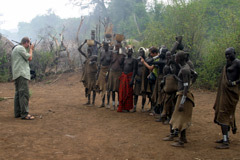
    <content:encoded xmlns:content="http://purl.org/rss/1.0/modules/content/"><![CDATA[<p><img title="Tourist at Morla" style="float: right; " class="image-right" alt="Mursi line up to be photographed by a tourist." src="http://www.mursi.org/images/tourist-at-morla.jpg" /></p>
<p class="image-right-landscape-caption">Mursi line up to be photographed by a tourist in the Mago Valley. (Ben Dome, 2004)</p>
<p style="text-align: justify; ">Foreign tourists are attracted to the Lower Omo by the image presented to them in travel agents’ brochures and newspaper articles of one of the last ‘wildernesses’ in the world, inhabited by wild animals, naked warriors and – in the case of the Mursi – by women wearing large pottery discs, or plates, in their lower lips. Here is an example of this literature, from an article by Amanda Jones that appeared in the <i>Sunday Times </i>Travel Section, 21 November 1999, under the heading ‘Tribes and tribulations’.</p>
<blockquote style="text-align: justify; ">
<p><i>The final leg of our journey was to the Mursi people. In southern Ethiopia, this is the tribe who strike fear into the hearts of northern Ethiopians and tourists alike. We’d heard so many lamentable tales about their behaviour, that we didn’t really know what to expect. The problem is that you can’t possibly come all this way and miss the Mursi, famous for the lip plates the women wear in their lower lips.</i></p>
<p style="text-align: justify; "><i>Because of their reputation, most visitors make a six-hour round trip drive from Mago National Park to see them. They come tearing down the road, jump out of their cars with cameras blazing and Birr aflying, create a riot, get scared, jump back into the car, lock the doors and take off again after 15 minutes. The Mursi have this down to a fine art. They encircle the ferengie, manhandle them a little, exact inflated sums for photos, force them to buy chipped lip plates and then whip up such a racket that the tourists retreat with only a few terrible snap shots of lip plates looming inches from their lens to show for their expensive foray into Mursi land.</i></p>
<p style="text-align: justify; ">In this tourist literature, the lip-plate symbolizes the ‘tribal’ and ‘untouched’ world of the Mursi, which should not be missed by anyone venturing into the Omo Valley. But it is their growing integration into the economic life of the highlands which drives Mursi of both sexes to play the demeaning part of archetypal primitives, as they line up to be photographed by passing tourists in exchange for the equivalent of a few pence.</p>
</blockquote>
<p>The exaggerated body painting and body adornments (e.g. the wearing of cattle headdresses or women carrying guns) is an example of cultural distortions introduced in order to compete for revenue from tourists.  Tourists are often surprised when they learn that this is not the daily appearance of the Mursi.  In fact, tourism has drastically altered how the Mursi treat outsiders.  The aggressive behaviour seen in places where Mursi meet tourists is very rarely found elsewhere in Mursiland.  The encounter with tourists is based purely on a brief financial exchange, not on the development of a relationship and the cash that it generates often leads to drunkenness. The resort to alcohol is partly due to the Mursi feeling increasingly peripheralised and objectified in their own home.</p>
<h3 style="text-align: justify; ">More information</h3>
<p style="text-align: justify; ">Jon Abbink,  'Tourism and its discontents: Suri-tourist encounters in southern Ethiopia'. In S. Bohn Gmelch (ed.), <i>Tourists and tourism: a reader.</i> Second Edition, 2009<i>,</i> pp. 115-136. Long Grove, Ill.: Waveland Press, Inc.</p>
<p style="text-align: justify; ">David Turton, ‘<a target="_self" title="Lip-plates and the people who take photographs" href="http://www.mursi.org/change-and-development/pdf/lip-plates.pdf/view">Lip-plates and “the people who take photographs”</a>: uneasy encounters between Mursi and tourists in southern Ethiopia’, <i>Anthropology Today. </i>20 (3), 2004, pp. 3-8.</p>
<p style="text-align: justify; "><br />See also the following film-clips:</p>
<ul style="text-align: justify; ">
<li><a class="internal-link" href="http://www.mursi.org/audiovisual/film-and-video-clips/film-clips-and-video-footage/interview-with-komor-a-kora-bio-iton-giga-and-aringatuin">Interview with Komor-a-kora, Bio-iton-giga and Arinyatuin</a>, 1991</li>
<li style="text-align: justify; "><a class="internal-link" href="http://www.mursi.org/audiovisual/film-and-video-clips/film-clips-and-video-footage/tourists-at-the-bridge">Tourists at the bridge</a>, 2001</li>
</ul>
<ul style="list-style-type: square; ">
<li style="text-align: justify; ">Trailer for the film ‘<a class="external-link" href="https://www.youtube.com/watch?v=K65zwVkiLNo">Framing the other</a>’ (2011), YouTube</li>
</ul>]]></content:encoded>
    <dc:publisher>No publisher</dc:publisher>
    <dc:creator>admin</dc:creator>
    <dc:rights></dc:rights>
    <dc:date>2012-06-10T23:40:00Z</dc:date>
    <dc:type>Page</dc:type>
  </item>


  <item rdf:about="http://www.mursi.org/change-and-development/national-parks/index_html">
    <title>National Parks</title>
    <link>http://www.mursi.org/change-and-development/national-parks/index_html</link>
    <description></description>
    <content:encoded xmlns:content="http://purl.org/rss/1.0/modules/content/"><![CDATA[<p><a title="Larger map of the Omo and Mago National Parks" class="internal-link" href="http://www.mursi.org/images/map-03-240px.gif"><img title="The Omo and Mago National Parks" class="image-right" alt="The Omo and Mago National Parks" src="http://www.mursi.org/images/map-03-240px.gif" /></a></p>
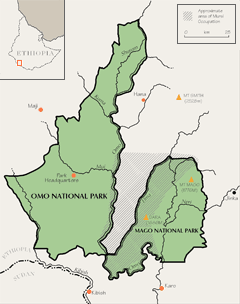
<p class="image-right-landscape-caption">The Omo and Mago National Parks, showing the approximate area of Mursi occupation. <a class="internal-link" href="http://www.mursi.org/images/map-03-240px.gif">Map 4</a></p>
<h3 style="text-align: justify; ">The Omo and Mago National Parks – an unresolved problem</h3>
<p style="text-align: justify; ">The Mursi live within and between the Omo and Mago National Parks, which include most of their best agricultural and grazing land (<a title="The Omo and Mago National Parks" class="internal-link" href="http://www.mursi.org/images/map-03-240px.gif">Map 4</a>). The Omo National Park (4,068 sq. km.) was designated in 1966 and the Mago National Park (2,162 sq. km.) in 1978. Apart from the Mursi, members of another seven ethnic groups live in and/or utilize the Omo Park for hunting, herding and cultivation: the Chai, Nyangatom, Dizi, Me'en, Bodi and Kwegu. The Mursi, Kwegu and Muguji live in both the Omo and the Mago Parks. The Mago Park is also utilized at certain times of the year by the Hamar and Banna for cattle herding and by the Aari for bee keeping. The boundaries of the parks were not agreed with local people and, to this day, have not been legally established (gazetted). They are, in effect, ‘paper parks’.</p>
<p style="text-align: justify; ">The management of these parks has represented an unresolved problem for the wildlife authorities since they were first designated. A report submitted to the Wildlife Conservation Department (as it then was) in 1978, recommended the merging of the two parks into a ‘Greater Omo National Park’, and the forcible resettlement of the Mursi and Bodi. In March 1993, an Italian consultancy firm, Agriconsulting, carried out a feasibility study for a project funded by the European Development Fund, focusing not only on the Omo and Mago, but also on the Nech Sar National Park near Arba Minch. This project, which became known as the ‘Southern National Parks Rehabilitation Project’, began in 1995, with a three-year ‘Preliminary Phase’, among the objectives of which were the gazettement of the three parks, according to their then boundaries, and the resettlement of people living within them. Neither of these objectives were achieved and the project did not proceed beyond its preliminary phase.</p>
<p style="text-align: justify; ">In February 2004, a Netherlands-based organization, African Parks Foundation (APF), also known as ‘African Parks Conservation’, ‘African Parks’ and, most recently, ‘<a href="http://www.africanparks-conservation.com/" title="African Parks Network website">African Parks Network</a>’, signed an agreement with the Ethiopian Government, allowing it to manage the Nech Sar National Park on a 25 year lease. The agreement included a clause stating that existing government plans to resettle the inhabitants of the Park (Kore agriculturalists and Guji pastoralists) would be completed before APF’s management began. Several thousand Guji were still in the park, however, when APF took over in February 2005, and are still in the park to this day (February 2008).</p>
<p style="text-align: justify; ">At about the same time that it was negotiating its agreement to take over the Nech Sar` National Park, APF had also expressed an interest in taking over management of the Omo National Park. In preparation for this, the Southern Region Government set about the ‘demarcation’ of these parks, in preparation for their gazettement. A ‘demarcation ceremony’ was held in the Omo National Park in March 2005, at which members of various local groups were asked to sign (with their thumbprints) documents describing the park boundaries. They were not given copies of these documents, so were not able to seek legal advice on the implications of what they had signed for their traditional land rights. The then Chair and main funder of APF, the Dutch business man the late Paul van Vlissingen, was present at this event.</p>
<p style="text-align: justify; ">APF’s management of the Omo Park began in January 2006. Its agreement with the government lists the ‘rights and obligations of the company’ and the ‘rights and obligations of the government’ but makes no mention of the rights of local people, who live in and around the park and whose livelihoods have traditionally depended on the use of natural resources within it. The agreement merely states (paragraph 1.4) that ‘the company undertakes as far as is practically possible to take community interests into consideration’. The agreement was not discussed with local people before it was signed, nor was it made available to them until eleven months after APF’s management of the park had begun. Various human rights organizations expressed concern about these and other aspects of APF’s management of the Omo Park.</p>
<p style="text-align: justify; ">In September 2007, after several months of negotiation, local staff of African Parks reached an agreement with representatives of Guji living in the Nech Sar park which would have allowed them to remain within the park boundaries, but excluded them from a fenced ‘core area’. This agreement was not endorsed by the Government. Meanwhile, criticism by human rights organizations of African Parks’ record in the Omo Park continued. In a letter to African Parks dated 31 October 2007, Survival International warned that it risked being complicit in the abuse of the human rights of the Mursi and other local people living in and around the Omo Park, unless it gave them certain formal assurances concerning their traditional rights of occupation and use. On 7 December 2007 African Parks issued a statement announcing its decision to ‘terminate’ its management of both the Nech Sar and Omo Parks. A year later it formally handed over management responsibility for the Omo National Park to the Southern Nations, Nationalities and Peoples' Regional State (SNNPRS).</p>
<h3 style="text-align: justify; ">More information</h3>
<p style="text-align: justify; ">For a clip from the film 'Shooting with Mursi', in which Mursi give their views about the National Parks, click <a class="internal-link" href="http://www.mursi.org/audiovisual/film-and-video-clips/film-clips-and-video-footage/people-and-parks">here</a>.</p>
<p style="text-align: justify; ">For a discussion of the EU funded ‘Southern National Parks Rehabilitation Project’ see David Turton, ‘<a title="The Mursi and the elephant question" href="http://www.mursi.org/change-and-development/pdf/the-elephant-question.pdf/view">The Mursi and the Elephant Question</a>’, in D. Chatty and M. Colchester (eds.) <i>Conservation and Mobile Indigenous Peoples: Displacement, Forced Settlement and Sustainable Development,</i>Berghahn Books, Oxford and New York, 2002, pp.97-118.</p>
<p style="text-align: justify; ">‘<a title="African Parks Foundation (APF) Omo Agreement" href="http://www.mursi.org/change-and-development/pdf/apf-omo-agreement.pdf/view">Agreement</a> between the Government of the Federal Democratic Republic of Ethiopia (Ministry of Agriculture and Rural Development) and the Southern Nations, Nationalities and Peoples’ Regional State, and African Parks (Ethiopia) PLC concerning the management of the Omo National Park’.</p>
<p style="text-align: justify; "><a class="internal-link" href="http://www.mursi.org/pdf/african-parks-foundation.pdf">'African Parks Foundation and the Omo National Park'</a>, by David Turton, May, 2006</p>
<p style="text-align: justify; "><a title="Letter from Survival International to African Parks Foundation" href="http://www.mursi.org/change-and-development/pdf/survival-afp-letter.pdf/view">Letter</a> from Survival International to African Parks Foundation, 31 October 2007.</p>
<p style="text-align: justify; "><a title="African Parks to give up its management of the Omo National Park" href="http://www.mursi.org/change-and-development/news-items/african-parks-to-give-up-its-management-of-the-omo-national-park">Announcement</a> by African Parks Network of the termination of its management activities in the Nech and Omo National Parks, 7 December 2007.</p>
<p style="text-align: justify; ">For a summary of international conventions and guidelines relating to the rights of indigenous peoples threatened with forced displacement from, or restriction of access to, their traditional lands, see the website of <a class="external-link" href="https://web.archive.org/web/20110721093935/http://www.conservationrefugees.org/lawsguidelines.html" title="Native Solutions to Conservation Refugees website">Native Solutions to Conservation Refugees</a>.</p>]]></content:encoded>
    <dc:publisher>No publisher</dc:publisher>
    <dc:creator>admin</dc:creator>
    <dc:rights></dc:rights>
    <dc:date>2012-06-10T23:40:00Z</dc:date>
    <dc:type>Page</dc:type>
  </item>


  <item rdf:about="http://www.mursi.org/introducing-the-mursi/links">
    <title>Links</title>
    <link>http://www.mursi.org/introducing-the-mursi/links</link>
    <description></description>
    <content:encoded xmlns:content="http://purl.org/rss/1.0/modules/content/"><![CDATA[<ul>
<li><a class="external-link" href="http://coolground.org/">Cool Ground</a></li>
<li><a class="external-link" href="http://www.justconservation.org/">Just Conservation</a></li>
<li><a class="external-link" href="http://mursi-archaeology.com/" rel="home" title="Mursiland Heritage Project">Mursiland Heritage Project</a></li>
<li><a class="external-link" href="https://web.archive.org/web/20160303185206/http://www.conservationrefugees.org/">Native Solutions to Conservation Refugees</a> (site is no longer online, <span>Wayback Machine snapshot</span>)</li>
<li><a href="http://www.rsc.ox.ac.uk/">Refugee Studies Centre</a></li>
<li><a class="external-link" href="https://web.archive.org/web/20060509002308/http://www.uni-mainz.de:80/Organisationen/SORC/">South Omo Research Centre</a></li>
<li><a href="http://www.survival-international.org/home">Survival International</a></li>
<li><a href="http://www.tourismconcern.org.uk/">Tourism Concern</a></li>
<li><a class="external-link" href="https://www.pastoralists.org/">Pastoralist Communication</a></li>
</ul>]]></content:encoded>
    <dc:publisher>No publisher</dc:publisher>
    <dc:creator>admin</dc:creator>
    <dc:rights></dc:rights>
    <dc:date>2012-06-10T23:40:00Z</dc:date>
    <dc:type>Page</dc:type>
  </item>


  <item rdf:about="http://www.mursi.org/introducing-the-mursi/making-a-living/index_html">
    <title>Making a living</title>
    <link>http://www.mursi.org/introducing-the-mursi/making-a-living/index_html</link>
    <description></description>
    <content:encoded xmlns:content="http://purl.org/rss/1.0/modules/content/"><![CDATA[<p style="text-align: justify; "><img title="Thatching" class="image-right" alt="Thatching a grain store" src="http://www.mursi.org/images/thatching/@@images/a43ce2aa-d907-44dd-9431-a19d79e73565.jpeg" /></p>
<p class="image-right-portrait-caption" style="text-align: justify; ">Thatching the roof of a grain store. (Ben Dome, 2004)</p>
<p style="text-align: justify; ">The Mursi practice hoe-cultivation and cattle herding. Cultivation accounts for well over half their diet while cattle, apart from being an important source of milk (especially for children) and meat, are a vital standby at times of crop failure, when they can be exchanged for grain in the highlands. The main crop is sorghum, of which they possess many drought-resistant varieties, but they also grow maize, beans and chick-peas. Because of their relatively low cattle numbers, the low and unpredictable local rainfall and the wide annual fluctuation in the level of the Omo and Mago floods, they must integrate all three of these activities by means of a complex cycle of seasonal movements.</p>
<p style="text-align: justify; ">There are two harvests each year, one along the banks of the two permanent rivers, Omo and Mago, where fertile silt is deposited by the annual flood, and one in forested areas further back from the rivers which are cleared for rain-fed, shifting cultivation. Planting takes place at the Omo and Mago in October and November, after the flood has receded and the banks have been cleared of vegetation that had grown up since the previous season. The harvest comes in January and February. River-bank land is the most valuable agricultural resource the Mursi possess. Areas liable to flood lie on both banks of the rivers, depending on the curvature of the meanders. Between October and February, when the bulk of the population is at the Omo, the cattle are kept in the wooded grasslands which rise towards the <a title="Mursiland - topography and drainage" href="http://www.mursi.org/images/map-01.gif/image_view_fullscreen">Omo-Mago watershed</a>.  The Elma valley is particularly important at this time, because it is relatively free from tsetse flies and water can usually be found at various points, even at the height of the dry season. The rain-fed crop is planted as soon as the main rains have begun, during March and April, and harvested in June or July.  The onset, duration and geographical distribution of the rains varies greatly from one year to the next. It is this unpredictability, coupled with the limited area available for flood retreat cultivation, that makes cattle a vital resource for the Mursi. Apart from providing an important source of protein, in the form of milk, blood and meat, cattle and small stock can also be exchanged for grain in the nearby highlands during times of local crop failure and may thus provide a last defence against starvation for many families.</p>
<p style="text-align: justify; ">Mursi attribute overwhelming cultural importance to cattle. Virtually every significant social relationship – most notably marriage - is marked and validated by the exchange of cattle. Bridewealth (ideally consisting of 38 head of cattle) is handed over by the groom’s family to the bride’s father, who has to meet the demands of a wide range of relatives, from different clans. This ensures that cattle are continually redistributed around the community, thus helping to provide for the long term economic security of individuals and families.</p>
<h3 style="text-align: justify; ">More information</h3>
<p style="text-align: justify; ">David Turton, ‘<a title="Mursi Response to Drought: Some Lessons for Relief and Rehabilitation" href="http://www.mursi.org/pdf/african-affairs.pdf/view">Mursi Response to Drought: Some Lessons for Relief and Rehabilitation</a>’.<i> African Affairs</i> 84,1985, pp. 331-46</p>
<p style="text-align: justify; ">David Turton,<strong> </strong><a title="Pastoral Livelihoods in Danger" href="http://www.mursi.org/pdf/pastoral-livelihoods.pdf/view">'</a><a class="internal-link" href="http://www.mursi.org/pdf/pastoral-livelihoods.pdf">Pastoral Livelihoods in Danger: Cattle Disease, Drought and Wildlife Conservation in Mursiland, Southwestern Ethiopia</a><strong>'.</strong> Oxfam Research Papers No. 12, Oxfam (UK and Ireland), 1995.</p>]]></content:encoded>
    <dc:publisher>No publisher</dc:publisher>
    <dc:creator>admin</dc:creator>
    <dc:rights></dc:rights>
    <dc:date>2012-06-10T23:40:00Z</dc:date>
    <dc:type>Page</dc:type>
  </item>


  <item rdf:about="http://www.mursi.org/introducing-the-mursi/local-groups-bhuranyoga/index_html">
    <title>Local groups (bhuranyoga)</title>
    <link>http://www.mursi.org/introducing-the-mursi/local-groups-bhuranyoga/index_html</link>
    <description></description>
    <content:encoded xmlns:content="http://purl.org/rss/1.0/modules/content/"><![CDATA[<p style="text-align: justify; "><a title="Larger map of Local groups in Mursiland" href="http://www.mursi.org/images/map-04.gif/image_view_fullscreen"><img title="Local groups in Mursiland" class="image-right" alt="Local groups (bhuranyoga) in Mursiland" src="http://www.mursi.org/images/map-04-240px.gif" /></a></p>
<p class="image-right-landscape-caption" style="text-align: justify; ">Local groups (bhuranyoga) in Mursiland. <a title="Local groups in Mursiland" href="http://www.mursi.org/images/map-04.gif/image_view_fullscreen">Map 5</a></p>
<p style="text-align: justify; ">The population is divided into five main local groups, or <i>bhuranyoga</i> (sing. <i>bhuran</i>), which are named, from north to south, Baruba, Mugjo, Biogolokare, Ariholi and Gongulobibi. Because the term <i>bhuran</i> refers to a group of co-resident people rather than to the physical space they occupy, it is not possible to draw clear cut spatial boundaries between <i>bhuranyoga.</i> What gives them their spatial definition is not that their members live within clearly bounded territorial units, but that they move back and forth, in a coordinated fashion, between the same sites for flood and rain cultivation and cattle herding. They have, in other words, territorial foci rather than territorial boundaries. (<a title="Local groups in Mursiland" href="http://www.mursi.org/images/map-04.gif/image_view_fullscreen">Map 5</a>)</p>
<p style="text-align: justify; ">Some of these local divisions are relatively new, especially the two most northerly ones, Baruba and Mugjo. About 150 years ago, the ancestors of the present Mursi, coming from the west, began occupying the east bank of the Omo in a move that is seen today, in Mursi oral history, as the decisive event in creating a specifically Mursi identity.  In the early years of this century, a second migration began, northwards to the River Mara which forms the present-day northern boundary of the Mursi. Both migrations represented a Mursi expansion into territory formerly inhabited by their northern neighbours, the Bodi.</p>
<p style="text-align: justify; ">Before the move to the Mara, there were three Mursi <i>bhuranyoga</i>, named from north to south, Dola, Ariholi and Gongulobibi, Dola covering the area currently occupied by Biogolokare. The names Biogolokare, Mugjo and Baruba, which distinguish different sub-units of Dola, came into use only gradually, after the migration to the Mara had begun and as the population of the newly occupied area grew. Before this the Biogolokare group were known as the ‘Dola of Darthum’ (a river). It was only since the 1980s that the names Mugjo and Baruba became established in everyday speech. Before that, members of these groups were generally also identified by geographical markers - the rivers around which they built their settlements and along which they cultivated. These were the Mako (a short, westward flowing tributary of the Omo, not to be confused with the much longer southward flowing tributary of the same name) in the case of Mugjo, and the Mara in the case of Baruba.</p>
<p style="text-align: justify; ">Over the years, then, new identities have been created, and older ones modified as part of a constant process of northward expansion. This expansion has been fed by a continuous south-to-north migration of individuals and families, largely through intermarriage, with the result that ties of <a title="Clans (kabicho)" href="http://www.mursi.org/introducing-the-mursi/clans-kabicho/index_html">clanship</a> and affinity, embodied in economic cooperation and exchange, spread throughout the population, cutting across local group boundaries.</p>
<h3 style="text-align: justify; ">More information</h3>
<ul style="text-align: justify; ">
<li>David Turton, '<a title="The meaning of place in a world of movement: lessons from long-term field research in Southern Ethiopia" href="http://www.mursi.org/pdf/workingpaper18.pdf/view">The meaning of place in the world of movement: lessons from long term field research in Southern Ethiopia</a>'. Elizabeth Colson Lecture, Refugee Studies Centre, 2004.'</li>
<li>David Turton, '<a title="A Journey Made Them: Territorial Segmentation and Ethnic Identity among the Mursi" href="http://www.mursi.org/pdf/a-journey-made-them.pdf/view">A journey made them: territorial segmentation and ethnic identity among the Mursi</a>', in Ladislav Holy (ed.) <i>Segmentary lineage systems reconsidered</i>, Department of Social Anthropology, Queen's University Papers in Social  Anthropology, Volume 4, Queen's University, Belfast, 1979, pp. 119-43. </li>
</ul>]]></content:encoded>
    <dc:publisher>No publisher</dc:publisher>
    <dc:creator>admin</dc:creator>
    <dc:rights></dc:rights>
    <dc:date>2012-06-10T23:40:00Z</dc:date>
    <dc:type>Page</dc:type>
  </item>


  <item rdf:about="http://www.mursi.org/introducing-the-mursi/leadership/priests-komorena">
    <title>Priests (Kômorena)</title>
    <link>http://www.mursi.org/introducing-the-mursi/leadership/priests-komorena</link>
    <description></description>
    <content:encoded xmlns:content="http://purl.org/rss/1.0/modules/content/"><![CDATA[<p style="text-align: justify; "><a class="internal-link" href="http://www.mursi.org/audiovisual/image-gallery/religion-and-healing/priest-at-a-healing-ceremony/view"><img alt="Priest at a healing ceremony" title="Priest at a healing ceremony" class="image-right" style="float: right; " src="http://www.mursi.org/audiovisual/image-gallery/religion-and-healing/priest-at-a-healing-ceremony/@@images/72d80e03-6225-40ae-919a-4f34557bf998.jpeg" /></a></p>
<p class="image-right-portrait-caption" style="text-align: justify; ">Kowlukoro Duli preparing to bless the herds at a 'Bio Lama' ceremony at Ulumholi in 2010.</p>
<p style="text-align: justify; ">The only formally defined leadership role in the society is that of <i>Kômoru</i>, or Priest, an inherited office which is principally of religious and ritual significance. The priest embodies in his person the well-being of the group as a whole and acts as a means of communication between the community and God (<i>tumwi</i>), especially when it is threatened by such events as drought, crop pests and disease. One clan in particular, Komorte, is considered to be, <i>par excellence</i>, the priestly clan. The priest currently in office in northern Mursiland (Dola), Ulikoro Konyonomora, is a member of this clan, as is his similarly named counterpart in the south, Ulikoro Bule.</p>
<p style="text-align: justify; "><b>The Bio Lama: </b>An example of Priestly duties, which may be performed by a willing member of a Priestly family, is the <i>bio lama</i>.  <i>Bio lama</i> literally means ‘rounding up the cattle’.  While all ceremonies performed by the Priests are for the public benefit, this ceremony is also performed in public, and draws large crowds of people and cattle.  At a <i>bio lama</i>, the well-being of the community, including human health, the cattle and the fertility of the land are all addressed, and rain may be asked for.  Boys have to go to special areas to obtain a supply of various coloured clays, and to cut leafy branches from particular species of tree.  The clay, mixed with water, is used to daub every member of the congregation, while the leaves, placed on the fire, would create smoke to “attract the attention of <i>tumwi</i>”.  The <i>bara</i> <a class="internal-link" href="http://www.mursi.org/introducing-the-mursi/age-and-age-sets">age-grade</a> construct a circle of stones nearby the Priest's settlement, within which the fire would be kindled. The ceremony, held a different phases of the lunar cycle, is spread out over four days, during which time goats or cattle may be sacrificed, the colours of which depend upon the priestly family.  At a <i>bio lama</i>, people say ‘the land is healed/lives by treating the earth, and all problems are banished’.  If it rains during or soon after the bio lama, people will remark on the powers of the Priest.</p>
<p style="text-align: justify; "><a class="internal-link" href="http://www.mursi.org/audiovisual/image-gallery/duelling/blessing-duelling.jpg/view"><img title="Komor-a-kora blessing duelling contestants" class="image-right" alt="Ulikoro Konyonomora (Komor-a-kora) blessing duelling contestants." src="http://www.mursi.org/images/komor-a-kora-duelling.jpg/@@images/a0c0a802-d949-46c5-86b5-75f21916e5cf.jpeg" /></a></p>
<p class="image-right-portrait-caption" style="text-align: justify; ">Ulikoro Konyonomora (Komor-a-kora) blessing duelling contestants. (David Turton, 1996)</p>
<p style="text-align: justify; "><b>At the death and instillation of a Priest: </b>When a priest dies, his body is taken into his hut, and his successor stands outside the entrance to the hut and blows his oryx horn trumpet (<i>joro</i>).  As the people begin to arrive, the heir's senior wife climbs onto the roof of the hut, holding a stick.  The classificatory sister's sons of the priestly descent group try also to climb onto the hut, but they are driven back by the wife of the heir, while the latter remains standing at the hut's entrance.  The sister's sons are attempting, unsuccessfully, to capture the <i>mênêngi</i> (“soul”) of the dead man to carry it off as their possession.  At the burial of a Priest, his cattle are driven to the grave, and are said to weep for the dead Priest. Then, several animals are killed and eaten, and a grave is dug.  The corpse is placed at the edge of the grave, and the heir climbs down into it.  As he crouches in the grave, a goat is held over him while its throat is cut with a spear, so that the blood falls on the heir but not onto the corpse.  While the heir remains crouching in the grave, the corpse is manoeuvred so that it is half in and half out of the grave.  The corpse is buried, sewn in a cow skin, with its head facing the point on the Omo at which the Mursi made their first crossing from the right bank – namely Dorl (<a class="internal-link" href="http://www.mursi.org/documents-and-texts/oral-texts/oral-text-3-the-parting-on-the-omo-waters">see oral text</a>).</p>
<p style="text-align: justify; ">Upon the death of a Priest there is some indication that his children or relations take the earth from the grave or the <i>clan’s sacred</i> tree at the Omo (baddi); with this earth they are able to do ritual things, such as putting this earth on the fire at the communal healing ceremony called <i>bio lama </i>or ‘rounding up the cattle’.  The relatives of the deceased <i>Kômoru</i> would go to “<i>bha nene na amadonê bha, bangadi</i>, <i>baddi, na sheshegé bha, sheshegé logo, sheshegé logo</i>”, describing how the children would visit their family place [at the Omo] and there they would ‘anoint’ with earth, and the earth of the termite mound (<i>bangadi</i>), and their sacred tree (<i>baddi</i>), and ‘re-align’ or ‘fine-tune’ (<i>sheshegé</i>) the earth and the knowledge.  The formal installation of the new Priest may occur several years after the death of the former Priest. The instillation takes place at Dorl, the sacred site of the Mursi crossing on banks of the Omo River.  At Dorl people perform a ceremony called <i>kamack Kômoru</i>, 'to take hold of the Priest<i>’</i>.  People select their <i>Kômoru</i> based on the character of the man: someone exemplary, a respectful, cool headed, hospitable man, one who listens etc…It is said that were the community to select someone with a bad character, he would curse people.</p>]]></content:encoded>
    <dc:publisher>No publisher</dc:publisher>
    <dc:creator>admin</dc:creator>
    <dc:rights></dc:rights>
    <dc:date>2012-06-10T23:40:00Z</dc:date>
    <dc:type>Page</dc:type>
  </item>


  <item rdf:about="http://www.mursi.org/introducing-the-mursi/history/index_html">
    <title>History</title>
    <link>http://www.mursi.org/introducing-the-mursi/history/index_html</link>
    <description></description>
    <content:encoded xmlns:content="http://purl.org/rss/1.0/modules/content/"><![CDATA[<p style="text-align: justify; ">The Mursi and their neighbours became part of the Ethiopian state in the last years of the nineteenth century, when the Emperor Menelik II established his control over the southwestern lowlands bordering Kenya and Sudan. This was an area inhabited by several small groups, with fluid identities, highly adaptable to environmental conditions and capable of absorbing outsiders easily. The Mursi as we know them today are the product of a large scale migratory movement of cattle herding peoples in the general direction of the Ethiopian highlands.   Three seperate movements<a><span class="internal-link"></span><span class="internal-link"></span></a><a class="internal-link" href="http://www.mursi.org/pdf/who-are-the-mursi"> </a>may be distinguished in the recent history of the Mursi, each the result of growing environmental pressure associated with the drying out of the Omo basin over the last 150-200 years.</p>
<p style="text-align: justify; ">First there was a move across the Omo, from the west, into what is now southern Mursiland, in the vicinity of Kurum (<a title="Mursiland - topography and drainage" class="internal-link" href="http://www.mursi.org/images/map-01.gif">Map 1</a>). This move took place around the mid-nineteenth century and is seen by the Mursi as a key historical event in the construction of their current political identity (see <a class="internal-link" href="http://www.mursi.org/documents-and-texts/oral-texts/copy_of_how-death-arrived">oral <span class="internal-link">text 3 and oral text 4). </span></a>Next there was a move northwards, into better watered territory, further upstream, which took place in the 1920s and 1930s. The effective northern boundary of Mursi territory was now the River Mara. (<a title="Mursiland - topography and drainage" class="internal-link" href="http://www.mursi.org/images/map-01.gif">Map 1</a>)</p>
<p style="text-align: justify; ">The third move began in 1979 and took the migrants still further into the upland plains of the lower Omo and into close and regular contact with their highland neighbours, the plough-cultivating Aari. Settlements were established in the upper Mago Valley (<a title="Mursiland - topography and drainage" class="internal-link" href="http://www.mursi.org/images/map-01.gif">Map 1</a>), which had last been occupied by the Mela (Bodi) in the early years of the last century. Ten years later, the Protestant missionary organisation SIM (Service in Mission) set up a mission station here, where it continues to provide educational, medical, agricultural and veterinary services.</p>
<p style="text-align: justify; ">Each of these moves was made, initially, by a small group of families who travelled a relatively short distance to a new place on the frontier of the settled area. As the pioneers established themselves, they were followed, over succeeding years, by a drift of individuals and families. Each move was explained by the migrants as a response to environmental pressure and as part of a continuing effort to find and occupy a cool (<i>lalini</i>) land (<i>ba</i>) or place, a place with riverside forest for cultivation and well watered grassland for cattle herding.</p>
<h3 style="text-align: justify; ">More information</h3>
<p>David Turton and Lugulointheno Jordomo, <a class="internal-link" href="http://www.mursi.org/pdf/who-are-the-mursi">'Who are the Mursi'?</a></p>
<p style="text-align: justify; ">David Turton, ‘<a title="Looking for a cool place: the Mursi, 1890s-1980s" href="http://www.mursi.org/introducing-the-mursi/pdf/cool-place.pdf/view">Looking for a Cool Place: The Mursi, 1890s - 1990s</a>’, in D. Anderson and D. Johnson (eds.) <i>The Ecology of Survival: Case Studies from Northeast African History.</i> Lester Crook Academic Publishing/Westview Press, London/Boulder, 1988, pp. 261-82.</p>
<p style="text-align: justify; ">David Turton, ‘<a title="Exploration in The Lower Omo Valley of Southwestern Ethiopia Between 1890 and 1910" href="http://www.mursi.org/introducing-the-mursi/pdf/exploration-in-the-lower-omo-valley.pdf/view">Exploration in the Lower Omo Valley of Southwestern Ethiopia</a>’, in M. Caravaglios (ed.) <i>L'Africa ai tempi di Daniele Comboni.</i><b> </b>Instituto Italo-Africano, Rome, 1981.</p>
<p style="text-align: justify; ">Jerry Carlson, '<a title="How the missionaries came to Makki" href="http://www.mursi.org/introducing-the-mursi/pdf/how-sim-came-to-makki.pdf">How the missionaries came to Makki</a>'.</p>
<p style="text-align: justify; "><b>Documentary films</b></p>
<p style="text-align: justify; ">Some of the events of recent Mursi history have been recorded in six <a class="internal-link" href="http://www.mursi.org/audiovisual/film-and-video-clips/television-documentaries">television documentaries</a> made by Leslie Woodhead and David Turton between 1974 and 2001.</p>]]></content:encoded>
    <dc:publisher>No publisher</dc:publisher>
    <dc:creator>admin</dc:creator>
    <dc:rights></dc:rights>
    <dc:date>2012-06-10T23:40:00Z</dc:date>
    <dc:type>Page</dc:type>
  </item>


  <item rdf:about="http://www.mursi.org/introducing-the-mursi/environment/index_html">
    <title>Environment</title>
    <link>http://www.mursi.org/introducing-the-mursi/environment/index_html</link>
    <description></description>
    <content:encoded xmlns:content="http://purl.org/rss/1.0/modules/content/"><![CDATA[<p style="text-align: justify; "><img title="The Omo at Kurum" class="image-right" alt="The Omo at Kurum" src="http://www.mursi.org/audiovisual/image-gallery/environment/kurum-crossing.jpg/@@images/bfa99342-e23a-4e5c-bba2-8eacc66c7d03.jpeg" /></p>
<p class="image-right-landscape-caption" style="text-align: justify; "><a class="internal-link" href="http://www.mursi.org/audiovisual/image-gallery/environment/omo-valley-and-south-sudan/view"><img title=" Omo Valley and South Sudan" class="image-right" alt=" Omo Valley and South Sudan" src="http://www.mursi.org/audiovisual/image-gallery/environment/omo-valley-and-south-sudan/@@images/a89c0f68-be2d-4b7b-8572-13a1857b6d50.jpeg" /></a>Above: The River Omo at Kurum, in the dry season (David Turton, 1991); Below: View over the lower Omo Valley into South Sudan</p>
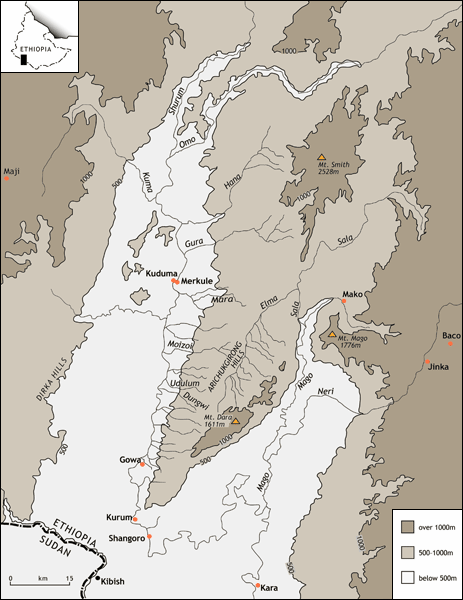
<p style="text-align: justify; ">The Mursi live in a rough oblong of territory, bounded to the west and south by the River Omo, to the east by the River Mago and to the north by the River Mara (<a title="The Mursi and their neighbours" class="internal-link" href="http://www.mursi.org/images/map-02.gif">Map 2</a>). Much of this area consists of a volcanic plain, sloping from east to west, which is being gradually lowered by the action of a large number of seasonal streams flowing westward to the River Omo and northward to the River Mago. The plain is dominated by a range of hills, running diagonally from southwest to northeast, which form a continuation of the Omo-Mago watershed and reach a height of 1,666m. in a dome-like summit, called ‘Dara’ (<a title="Upland plains of the lower Omo valley - topography and drainage" class="internal-link" href="http://www.mursi.org/images/map-01.gif">Map 1</a>). The climate is semi-arid to arid, with mean annual rainfall decreasing from about 800mm to 400mm from north to south. Most of the year’s rainfall is concentrated into two short rainy spells, one between March and April (the primary maximum, or ‘big rains’, called <i>oiyoi</i> in Mursi) and one between October and November (the ‘small rains’, or <i>loru</i>).</p>
<p style="text-align: justify; ">The Omo (<i>Warr</i> in Mursi) is one of Ethiopia’s largest rivers. It flows south for over 1000km. from the Blue Nile and Sobat watersheds, to the northern end of Lake Turkana, on the Kenyan border. Since most of its main catchment is at heights of 2000-3000m., its level rises and falls every year in response to the rainfall regime of the Ethiopian highlands. It begins to rise in April or May and reaches its maximum level in August or September, when it overflows its banks in Mursiland and, more extensively, in its lower basin. Having reached its maximum level, the river recedes rapidly during September and October, when people start preparing the recently flooded area for flood-retreat cultivation. It is at its lowest, and easily fordable at several places, by December/January, the height of the dry season (<i>su kiango</i>: literally ‘the stomach of the sun’).</p>
<p style="text-align: justify; ">Vegetation in the immediate vicinity of the Omo banks varies between large forest trees, (e.g. Ficus (<i>chamochi</i>), Diospyros (<i>kirithoi</i>), Ziziphus (<i>dangkwe</i>), Salvadora (<i>gegi</i>) and Tamarindus (<i>ragai</i>)) and dwarf shrub grassland (e.g. Tribulus (<i>kathogi</i>), Solanum (<i>turgiyai</i>), Maerua (<i>kamaloi</i>), Sporobolus (<i>keri</i>) and Ricinus (<i>balathi</i>)). Further back from the east bank in the Mursi area, and decreasing in width from north to south, is a dense belt of woody plants or ‘bushland thicket’ (e.g. Euphorbia Tirucali L. (<i>kalangarai</i>), Sarcostemma (<i>kirin kirini</i>), Cissus Quadrangulsaris L (<i>turoi</i>), Sanseviera (<i>kashoi</i>), Acacia Mellifera (<i>radi-a-kora</i>), Adenium Obesum (<i>dorbin</i>) and Plectranthus (<i>lukwe</i>)). The bushbelt gives way abruptly, along the 500m contour, to open wooded grassland, rising gradually to the Omo-Mago watershed. Here are found, scattered or in groups, such trees as Commiphora Africana (<i>olbai</i>), Comiphera penduculata (<i>lareni</i>), Combretum (<i>lalai</i>), Sclerocariya (<i>chobwe</i>), Lannea (<i>kiringeni</i>) and Grewia (<i>kalochi-a-kora</i>).</p>
<p style="text-align: justify; ">It has been estimated that the level of Lake Turkana dropped dramatically (for a ‘non-outlet’ African lake) between the late 1890s and the 1970s, due to reduced rainfall over the Omo’s highland catchment area (Butzer, 1971). This resulted in a reduced river flow and, in some cases, the drying out of the Omo’s westward flowing tributaries, leading to the growth of woody vegetation along the Omo banks. Satellite imagery shows that the Omo delta expanded by 500 sq. km during the 1980s and 1990s, suggesting that the lake level and river flows have continued to decrease up to the present (Haack, 1996).</p>
<p style="text-align: justify; "><strong>‘Landscape People and Parks’ Project (2007-2010)</strong></p>
<p style="text-align: justify; ">The ‘Landscape People and Parks’ project is the first landscape-scale attempt to understand the interaction between people and the environment in the lower Omo. The project team has been inter-disciplinary, including one historian, two anthropologists and one palaeoecologist. The project ran between 2007-2010, funded by the AHRC.  Research methods included the collection and analysis of oral histories of land use and settlement over the past two hundred years; a study of library and archival sources relating to the history of the lower Omo since the 1880s; a study of long term vegetation change, using fossil pollen and charcoal counting; and a study of vegetation structure and its immediate response to human action over the past forty years.</p>
<p style="text-align: justify; ">The overall aim of the project has been to reach a detailed understanding of the sequence of environmental changes and of the way these changes have influenced, and have been influenced by, the land-use practices and migratory movements of the human population.</p>
<p style="text-align: justify; ">Palaeoecological research, based on the analysis of fossilised pollen from hyrax middens in the northern part of the study area resulted in a 2000-year record of vegetation change. This is the first time such evidence of long term vegetation change in the lower Omo Valley has been obtained and the first time this particular method of obtaining fossilised pollen has been attempted in East Africa. Both the palaeoecological research and the study of bush encroachment in the savannah over the shorter term helped to demonstrate the wider relevance and value of integrating ecological and local knowledge of landscape change.</p>
<p style="text-align: justify; ">Oral history interviews carried out amongst the peoples of the study area, combined with a thorough examination of secondary sources, resulted in the most comprehensive and detailed account yet given of the complex processes of identity formation in the lower Omo over the past two hundred years.</p>
<p style="text-align: justify; ">In September 2009 the project brought together scholars from various disciplines (history, anthropology, palaeoecology and archaeology) who have worked in the lower Omo over the past forty years, for an international workshop on ‘Anthropology and History along the Omo.’  This workshop generated a series of <a class="internal-link" href="http://www.mursi.org/news-items/free-online-access-to-articles-on-the-lower-omo-valley-for-a-limited-period">publications </a>in the <span class="internal-link">Journal of East African Studies</span>.</p>
<p style="text-align: justify; ">As the only source of academic research data on the history of human-environmental relations in the Lower Omo, the project has had a significant, if difficult to quantify, impact on two controversial policy debates concerning the future of river basin development in the lower Omo: the future of state-sponsored conservation and the investment in hydro-power and large-scale commercial irrigation schemes. Project members have contributed to these debates through conference papers and presentations, media interviews and frequent discussions with politicians, administrators, human rights activists and aid officials.</p>
<h3 style="text-align: justify; ">More information</h3>
<p class="EndNoteBibliography"><span>For the analysis of a two thousand year record of vegetation change in Mursiland, obtained from a fossil hyrax midden (a method never before employed in East Africa), see Graciela Gil-Romera, Henry F. Lamb, David Turton, Miguel Sevilla-Callejo and  Mohammed Umer,</span> '<a class="external-link" href="http://www.academia.edu/7125520/Long-term_resilience_bush_encroachment_patterns_and_local_knowledge_in_a_Northeast_African_savanna">Long-term resilience, bush encroachment patterns and local knowledge in a Northeast African savanna</a>'. <i>Global Environmental Change,</i> 20<strong>,</strong> 2010 pp. 612-626.</p>
<p class="EndNoteBibliography"><span style="text-align: justify; ">For a rare study of vegetation dynamics in the grassland plain west of the Omo (north of lat. 5 30N), see Michael J. Jacobs and Catherine A. Schloeder, ‘</span><a href="http://www.worldcat.org/oclc/193893162" style="text-align: justify; " title="WorldCat: Fire frequency and species associations in perennial grasslands in south-west Ethiopia">Fire frequency and species associations in perennial grasslands in south-west Ethiopia</a><span style="text-align: justify; ">’, </span><i style="text-align: justify; ">African Journal of Ecology</i><span style="text-align: justify; ">, 40, 2002, pp. 1-9.</span></p>
<p class="EndNoteBibliography"><span style="text-align: justify; "><span style="text-align: justify; ">For a discussion of the growth of the Omo River delta, using satellite imagery, see Barry Haack, ‘</span><a href="http://www.worldcat.org/oclc/204266203" style="text-align: justify; " title="WorldCat: Monitoring wetland changes with remote sensing">Monitoring wetland changes with remote sensing: an East African example</a><span style="text-align: justify; ">’, </span><i style="text-align: justify; ">Environmental Management</i><span style="text-align: justify; ">, 20:3, 1996, pp. 411-419.</span></span></p>
<p style="text-align: justify; ">For information on the geomorphology and ecology of the lower basin of the Omo see (1) Karl Butzer, <i><a href="http://books.google.com/books?id=rWKeAAAACAAJ&amp;dq" title="Google Books: Recent History of an Ethiopian Delta">Recent History of an Ethiopian Delta: the Omo River and the Level of Lake Rudolf</a>,</i> Research Paper 136, Department of Geography, University of Chicago, 1971; and (2) Claudia Carr, <i><a href="http://books.google.com/books?id=NitkAAAAIAAJ" title="Google Books: Pastoralism in Crisis">Pastoralism in Crisis: the Dassanetch and their Ethiopian Lands</a>,</i> Research Paper No. 180, Department of Geography, University of Chicago, 1977.</p>]]></content:encoded>
    <dc:publisher>No publisher</dc:publisher>
    <dc:creator>admin</dc:creator>
    <dc:rights></dc:rights>
    <dc:date>2012-06-10T23:40:00Z</dc:date>
    <dc:type>Page</dc:type>
  </item>


  <item rdf:about="http://www.mursi.org/introducing-the-mursi/clans-kabicho/index_html">
    <title>Clans (kabicho)</title>
    <link>http://www.mursi.org/introducing-the-mursi/clans-kabicho/index_html</link>
    <description></description>
    <content:encoded xmlns:content="http://purl.org/rss/1.0/modules/content/"><![CDATA[<p style="text-align: justify; ">A clan (<i>kabi</i>) is a category of  people who are presumed to be descended in the male line from different  co-wives of the same man. There are around 18 in total but they vary  greatly in size. The four largest are probably Komorte, Bumai, Juhai and Garakuli.  There is a distinct concentration of members of certain clans in  certain areas, but members of the same clan may be found scattered  throughout the length and breadth of Mursiland. Although it is not  possible for all members of the same clan to show how they are related,  there is a strong taboo against marrying a fellow clan member. In the  case of certain clans - Komorte and Juhai for example – even inter-clan  marriage is prohibited.</p>
<p style="text-align: justify; "><span style="text-align: justify; ">The history behind different clan origins is ‘confusing’. The Gushumi, Changuli and Isai clans are very small.   Members of the Isai clan are sometimes called the ‘crocodile people’, and they are said to have once been hunters and gatherers, like the <a class="internal-link" href="http://www.mursi.org/neighbours/index_html">Kwegu</a>.  When the Komorte, Bumai, Juhai, Garakuli and Kagisi crossed the Omo around two hundred years ago, they are said to have ‘found’ the Berneshe and Bongosi people on the east bank.  It is recognised that the Berneshe  were once <a class="internal-link" href="http://www.mursi.org/neighbours/index_html">Dassanetch</a>.  The Chermani  originated from the <a class="internal-link" href="http://www.mursi.org/neighbours/index_html">Kwegu </a>and their place is Shiri, on the Omo near Bulgis.  The Bongosi have a place at the Omo called Bongo, as do the Galnai.  The Bumai clan was one of the original five </span><span style="text-align: justify; ">that crossed the Omo from the west. The same clan name is found amongst the <a class="internal-link" href="http://www.mursi.org/neighbours/index_html">Chai (Suri or Surma)</a>, although it is often said that the Buma originated from amongst the hunter-gathering <a class="internal-link" href="http://www.mursi.org/neighbours/index_html">Kwegu</a>.  The Ngerriai and Magaiyai clans are said to have originated from Omotic speaking highland cultivators.  The Gongwi are related to the Buma.  The Kulgisai clan is said to have originated from amongst the <a class="internal-link" style="text-align: justify; " href="http://www.mursi.org/neighbours/index_html">Bodi and </a>there is a Kagisi family group called Tumuri, which is the name the Mursi give to the <a class="internal-link" style="text-align: justify; " href="http://www.mursi.org/neighbours/index_html">Bodi</a>. Finally, the Garakuli clan is said to have originated from amongst the Hamar.  Clearly the Mursi are a melting pot of many other peoples and traditions.</span></p>
<p style="text-align: justify; ">Mursi clans:</p>
<ul style="text-align: justify; ">
<li>Berneshe</li>
<li>Bongosi</li>
<li>Bumai</li>
<li>Changuli</li>
<li>Chermani</li>
<li>Galnai</li>
<li>Garakuli</li>
<li>Gongwi</li>
<li>Gumnai</li>
<li>Gushumi</li>
<li>Isai</li>
<li>Juhai</li>
<li>Kagisi</li>
<li>Komorte</li>
<li>Kulgisai</li>
<li>Maiyaiyai</li>
<li>Mangwi</li>
<li>Ngeriai</li>
</ul>]]></content:encoded>
    <dc:publisher>No publisher</dc:publisher>
    <dc:creator>admin</dc:creator>
    <dc:rights></dc:rights>
    <dc:date>2012-06-10T23:40:00Z</dc:date>
    <dc:type>Page</dc:type>
  </item>


  <item rdf:about="http://www.mursi.org/introducing-the-mursi/age-and-age-sets">
    <title>Age and age sets</title>
    <link>http://www.mursi.org/introducing-the-mursi/age-and-age-sets</link>
    <description></description>
    <content:encoded xmlns:content="http://purl.org/rss/1.0/modules/content/"><![CDATA[<p class="image-right-landscape-caption" style="text-align: justify; "><a class="internal-link" href="http://www.mursi.org/audiovisual/image-gallery/ritual-and-ceremony/nitha.jpg"><img title="Nitha" class="image-right" alt="Photo of Garana naming the new set" src="http://www.mursi.org/images/nitha.jpg" /></a>At dawn, Garana names the new Geleba age set at Kurum, January 1991. (David Turton).</p>
<p class="image-right-landscape-caption" style="text-align: justify; "><a class="internal-link" href="http://www.mursi.org/audiovisual/image-gallery/ritual-and-ceremony/IMG_9623.JPG"><img title="Kneeling before the bara (korda koma)" class="image-right" alt="Kneeling before the bara (korda koma)" src="http://www.mursi.org/audiovisual/image-gallery/ritual-and-ceremony/IMG_9623.JPG/@@images/91772ee8-d378-4a57-b9ae-5ba589c6f5cd.jpeg" /></a>Members of the <i>terru</i> age-grade kneel before the Bara who discipline them verbally and with whips in a 'kneeling' (<span style="text-align: left; float: none; "><span></span><i>korda kôma) </i>ceremony,<i> </i>Dirikôrro, 2010.<br /></span></p>
<p style="text-align: justify; ">As amongst other East African herders, men are formed into named ‘age sets’, and pass through a number of ‘age grades’ during the course of their lives. Married women have the same age grade status as their husbands.   By becoming a member of an age set (<i>teny</i>) a man achieves full social adulthood (<i>hirimo</i>), although this may happen long after he has reached physical maturity. Members of the most recent set to be formed occupy the grade of rora, which may be translated as ‘junior elders’. When a new set is formed, the previous rora become bara, or ‘senior elders’ and the previous bara become karui, or ‘retired elders’.</p>
<p style="text-align: justify; ">It is the bara of a local community who are expected to play the leading role in reaching decisions about matters of public concern and to be most active in public meetings. But some bara are more politically ambitious than others, and these will be more active in public life. Some are also more highly regarded than others for their statesmanlike qualities and oratorical skills, although none have the right to make decisions on behalf of the community as a whole.</p>
<p style="text-align: justify; ">The rora are often described as the equivalent of the Ethiopian police force or army. Their job is to assist the bara in ensuring the safety of people and of the herds and the smooth running of internal community relations. Depending on the  interval between the formation of successive sets, however, this ideal division of tasks may not reflect the social reality for many men. The most recent set, known as Geleba (the Mursi name for the Dassanetch, who live in the lower basin of the Omo),  was formed in 1991. This was thirty years after the formation of the previous set, Benna (Stones), which now occupies the bara grade.  Because  the Geleba set  has an age span of thirty years (its youngest members are now around 30 and its oldest members around 60), some senior members of the set, although officially rora, play a role in public decision making which is indistinguishable from that which, according to the ideal, is expected of bara.</p>
<p style="text-align: justify; ">Each local group (<i>bhuran</i>) holds its own age set formation ceremony (<i>nitha</i>) in the same year, and according to a strict order of precedence. This begins with the southern group, Ariholi, followed by Gongulobibi and then Dola. Ariholi, which is known as the ‘stomach’ (<i>kiango</i>)  of the country, has priority because it was the first part of current Mursi territory to be settled.  In 1991 the Ariholi ceremony was held at Kurum, on the left bank of the Omo, and was organised and presided over by the late Ulijeholi Garana.</p>
<h3 style="text-align: justify; ">More information</h3>
<p style="text-align: justify; ">David Turton, ‘Territorial organisation and age among the Mursi’, in PTW Baxter and U. Almagor (eds), <a href="http://books.google.com/books?id=1BBkAAAACAAJ" title="Google Books: Age, Generation and Time"><i>Age, Generation and Time: Some Features of East African Age Organisations</i></a>, C. Hurst &amp; Company, London, pp. 95-130, 1978.</p>
<h3 style="text-align: justify; ">Related item</h3>
<p style="text-align: justify; "><a title="The Nitha" class="internal-link" href="http://www.mursi.org/audiovisual/film-and-video-clips/film-clips-and-video-footage/the-nitha">A clip from the film ‘Nitha’</a>, showing the culmination of the Ariholi age-set ceremony held at Kurum in southern Mursiland in January 1991. In the very early morning, the new set is given its name (‘Geleba’) by the presiding senior elder, Ulijeholi Garana. This was the first age set to be formed since 1961.</p>]]></content:encoded>
    <dc:publisher>No publisher</dc:publisher>
    <dc:creator>admin</dc:creator>
    <dc:rights></dc:rights>
    <dc:date>2012-06-10T23:40:00Z</dc:date>
    <dc:type>Page</dc:type>
  </item>


</rdf:RDF>